How Process-Side Noise Tells Chemical Reps a Plant Is Actively Buying Right Now
Permits, shifts, and regulations reveal buying windows before pipelines do.

Real-time plant activity signals for industrial sales outreach timing are observable changes in a facility’s capital plans, regulatory exposure, and operations. For chemical reps, permit filings, new lines, shift additions, and substitution deadlines reveal buying windows before they appear in the pipeline. The strongest evidence combines a plant’s fit with a specific change and its purchasing timetable, rather than treating every signal as proof of an immediate order.
Why chemical buying does not spread evenly across time or accounts
Chemical buyers rarely change suppliers on a whim. When a regulation changes, a formula needs to change, or a supply chain breaks, buyers have a short window to weigh their options. Between those events, an established specification gives the buyer a reason to stay put. Demand therefore concentrates in particular plants at particular moments, even when the wider market looks quiet.
Deloitte’s 2026 Chemical Industry Outlook describes a sector nearing the bottom of a capital cycle, with US production volumes expected to contract 0.2% in 2026 and demand uneven across end markets. Buying windows still open in that market. It makes broad market conditions a poor guide to which account needs attention today. A rep working from call patterns or CRM history reaches a crowded, lagging market, while one responding to an operational event can enter before competing suppliers recognize the need.
Why traditional intent data fails for manufacturing accounts
Topic-based intent data tracks how much more content buyers read but does not show what has changed inside a plant. Its model works for buyers who look into purchases online. A manufacturing buyer looking into a new line may instead call peers, go to Pack Expo, and ask for spec sheets directly. Those actions do not necessarily appear in a publisher content network, leaving the tool without evidence of an active evaluation.
WhiteWhale’s 2026 analysis identifies two further mismatches beyond that research behavior. Major equipment and facility decisions involve plant managers, operations VPs, procurement, finance, and sometimes the CEO, while account-level topic activity cannot resolve who is moving. Manufacturing niches also resist broad topic clusters. A buyer’s need for a specific process may lead to a sale even if the buyer reads too little content for the tool to pick up that interest.
The productive alternative is to track observable events tied to capital allocation and operating changes, including permits, job postings, capital disclosures, and regulatory filings. These events provide a reason for a conversation. A rep can reference the underlying change rather than infer interest from an account’s reading habits. However, the event still needs interpretation, because approval, staffing, and production do not happen at the same moment.
What signals indicate a plant is about to make a capital purchase decision?
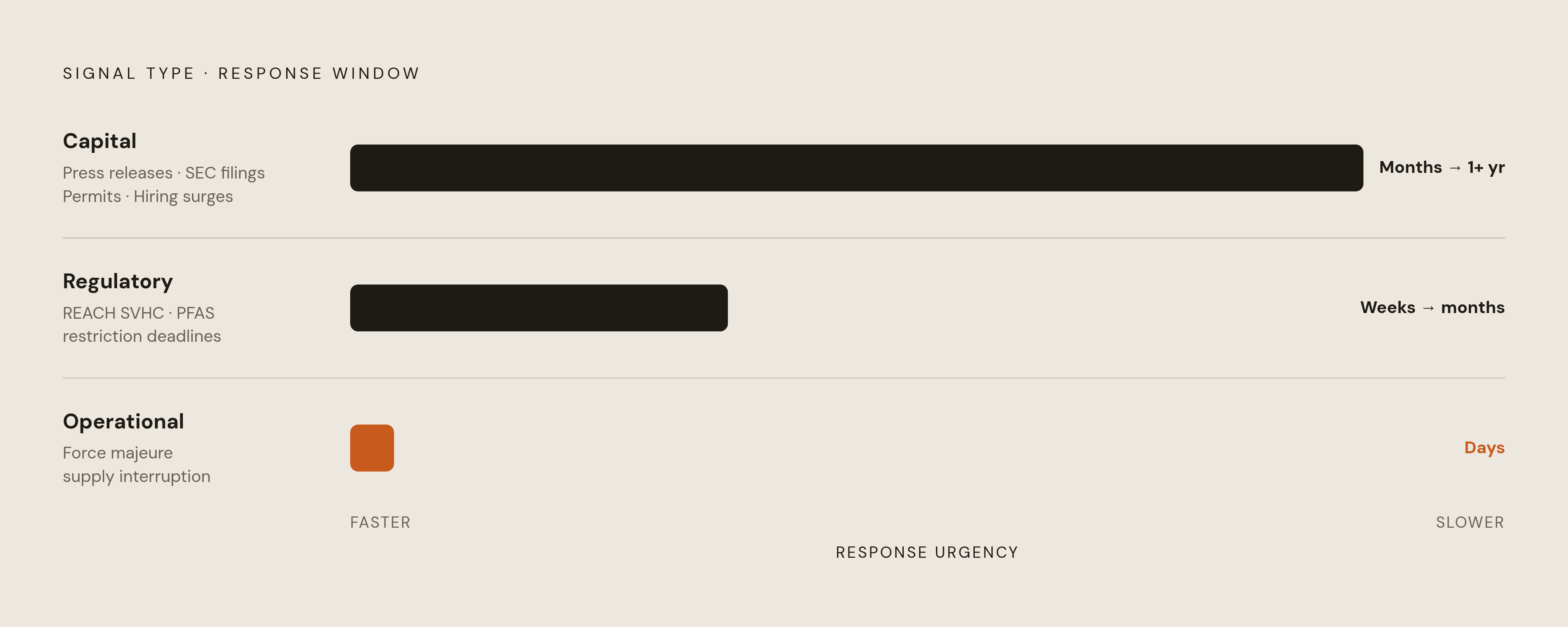
A new plant, production line, or automation plan places an account in the highest-urgency tier for early detection. The buying process can extend over more than a year. Chemical spend is staged through that process. Detecting the project early therefore gives a rep access to decisions that may already be settled by the time the line is running.
The public evidence can be concrete enough to reference on a call. A company press release may say where a new plant will be, while an SEC filing may show that capital expenditure has risen. An earnings call may describe a new production line or automation plan. Each establishes a different part of the purchasing context. Together, the project description and capital commitment give a rep more to work with than a general statement about growth.
At facility level, a building permit and a concurrent hiring surge provide stronger evidence than either alone. The permit signals regulatory approval for construction or retrofit, while production or maintenance hiring indicates that consumption will follow. Publication timing complicates the sequence, however. A permit portal may publish after the recorded event, whereas a job advertisement may precede the project by weeks. A rep waiting for the permit to appear can therefore trail one who has already identified the staffing change.
Regulatory triggers and how REACH SVHC listings and PFAS restrictions create substitution windows
Regulatory signals differ from capital announcements because a restriction can establish a public deadline for changing a formula. That makes the buying window more plannable. PFAS and solvent restrictions can turn an existing formulation into a liability, creating demand for a qualified substitute before the applicable deadline. A rep who brings supporting data can help with a technical problem the buyer now faces, giving the buyer a reason to rethink a product that had worked well.
ECHA’s candidate list obligations page lists supply-chain communication, consumer notification, ECHA notification, and safety data sheet updates among the things that listing requires. Candidate listing points to compliance work and possible interest in reformulation, though some affected buyers may have no need to replace the substance right away. The commercial response must distinguish that early warning from a restriction that actually requires substitution.
A competitor’s force majeure creates a different clock. Supply has stopped, production is at risk, and procurement may be reachable that week. Unlike a known regulatory deadline, this is an unplanned interruption where availability and lead time can outweigh the existing relationship. Reps should respond in days with an available alternative and its delivery terms. Where a restriction creates a planned substitution window, the response instead centers on qualification data delivered before the deadline.
Operational signals and what permit filings, shift additions, and new plant management reveal about timing
Operational signals often require a pattern of evidence. A plant posting second or third shift roles indicates that capacity is rising, with consumables, MRO, and chemical inputs needed before the additional headcount is fully hired. Materials must be ready when the shift starts. The posting therefore points to a purchasing requirement that precedes the visible increase in production, making it useful even without a corporate expansion announcement.
A new VP of Operations or plant manager brings new priorities, vendor reviews, and budgets, with the early months of tenure concentrating many vendor decisions. Ownership changes can open the same door. A private equity acquisition prompts review of supply relationships immediately at close, so historical account stability is not a reliable reason to defer attention.
Other operating events provide a longer or more specific timetable. An expansion or retrofit permit can give a rep weeks of notice before construction becomes visible, while a scheduled turnaround creates a safe opportunity to test a supplier without disrupting running production. Capital activity establishes the project, regulatory exposure explains a possible substitution need, and operational changes help locate the purchasing or qualification moment. Watching all three produces a layered view that no single source supplies.
Why the spec-lock dynamic makes timing signals especially powerful for cross-sell and upsell
Once a chemical product is in a customer’s formula or specification, the customer must go through requalification to replace it. That requirement protects the incumbent but constrains further selling. An existing supplier may have access to the account without having an immediate opening for another product. Reformulation, expansion, and a new-shift startup create that opening because the buyer has a reason to revisit requirements.
The trigger changes the supplier’s position in the evaluation. Before specification, a product is one of many samples available for consideration. After specification, it becomes difficult to dislodge. Reaching the buyer during the trigger event is therefore more than a first-call advantage, because a successful qualification can establish a durable share of the account’s spending. A new production line can create a fresh specification process even where the supplier already serves the plant.
For a specialty chemical supplier with hundreds to thousands of active SKUs across multiple end-markets, this timing helps identify which accounts are ready for a second or third product conversation. Portfolio breadth alone does not establish readiness to buy. Even when signals are public, reps may not see them together. Local permit portals, shift postings, and facility-level job boards are not aggregated by most commercial data tools. Plant-level coverage can show a chance to sell that a rep would miss in an account-level view.
What plant-level data coverage looks like in practice, and where most supplier CRMs fall short
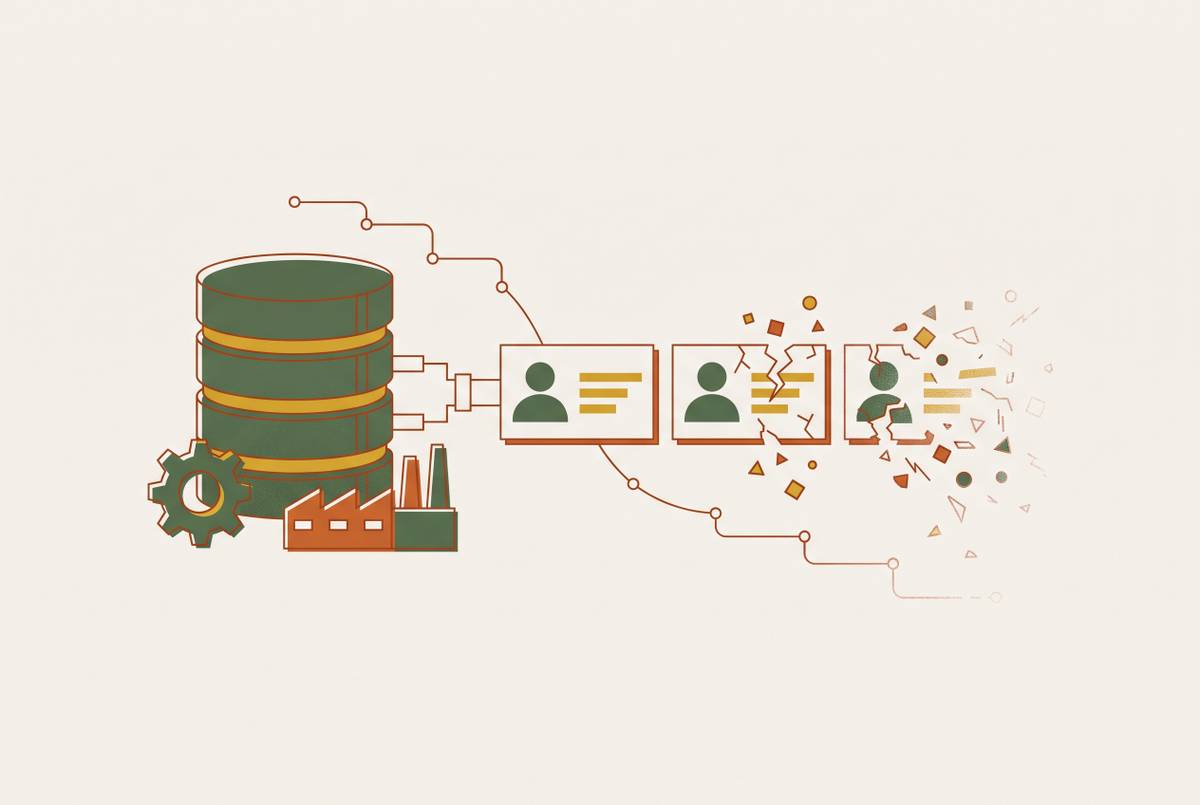
A CRM records existing business and conversations, but those records do not automatically describe a plant’s processes, permits, equipment, or purchases from competing suppliers. A data warehouse may hold statistical context without relationship signals, while external intelligence may describe competitors without connecting that information to the facility’s current state. On its own, each view leaves out part of what a rep needs to know about whether a plant fits and what has changed there.
Plant-level coverage supplies the missing operating context. It includes what the facility makes, which equipment and utilities it runs, what permits it holds, and what is changing. That context makes a signal commercially interpretable. Without it, a permit filing may tell a rep that a project exists but not whether the plant could use the supplier’s products. A complete company record is therefore not the same as a useful facility profile.
A demand intelligence platform can link detailed plant profiles to a supplier’s portfolio to find plants that fit, what they might buy, and trigger events across many facilities. Manual assembly cannot provide the same coverage. But the platform needs clean product, customer, and plant-level data to match plants with products they could use. A trigger assigned to the wrong type of facility wastes selling time and weakens confidence in the system. Data hygiene is consequently a precondition for signal monitoring.
How to build a signal-aware territory and account prioritization approach
Facilities should be prioritized by fit, recent activity, and urgency. A region-based territory can give equal attention to plants with very different purchasing potential. Plant fit establishes whether the facility’s processes and end-markets match the supplier’s portfolio. Signal activity establishes whether a structural, regulatory, or operational change has occurred. Timing urgency then determines how quickly the team needs to respond.
WhiteWhale recommends writing triggers in plain, verifiable language, such as whether an account has announced a manufacturing facility or increased capital expenditure in its latest SEC filing. Each alert should include its original source. That lets the rep open with the project’s details rather than a generic claim that the account appears interested. It also preserves the distinction between an observed event and an interpretation of what that event means for chemical demand.
Response speed should follow the buying window. A planned expansion may give a rep months to work with a buyer, while a force majeure calls for action within days. Regulatory outreach should track what the buyer must do and by when, while keeping REACH candidate listing distinct from a ban. Operational outreach should be timed to shift startup, a manager’s early months in the role, or the maintenance calendar. These differences turn a signal feed into an account workflow.
High-fit accounts without an active signal should stay in nurture until there is a reason for outreach. A fitting plant with a fresh trigger deserves priority even if it is absent from the CRM or has historically been a Tier 2 or Tier 3 account. An expansion or forced reformulation can change its potential abruptly. With clean plant profiles connected to the product portfolio and original event sources, reps can open calls around what a facility runs and what has just changed there. The conversation then begins with the buyer’s operating requirement, at the point when purchasing has become necessary.