Contact Data Decay Rates in Manufacturing Databases
Manufacturing buying centers change faster than standard decay rates reveal.
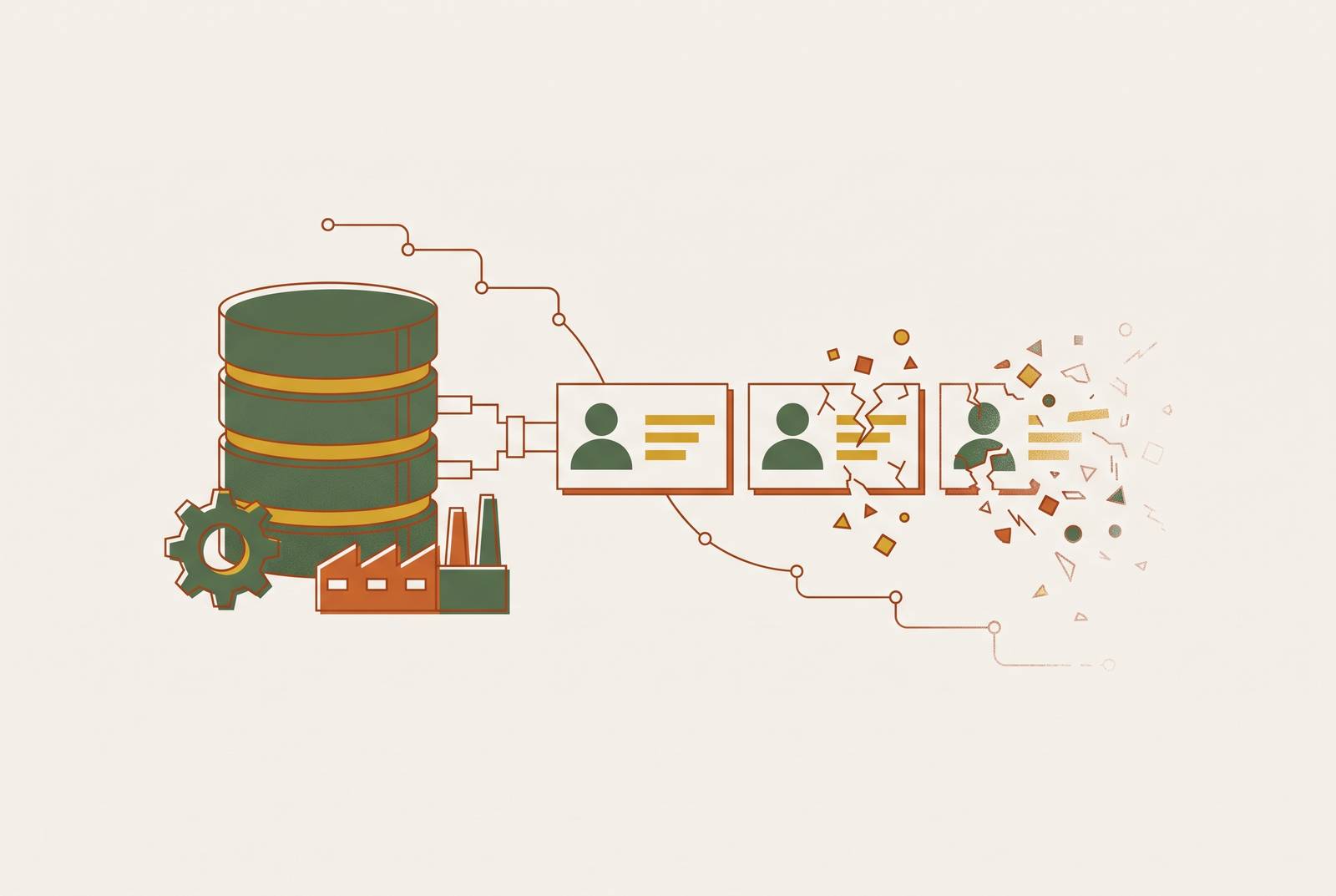
Contact data decay in manufacturing databases is a sales risk that a sector-wide turnover rate cannot capture. Long sales cycles, narrow decision-maker pools, and plant-specific buying authority make stale records disproportionately costly. A tiered, signal-driven maintenance system anchored in facility data preserves the account knowledge needed to pursue the opportunity when a contact changes.
Why contact data in manufacturing databases decays differently than the B2B baseline suggests
A manufacturing sales manager works through a contact list and finds seven phone numbers reaching nobody, four contacts who have left, and three firms that have been acquired. These are different failures, but they produce the same immediate result. The list no longer describes the accounts the sales team needs to reach. Some records have lost their contact details, while others have lost the company structure that made those details useful.
The annual B2B decay benchmark that is so often cited is a single-source average that conceals a spread of roughly three times between the fastest- and slowest-decaying sectors. People tend to stay longer in established manufacturing than in sectors where employees often change jobs. Lower turnover across a workforce does not establish that the people controlling purchases remain in place.
People in technical and production roles may stay in place while those in procurement and plant leadership change. Meanwhile, a sales opportunity can stay open long enough for those changes to accumulate before contract negotiations expose them.
How the four root causes of decay play out inside a manufacturing account
Four structural forces drive contact decay, namely job changes, restructuring, mergers, and domain changes after M&A. They operate continuously and can affect the same account at the same time. A job change can invalidate a work email, phone extension, and title together. Yet those fields also degrade independently, leaving a record partially stale even when an email still gets through.
In manufacturing, restructuring reaches beyond a person’s contact details into the account hierarchy. That hierarchy includes the parent company, divisions, plants, and ship-to locations. An acquisition can reshuffle reporting lines, procurement contacts, and email domains while the physical facility continues producing normally. A rep may still know where the plant is and what it makes, but no longer know who can authorize a purchase. The old record preserves the address while misrepresenting the route to a decision.
Chemicals M&A illustrates how these changes spread. Deal activity on a trailing twelve-month basis through Q1 2026 involved hundreds of transactions across the broader chemicals sector, with the largest deals accounting for the majority of value. The significance for contact maintenance is not the transaction value itself. Each acquisition can make procurement relationships and reporting lines out of date at several facilities at once. Longer employee tenure does not protect an account from that kind of discontinuity, because the organization around an employee can change without the employee leaving.
Why decision-maker mobility inside manufacturing is the decay problem that most CRMs are not built to catch
The most consequential decay occurs in the buying center. Manufacturing decision-maker mobility is roughly one in four contacts changing employers per year, with procurement, management, and production leadership particularly affected. A stable technician population can therefore coexist with substantial movement among the people who control supplier selection. A database weighted toward commercial decision-makers inherits that risk.
Middle management presents a particularly damaging combination of mobility and authority. Plant managers and procurement supervisors can move often enough to make their records unreliable while holding enough influence for that unreliability to damage a deal. Seniority adds another distinction. Senior titles decay faster than director and manager roles in most sectors, so lists weighted toward senior decision-makers can deteriorate faster than their sector average suggests. Where plant-level authority sits at director or VP level, the records that matter most commercially require particular attention.
A departure also changes more than one relationship. It can alter the balance of a multi-stakeholder buying center or bring in a procurement manager with an established supplier preference. An email address may remain forwarded or monitored for months after its owner leaves, so a CRM waiting for a hard bounce receives no timely warning.
Corvus tracks facility-specific production and equipment data, providing a reference point independent of the departing contact. That information preserves the production context needed to re-identify and re-qualify the person who now has buying authority. The plant remains legible even when the buying center must be reconstructed.
How the 18-month sales cycle turns moderate decay into a structural pipeline risk
An 18-month sales cycle gives a moderate annual decay rate enough time to become a material pipeline problem. Contact information gathered at qualification must remain useful through consideration, evaluation, and negotiation. A record that was correct at the start is not evidence that the relationship still exists at the end. The longer that interval, the more opportunity there is for an apparently qualified deal to outlive its original buying center.
Consider a lead developed in May and carried through to negotiation in November. The spring contact may no longer participate in the fall decision. The underlying need has not necessarily disappeared, but the rep must rebuild the relationship, establish the replacement’s authority, and recalculate the quote. If the new procurement manager prefers another supplier, the same disruption can lose the opportunity. None of this requires an email bounce to appear in the CRM.
The risk accumulates across both elapsed months and the contacts involved in a deal. A moderate annual rate does not show that every record will fail within 18 months. With several contacts in a deal, though, the team cannot safely count on its original buying-center map staying the same through close. The structural failure is reliance on that assumption without detecting intervening changes.
Forecasts then inherit the same weakness. A committed opportunity may reflect relationships and authority that no longer exist, even though its stage has not changed. What appears to be a late sales execution failure can therefore originate in contact data that stopped describing the deal much earlier.
How sub-sector variation inside manufacturing creates hidden decay hot spots that a single refresh cadence misses
Manufacturing is not a single contact-decay tier. A rep calling food and beverage processing plants has different contact records to keep up to date from a rep calling specialty chemical plants. Both may work within the same territory model, but their contact lists do not necessarily age at the same speed. Treating them alike makes the more volatile sub-sector a hidden source of stale records.
In stable manufacturing, contacts can be checked once a year, with event-triggered updates in between. Food and beverage processing behaves more like a moderate-decay sector, for which that interval is too long. Contacts in high-turnover assembly operations also need to be checked more often. A company name or a broad industry label does not fully describe the production setting in which its contacts work.
A territory plan based on NAICS codes and company headcounts can consequently give a dairy processing plant and a specialty resins plant the same refresh priority. That uniformity looks orderly, but it under-maintains the accounts most likely to change. Verification effort is assigned without enough knowledge of the facilities being covered.
Facility-level profiling, including the production and process information captured by Corvus, supplies a more useful basis for those decisions. Knowing whether a site is a food processing operation or a chemical blending plant helps distinguish likely maintenance needs before a cadence is assigned.
What stale contact data actually costs a manufacturing sales team in lost time, missed pipeline, and broken territory logic
A field rep’s day can disappear into dead phone numbers, bounced emails, and quotes rebuilt for replacement decision-makers. Each task leaves less time to talk with customers and may bring no new opportunity. Across a portfolio of plants, each with its own buying center, the reconciliation work compounds. The immediate cost of decay is therefore not chiefly poor email deliverability. It is selling time diverted into recovering account knowledge that the CRM appeared to contain.
That individual burden becomes a territory problem when the underlying account information is also stale. Incorrect plant locations, production volumes, or contact authority distort the logic used to allocate coverage. A territory may seem to have accounts worth pursuing, yet leave its rep with a contact list that leads nowhere. The imbalance becomes visible through wasted effort only after the territory has already been assigned.
Natural and mechanical decay can reinforce each other. Job changes and acquisitions change the account itself, while rushed migrations and multi-plant hierarchies that do not line up add errors to the system. High CRM adoption can distribute the same stale assumptions across more reps and more outreach.
Plant-level account modeling offers a firmer basis for coverage than a flat contact list. When production type and equipment remain attached to the facility, a change of person need not erase the account’s commercial context. Forecasting benefits from the same distinction, because the continued suitability of a plant and the current composition of its buying center become separate questions.
How to build a contact maintenance system that matches the actual decay profile of a manufacturing territory
Specialty chemicals and industrial gases warrant annual verification with event-triggered updates. Food and beverage processing and high-turnover assembly operations warrant quarterly verification at minimum. Assigning those intervals by sub-sector production type, rather than company name or NAICS code alone, directs maintenance toward the places where records are more likely to fail. Scheduled verification supplies a baseline for responding to change.
Event-triggered updates address changes that cannot wait for the next scheduled review. M&A, leadership changes, and facility relocations are especially important because each can invalidate records even in a stable sub-sector. Early warning adds a further layer by combining contact inactivity with external evidence, including a LinkedIn position change, a press release, or a domain change. A surge in out-of-office replies without return dates, declining replies on unchanged sequences, and disconnected phone responses also warrant attention. These signals support moving verification from a cleanup task after failed outreach to a prompt before the next campaign.
A domain change or declining reply rate can indicate that account information needs checking, but neither establishes that a facility is actively evaluating equipment or suppliers. Production and equipment profiles also help put a sale in context, but do not prove that a plant is about to make a capital purchase. Outreach timing depends on interpreting the signal for what it shows.
By retaining a facility’s production processes, equipment profile, and output, systems such as Corvus preserve the context from which a rep can identify a replacement decision-maker and re-qualify their authority. Integrating that intelligence into a CRM through HubSpot, Salesforce, or Dynamics 365 keeps the account’s commercial value separate from the freshness of any one contact. This reduces repeated research, grounds territory planning in production reality, and bases forecasts on current buying centers. The contact decays, but the facility persists as the account asset on which the relationship can be rebuilt.