Why Facility-Level Profiles Outperform Company Records When Prospecting Specialty Chemical Manufacturers
Facility-level data reveals what each plant actually makes and who buys there.
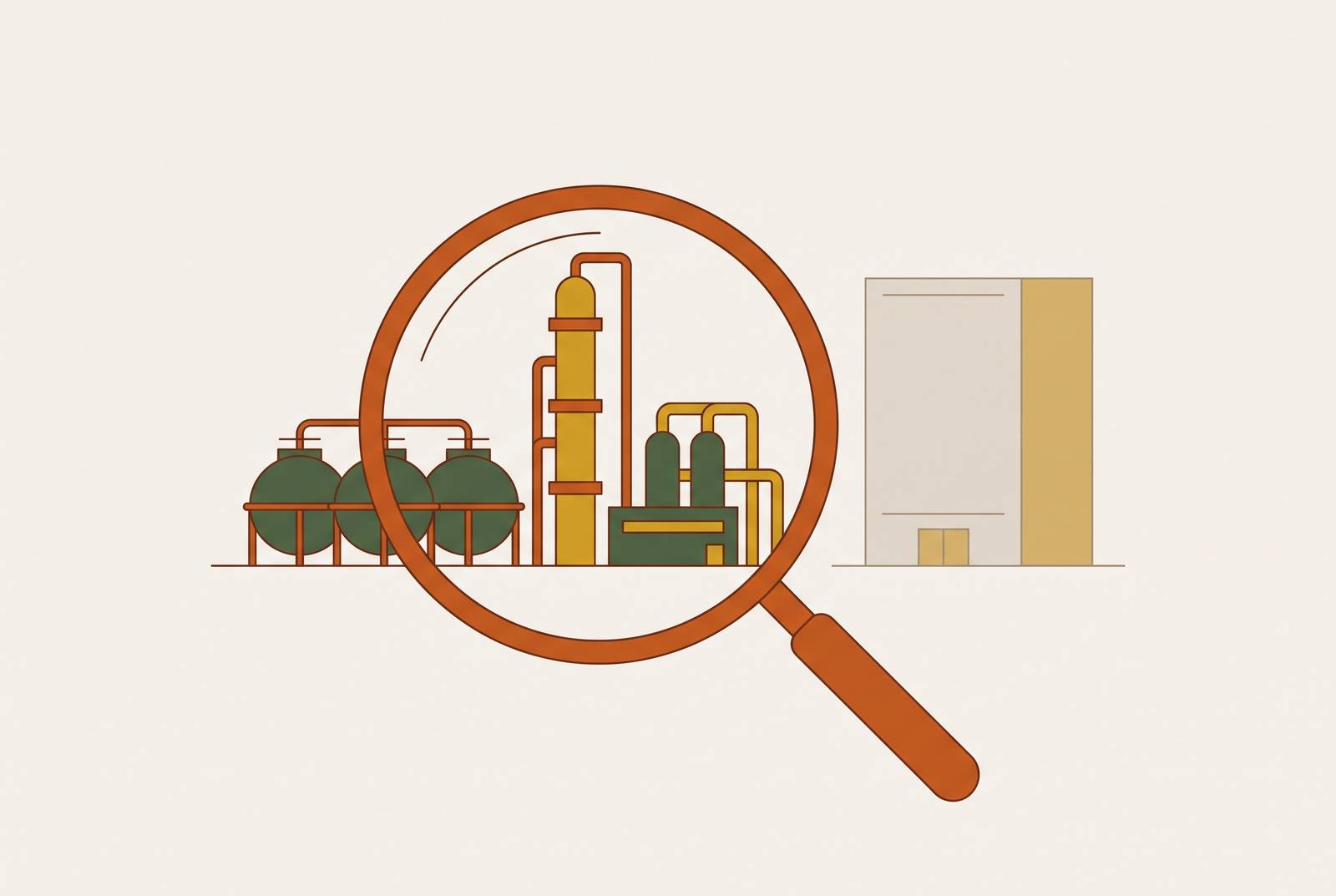
Facility-level profiles outperform company records for specialty chemical prospecting because a plant’s processes determine what it buys. The right data foundation goes beyond corporate headquarters to show each facility, how it produces its goods, and who handles its purchases. Company records help with corporate relationships, but they cannot reliably show whether a product fits a plant’s needs.
Why company records were designed for a sales motion that specialty chemical sales cannot use
A rep searches for food-processing or chemical plants in a territory and receives a list of corporate headquarters. The results identify manufacturers, but not necessarily places where those manufacturers produce anything. A packaging company operating more than a hundred plants across the U.S. may appear as one record. The rep cannot search those accounts for its facilities, what they make, or who manages them.
The problem begins with the unit being recorded. A company-centric database organizes information around the parent business, which suits a sales motion directed at corporate buyers. Specialty chemical purchases follow a different path. The plant manager who approves a lubricant or process-chemistry purchase works at a particular facility, where the production process establishes the need. A parent record cannot stand in for that location merely because both share a company name. If the purchase is decided at the plant and the database has no plant record, the rep is prospecting the wrong entity.
How generic industry classification breaks down specifically for specialty chemicals
That mismatch becomes more severe when industry classification substitutes for knowledge of production. The Manufacturing sector, 31-33, includes pharmaceutical batch plants, commodity petrochemical refineries, food ingredient processors, and specialty coatings facilities. Those plants have different operating conditions and purchasing needs. Even a Chemical Manufacturing filter leaves crucial distinctions unresolved. It identifies the company’s industry as chemicals while leaving the chemistry a particular site consumes unspecified.
Process type is the more useful discriminator. Batch production requires different chemistry from continuous flow, while CNC machining creates different metalworking-fluid needs from grinding or forming. Halocarbon launched three metalworking-fluid formulations for CNC and difficult-to-machine materials, with the range now expanded to four formulations. A facility’s machining process and the materials it handles provide the meaningful connection.
Classification also needs to distinguish production plants from contract manufacturers, distributors, and component suppliers. A distributor may be a valid commercial target, but it is not interchangeable with a plant consuming process chemistry. Mixing those roles in a prospect list obscures why each account would buy. Company-level SIC or NAICS codes do not supply the production detail needed to resolve that difference.
The decision-maker problem that company records cannot solve
The same structure that hides production sites also hides the people responsible for purchases there. A headquarters-indexed contact database may list a corporate VP while leaving the plant manager at a 300-person processing facility functionally invisible. Title matching alone cannot repair that omission. Without a facility record, the search lacks an anchor connecting the person to the location and its operation.
That gap produces two distinct targeting failures. A corporate contact may respond that “that's decided at the plant level,” while a plant manager may receive an offer unrelated to the process at their site. Finding a relevant title solves neither problem unless the record also establishes where the person works and what happens there. A search for “plant manager, specialty coatings, within 100 miles” therefore depends on an underlying record of the facility, its production, and its local title structure. Outreach aimed at the wrong person or an irrelevant facility is a targeting failure that persists even with better delivery.
What field reps actually lose when their territory is built on company records
For field reps, these gaps consume time before they produce any conversation. SPOTIO’s 2026 State of Field Sales found that B2B field reps spend roughly 11% of their time on prospecting research before making a single contact. That figure measures time spent on research and gives no measure of how much time facility data saves. Still, identifying a plant, its process, and its purchasing contact is work the prospecting record should already support. Otherwise, each account requires reconstruction before qualification can begin.
The map is incomplete as well as laborious. A rep can drive past facilities that never appeared in the territory search, while Google Maps or an industrial directory provides only a fraction of the available sites and no process-type context. Corporate account counts consequently conceal addressable locations. In the multi-plant CRM example, one global manufacturer became eleven records across five states after plant-level enrichment, with two facilities mid-expansion.
Personnel changes compound that loss of visibility. A plant manager’s departure, a reorganization, or an acquisition can leave an orphaned contact without a plant-level anchor for an update. The corporate account may remain recognizable while the local relationship becomes unusable.
What a facility-level profile actually contains and why that changes what a rep can do
A facility-level profile gives each place where goods are made its own record. It describes what the plant makes, which processes it runs, what equipment is on the floor, and who is responsible for procurement there. These fields establish product fit before contact begins. Batch versus continuous-flow production narrows the relevant chemistry, just as CNC machining versus forming narrows the relevant metalworking-fluid conversation.
Activity signals add a reason to revisit that fit. An expansion, new product line, equipment procurement announcement, or regulatory filing becomes useful when it can be attached to the affected facility. The distinction is between knowing a company announced something and knowing which plant presents an opportunity. A product launch can establish the application a formulation serves, while a facility’s equipment or process signal identifies a potential buyer for that application. Neither signal alone supplies the complete match.
The resulting territory map uses facility density and drive time. Records can be ranked by process fit and buying signal, so sites near each other are not given the same promise just because they are in the same area.
How process-type signals translate into relevant specialty chemical outreach
That connection changes what a rep can say on the first call. A record showing CNC machining on difficult-to-machine materials gives the rep a specific chemistry to bring up. A parent record labeled Manufacturing does not. The first provides a basis for discussing an application, while the second leaves the rep asking the prospect to establish basic relevance.
The same mechanism applies beyond metalworking fluids. Batch processing, continuous flow, coatings application, and food processing each need a different product conversation because they need different chemistry. Facility data links the process-specific offer to a person responsible for the operation, joining technical relevance with purchasing relevance. That is the mechanism by which facility knowledge can improve response, although it does not establish a guaranteed response rate.
Company-level intent signals answer a different question. They may show that a business is researching a chemical category without identifying the facility driving that research or the process operating there. Process data supplies the missing context. Message relevance at the facility level is therefore not simply a writing skill. It depends on information that either exists in the rep’s toolset or does not.
Why M&A activity in specialty chemicals accelerates the gap between company records and plant reality
Every carve-out or ownership change can separate a facility’s actual parent, operating profile, and contact structure from the corporate record used to represent it. The mismatch can persist for months or years. A plant formerly grouped under one parent may belong under another, or be temporarily unaffiliated, while the prospecting database still reflects the earlier structure.
For sellers, the consequences run in both directions. An acquisition can break ties with existing contacts while adding more facilities to an account. If the change appears only as an update to the headquarters record, the rep may miss which plants became addressable and which local relationships need attention. A facility record preserves the location as the unit against which ownership and contact information can be assessed.
AI-enabled tools are increasingly used for commercial diligence and integration planning in chemicals M&A. That makes clean plant-level information useful for identifying which acquired facilities are addressable and what they need. It does not remove the underlying requirement for a location-specific record.
The strongest objection to facility-level data and where it actually holds
Platforms containing hundreds of millions of company-centric contact records can be superior for inside sales teams targeting CIOs, CFOs, or VPs at headquarters. Their architecture fits that task. Facility detail is not the answer to every commercial data requirement.
Specialty chemical teams also have work that benefits from corporate records. Parent-account mapping, executive contact discovery, and strategic account reviews need information about the company as a whole. Those uses justify a corporate data layer without making it the foundation for plant prospecting.
The volume argument weakens when the task is finding plants that consume a particular chemistry. More contacts do not reveal omitted facilities or establish their process fit. The relevant cost is the outreach spent on unsuitable contacts and the addressable plants absent from the territory map.
What data stack is best for prospecting specialty chemical accounts?
The practical standard is a facility-indexed layer as the primary foundation for prospecting and territory planning. For specialty chemical manufacturers and distributors, the best fit depends on whether the team needs production-site buyers or corporate relationships. To prospect at the plant level, reps need process types they can search, contacts at each facility, and signals of local activity. The selection criterion is coverage of the buying unit.
For metalworking-fluid contact lists, that standard means connecting buyers to facilities whose machining or other production processes fit the product. Territory planning also needs facility density and drive-time mapping. These tools need to work together because a rep who finds a plant that fits still has research to do if there is no relevant contact. A rep with a contact but no process context still has to research whether the facility fits the product.
The data also needs to reach the working CRM. Facility records and plant contacts should go into Salesforce, HubSpot, or Dynamics 365 as enriched account records. Expansion announcements, product launches, equipment procurement cycles, and regulatory filings should be surfaced at the affected facility and pushed to the rep. That makes the data available where qualification and follow-up occur. The appropriate foundation is the record that connects a real plant, a relevant process, and the person who can buy.