Permit Filings and Regulatory Submissions as Early Indicators of Plant Procurement Cycles
Permits reveal machinery investments 12-24 months before procurement peaks.

Permit filings and regulatory submissions give industrial sales teams early signs of activity at a plant, often leaving a 12 to 24 month window to reach out before procurement peaks. They show how a facility plans to change its process before equipment specifications and supplier relationships lock in. Sales teams can use that window by matching permit type, jurisdiction and plant-level production data to a specific purchasing hypothesis.
Why permit filings are a procurement signal, not just a compliance event
Most salespeople treat permits as a legal or compliance topic. Commercially, they are disclosures of intended investment. A manufacturer seeking permission to build, expand or retool exposes plans that can imply future demand for equipment, construction services and process inputs. A filing gives a seller evidence of a planned change at a particular facility that a company profile cannot show. That distinction separates a prospective buyer from an account with an identifiable purchasing trigger.
The mechanism comes from the sequence regulated projects must follow. Major stationary sources and major modifications above specified emissions thresholds need preconstruction permits before work can begin on the regulated emissions-related components. This places the filing upstream of the physical change and can expose equipment needs while planning remains open. It does not mean every groundbreaking activity requires an air permit, or that every purchase waits for approval.
The lead-time window between a permit filing and peak procurement
Buyers commit to capital equipment first because their equipment choices shape the specifications and the project budget. ISM’s December 2025 buying policy data provides the anchor for this distinction, with capital expenditure commitments operating on a longer horizon than MRO and consumables. Specialty chemicals, metalworking fluids and other process inputs sit nearer the end of that sequence.
For a capital equipment supplier, the useful window is before the design and planning phase closes. Engagement during that phase can allow a vendor to influence specifications and be included in the budget. Waiting until construction is nearly complete changes the opportunity. By then, equipment decisions and vendor relationships may already be fixed, leaving the seller to compete for what remains.
Consumables suppliers have more time, but not unlimited time. Their target is the period when the facility is selecting and qualifying inputs before operations begin. A long interval between filing and startup should therefore be read as a sequence of purchasing deadlines. Sellers should identify when their category becomes committed.
What permit types show that a plant is approaching a capital purchase decision?
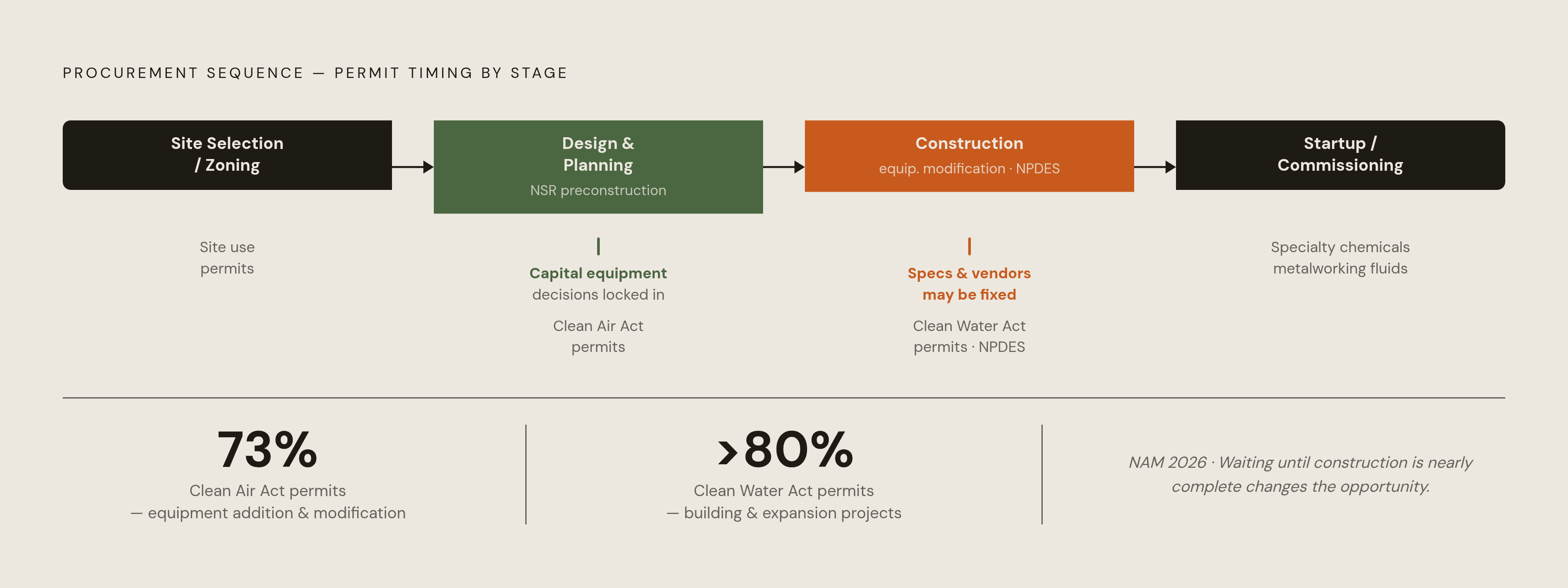
Zoning and site entitlement filings provide the earliest signal in the sequence. The company has selected a site and is seeking land-use approval, but construction has not begun. Procurement remains furthest away at this stage. For a construction-phase services vendor, however, that early visibility provides a longer period in which to enter the account before the project advances to detailed execution.
Clean Air Act New Source Review (NSR) preconstruction permits give a clearer sign of what equipment a plant will need. These filings occur as facility design is being finalized, when the production process is sufficiently developed to characterize its air emissions. The plant is therefore already choosing equipment. NAM’s 2026 America on Hold report found that Clean Air Act permits were required for 73% of equipment addition and modification projects among manufacturers surveyed.
Equipment addition and modification permits come closest to the point when a plant decides what to buy. They describe a planned change to productive assets, making them particularly useful for connecting a process to the inputs it will consume. Water permits supply a related but distinct signal. The same report found that Clean Water Act permits were required for more than four-fifths of building and expansion projects, while an NPDES permit for process water discharge can indicate a water treatment chemical requirement tied to startup.
Building or expanding facilities and adding or modifying equipment are the most common permitted manufacturing projects. These categories consequently generate most procurement-relevant permit signals, but volume alone is not the right filter. Product fit determines which filing deserves attention. A specialty chemical supplier serving a new process line should weight equipment modification permits most heavily, while a construction-phase services vendor should weight NSR and site entitlement filings.
How permit geography changes the timing and urgency of the opportunity
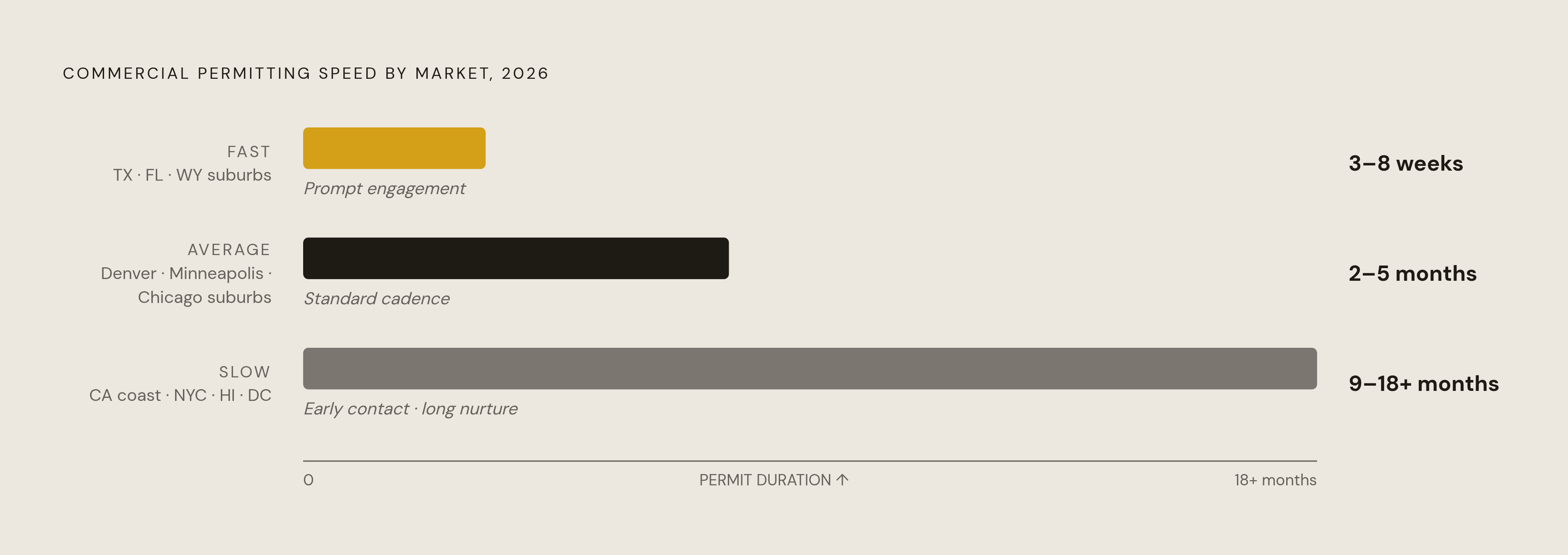
Jurisdiction changes the urgency of an otherwise similar filing. TCG’s 2026 commercial permitting timeline data shows that in fast markets, including Texas suburbs, Florida suburbs and Wyoming, it takes three to eight weeks to go from a complete application to an issued permit. Its slowest markets, including coastal California, New York City, Hawaii and Washington DC, run 9 to 18 months or more. In average markets, including Denver suburbs, Minneapolis and Chicago suburbs, it takes roughly 2 to 5 months. These are commercial permitting benchmarks, with timelines that vary for individual environmental approvals.
A filing in a fast jurisdiction may demand immediate outreach, while a comparable filing in a slower jurisdiction may support a much longer account-development period. Treating both as equally urgent misallocates selling time. Environmental reviews, public hearings and department queues help explain the difference, so permit category alone cannot establish how close a project is to construction.
Entitlement can extend the runway before the permit clock starts. A variance or conditional use permit adds months, and rezoning adds more because entitlement precedes permitting. A seller should therefore distinguish the first public signal from a complete permit application. In practice, a filing in suburban Houston may call for prompt engagement, while the same type of filing in Los Angeles may warrant early contact followed by a longer nurture cadence.
Why permit delays extend the live opportunity rather than killing it
A delayed permit can defer the procurement cycle while the underlying requirement remains, leaving an account commercially relevant even after activity appears to go quiet. NAM’s permitting reform data shows that it takes an average of 4.1 years to complete an environmental-impact-statement for manufacturing projects. That figure concerns this review process and shows why extended timelines should be expected. A quiet account should get a new score based on how the project is moving ahead.
Regulatory changes can also shorten parts of the waiting period. The EPA announced a proposed rule on NSR preconstruction permitting that would allow companies to build or update non-emitting sections of a facility before obtaining a Clean Air Act construction permit. The proposal is not finalized guidance. If adopted, it could bring some construction activity forward and compress the interval between a filing and active procurement, making faster alerts more useful.
The seller’s response should therefore operate at two speeds. Sellers should act quickly on relevant filings in fast-track jurisdictions, while in slow or delayed jurisdictions they should build relationships early and follow up over a longer period as the project reaches permit milestones.
Translating a permit filing into a specific purchasing hypothesis
A permit filing’s value depends on translating the disclosed project into a hypothesis about what the facility will buy, in what quantities and when. That hypothesis needs three elements, namely the production process, the inputs it consumes and the point at which those inputs must be selected. Without all three, outreach remains a generic response to expansion news rather than a reasoned account of a plant’s upcoming need.
Metallus’s 2026 proxy filing disclosed scheduled 2026 commissioning of a new bloom reheat furnace, roller hearth furnace and automated saw line assets. That schedule functions as a procurement clock. For a relevant supplier, it supports a hypothesis about demand for high-temperature lubricants, coolants and process chemicals before the assets run. The filing gives the seller a defined process change and a commissioning horizon to evaluate.
The same reasoning applies to permit-specific signals. An NSR filing for a new metalworking or machining line points toward cutting fluids, coolants and surface treatment chemicals whose selection precedes startup. An NPDES filing for process water discharge points to a need for water treatment chemicals.
Facility production data gives the hypothesis its scale. A 40-person plant on one shift buys differently from a 400-person plant on three shifts, so shift count and capacity act as consumption proxies. They indicate the likely size of the opportunity without supplying an exact order quantity. Before the first call, the seller should validate the hypothesis against available plant-level process knowledge rather than rely on the parent company’s industry classification.
Why HQ-level data fails at the permit-signal stage and what plant-level data makes possible
Most permit filings identify a specific facility or regional subsidiary. A seller relying only on headquarters-level CRM records can therefore miss an expansion even when the parent is already an account. One company may operate dozens of plants, each with its own production process, plant manager, budget authority and permit history.
NAICS codes and total headcount do not identify which facility is expanding, what equipment it runs or what that equipment requires. Plant-level records give that detail by showing production processes, equipment types, environmental permit histories and operational signals.
That detail makes a dated filing commercially interpretable. That detail links the permitted change to how the facility already runs and helps sellers tell whether a filing points to a need for their inputs or to unrelated activity elsewhere in the company. Freshness is equally important to this connection. B2B data degrades continuously, and a record enriched once can become stale within months, while a time-stamped public filing supplies a new trigger for reassessing the account. Permit monitoring can therefore reactivate older records and expose expansion activity at plants a seller already serves.
Building a permit-monitoring workflow into territory and account planning
To turn these signals into repeatable account work, sales teams should begin with territory and process fit. They should track filings that match the production processes their products serve rather than collect every permit tied to manufacturing. Air quality preconstruction permits, equipment modification permits and water discharge permits are high-signal categories for industrial consumables sellers. Public sources include EPA databases, state environmental agency portals and county-level building permit records.
The account record should connect what the facility makes, what the permitted change implies about input requirements and how the jurisdiction changes the expected timing. Scoring should weight jurisdiction tier, process match and whether the account is existing or new. This gives account managers a basis for distinguishing urgent, well-matched opportunities from projects that need longer development.
Capital equipment sellers should act as soon as an NSR filing appears, while specialty chemical and metalworking fluid sellers should reach out during construction, before startup, when the plant is choosing and qualifying fluids. Delayed projects should remain on a milestone-based nurture cadence. CRM integration should link signals to facility and account records, trigger tasks and feed the pipeline so teams assign sales work based on the research.
Existing accounts offer the lowest-friction place to apply this workflow. A plant already buying from a supplier that files for an expansion or equipment addition is indicating potential additional demand from a buyer with an established relationship. That makes existing-account expansion permits a priority in scoring.