Real-Time Activity Signals That Indicate a Plant Is Expanding or Contracting

Manufacturing sales doesn't run on the same fuel as most B2B categories. Funding rounds and headcount spikes tell you almost nothing about whether a plant is about to buy metalworking fluid, industrial coatings, or a new compressor system. What tells you something is capex cycles, permit filings, supply chain shifts, and the operational mandates that come with a new plant manager. Reading those signals in real time, rather than three weeks after a competitor already has, is what separates a sales conversation that lands from a cold call that shows up too late.
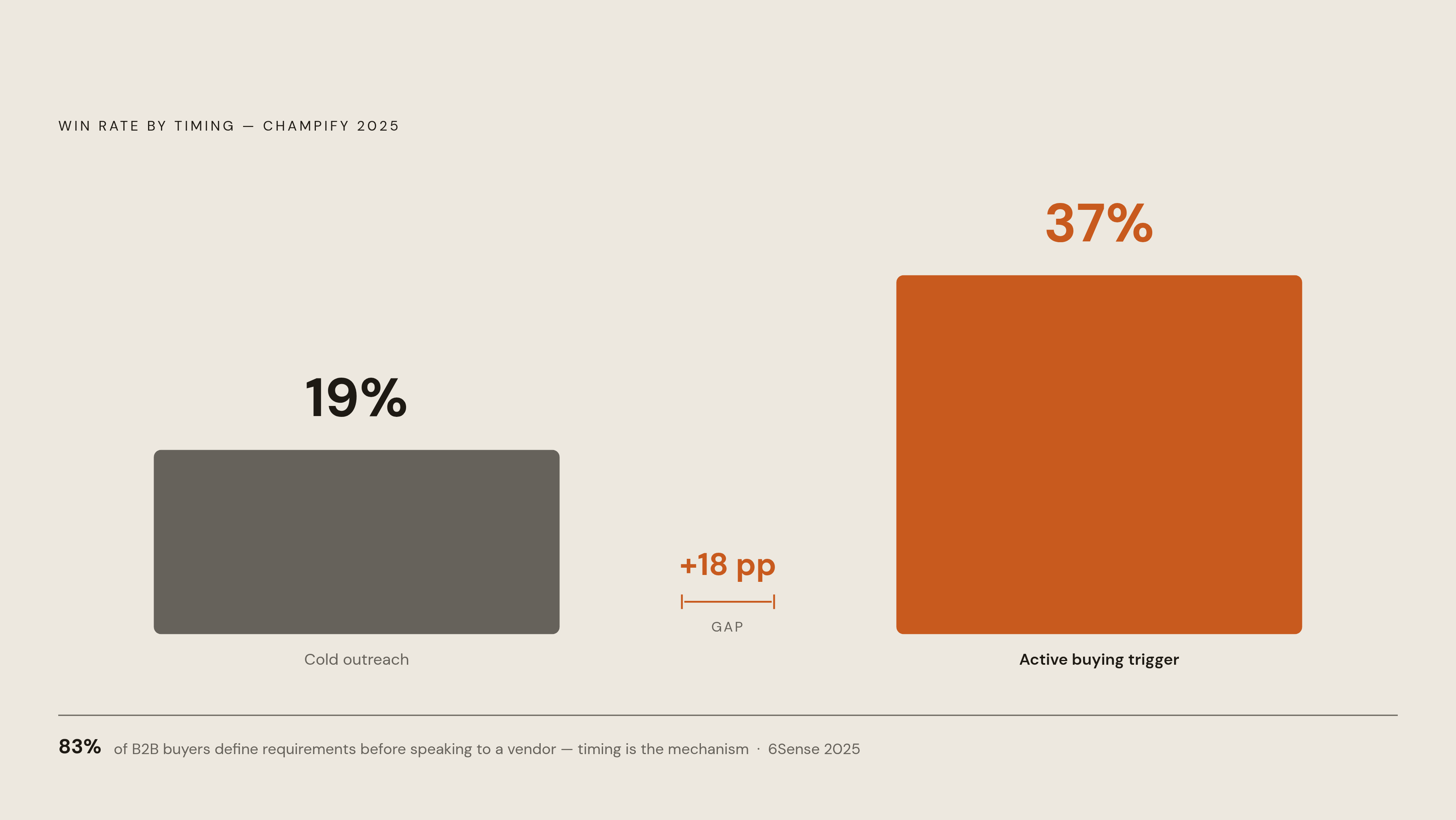
The cost of missing that window is not a rounding error. According to Champify's 2025 research, accounts with an active buying trigger convert at a 37% win rate. Cold outreach converts at 19%. That's the difference between a rep who eats and a rep who doesn't, and it traces back almost entirely to timing. Once a signal fires, the window to act is narrow before a competitor reaches out and the opportunity goes cold. Given that 6Sense's 2025 research found 83% of B2B buyers define most or all of their purchase requirements before ever talking to a salesperson, and Forrester has found 92% start the buying process with a vendor already in mind, reacting to an RFQ means chasing a process someone else already shaped. What follows is a working catalog of the observable, dateable signals that show a plant is moving, before the paperwork catches up.
The current state of industrial capital project activity and what it means for signal volume
August marked the fourth straight month of steady growth in planned capital project activity, with reporting tracking 160 new industrial projects across North America, spanning new facility construction, expansions, and equipment modernization. Sixteen of those August projects were manufacturing facility builds valued at $100 million or more. The largest by a wide margin is a SpaceX processing, warehouse, and storage complex planned for Vermilion Parish, Louisiana, at $100 billion. SpaceX also has a 100-million-square-foot manufacturing facility, called Terafab, planned for Grimes County, Texas, at $16.8 billion.
Geographically, the August activity clustered heavily. Ohio led with 16 projects. Alabama and Texas followed with 11 each, California with 10, Pennsylvania with 9, and Massachusetts with 7. For a rep covering a defined territory, that clustering matters: signal density is not evenly spread across the map, and a Midwest-heavy book of accounts is going to generate more activity than a Southeast one this particular quarter.
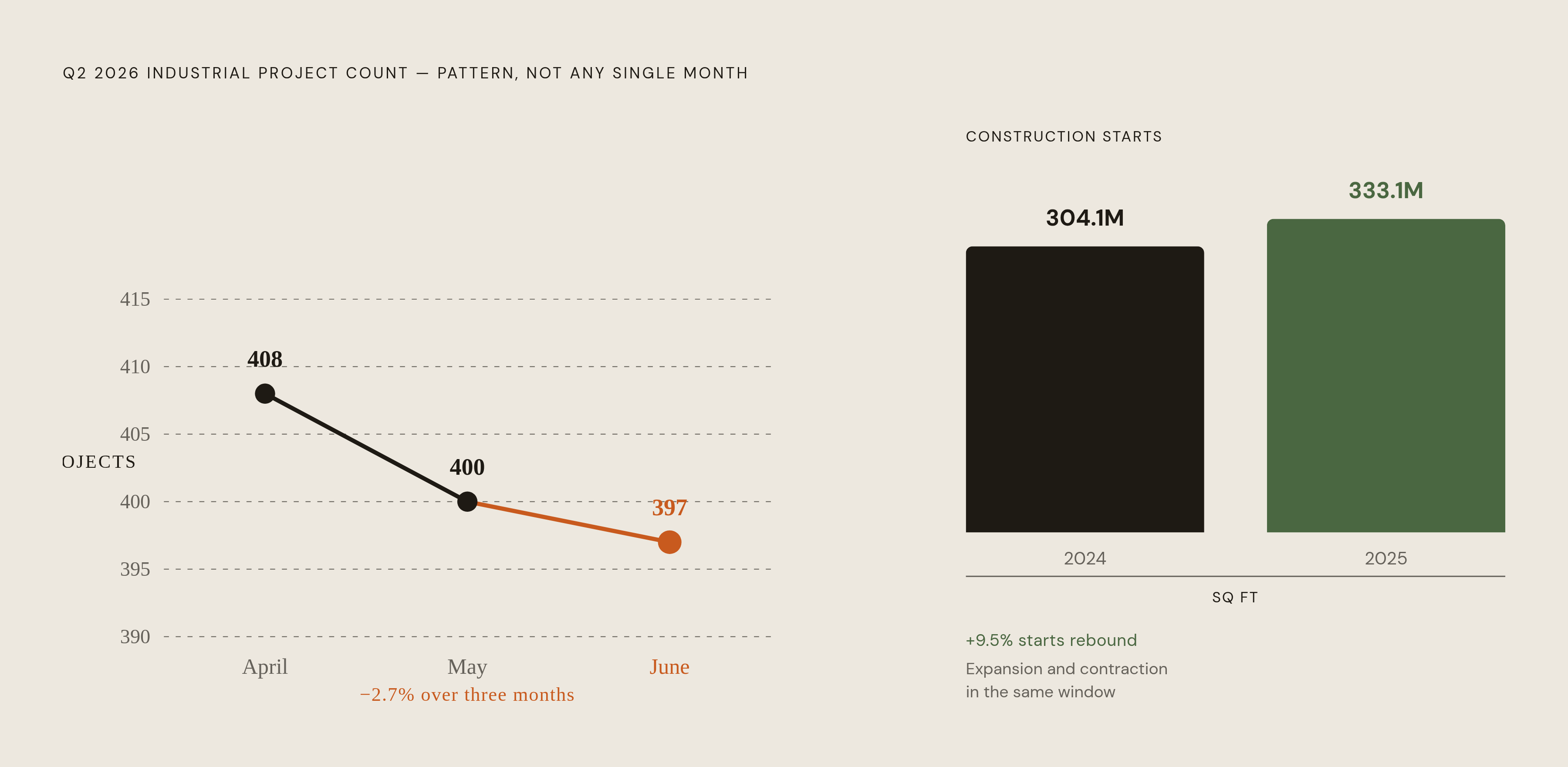
But the same data cuts both ways. Q2 2026 showed a steady decline in overall project counts: 408 in April, 400 in May, 397 in June, a consistent 2.7% drop over three months. Growth headlines and contraction data were sitting inside the same reporting window. That's worth sitting with for a second, because it means treating "capital project activity is up" as a blanket statement misses the accounts quietly pulling back underneath it.
Zoom out to construction stock and the picture gets more textured still. Roughly 427.6 million square feet of industrial space is currently under construction nationally, about 2% of total stock. Starts rebounded from 304.1 million square feet in 2024 to 333.1 million in 2025, and 180.6 million square feet of new starts were recorded through July 2026 alone. None of this is a once-a-quarter research project. The volume of concurrent activity, expansion and contraction running side by side, means signal monitoring has to be a standing discipline, not something a rep does before a big account review.
Capital project and construction signals (the strongest and earliest expansion indicators)
Permit filings sit closest to the source. Local planning committee minutes, permit applications, and zoning board records are public in most municipalities, and most reps never look at them. That's a mistake, because a permit filing precedes equipment purchasing and consumables sourcing by months, sometimes longer. A rep who checks a county planning portal reaches the account before the buying committee has even been staffed.
Industrial project intelligence firms compile this kind of activity at scale, tracking new construction, expansions, relocations, equipment modernization projects, and plant closings across thousands of facilities, which is the kind of plant-level signal feed that platforms like Corvus index to help industrial sales teams identify accounts before a buying process opens. Construction tracking services separately show industrial construction up sharply by building-use category, driven in large part by AI supercomputer facilities and manufacturing reshoring back to North America.
Real estate data tells a parallel story, and it's worth treating as a leading indicator in its own right. National industrial vacancy compressed 60 basis points to 6.8%, the first meaningful tightening since mid-2023. Class A warehouses over a million square feet tightened further, down to 5.8% vacancy. Big-box leasing, spaces of at least 500,000 square feet, rose 58.3% year over year. And according to Kidder Mathews research, industrial leases over 200,000 square feet signed in the first half of 2026 ran nearly 20% ahead of the same period in 2025. Large lease signings and build-to-suit announcements, trackable through commercial real estate databases from firms like JLL, CoStar, and CBRE, tend to precede equipment and consumables purchasing by a significant runway of months. That's a long runway, and most of it goes unused.
The mirror image matters just as much. Permit withdrawals, plant closure notices, consolidation filings buried in planning records, sublease listings for industrial space, early lease terminations, and equipment liquidation auctions all point the other direction. The recent cycle shows how sharp that reversal can get: new industrial deliveries in 2025 fell more than 45% from recent peaks, space under construction dropped more than 60% from 2023 highs, and new construction starts came in roughly 65% below late-2022 levels. Same data streams, opposite conclusion, depending on which direction the account is actually moving.
Hiring signals: what a plant's job postings reveal about its production trajectory 60 to 90 days out
Job postings are a budget disclosure dressed up as a recruiting page. By the time a plant posts a role, the headcount is approved, the pain point behind it is real, and that posting typically shows up 60 to 90 days before the company starts formal vendor research. That's a wide enough window to build a relationship before a single RFP goes out.
Not every posting carries equal weight. Production and operations roles, machinists, CNC operators, process engineers, maintenance technicians, signal that existing capacity is ramping or a new production line is coming online, and that's a direct trigger for metalworking fluids, specialty chemicals, and process chemicals. Facilities and EHS postings usually mean a new building or a compliance-driven retrofit, both of which push consumption of the same categories. Procurement and supply chain hires are a slightly different animal: they signal that a company is building out its buying infrastructure ahead of a scale-up, and a newly seated procurement director is going to run a vendor review almost as a matter of habit.
Volume alone doesn't tell the whole story. A plant posting five engineering roles inside two weeks is signaling something different than the same five roles trickling out over a quarter, that's compressed urgency and real budget commitment, not routine backfill, and it's worth tracking as its own category. Research from Growth List found 75% of B2B sales engagements in 2025 originated from signal-based triggers like leadership changes, funding rounds, or hiring surges.
Contraction shows up in hiring data too, and sometimes it's subtle. Headcount declining in one department while another department hires can mean restructuring or product line consolidation rather than an overall pullback. WARN Act filings are the sharper instrument here: mandatory, public, facility-specific notice of mass layoffs, and about as hard a contraction signal as exists. None of this data requires specialized tools to access. LinkedIn, Indeed, and state workforce agency sites all surface it. The hard part isn't finding the postings, it's knowing which roles map to which production changes.
Earnings commentary, capex guidance, and what publicly available financial disclosures actually say about plant activity
For publicly traded manufacturers, earnings calls and SEC filings do a lot of the talking. Capacity utilization figures, changes to production guidance, capex plan updates, and operational efficiency initiatives all show up in these disclosures, and all of them are forward-looking statements about where money is about to move inside a facility.
A CFO naming a capex allocation to a specific plant on an earnings call is, in effect, naming a procurement cycle before anyone drafts an RFQ. Manufacturing buying committees are slow by nature, plant managers, procurement directors, operations VPs, and finance all have to sign off, so a signal caught at earnings time buys months of runway to build relationships before the formal process even opens.
The catch is assembly. Pulling this together from scattered transcripts, filings, and trade press by hand takes real time per account, and that friction is itself a kind of signal: it explains why most reps never get to this information before it's stale. RepVue data puts manufacturing sales quota attainment at only 50.5%, and that gap is, in part, a timing problem — intelligence that arrives late leaves little room to act. Guidance cuts, explicit capex deferrals, facility rationalization announcements, and plant closures disclosed in 10-K risk factors are the contraction-side equivalents, sitting in the same filings, just easier to miss if nobody's reading closely.
Leadership changes as a time-bounded buying trigger
A new leader arrives with a mandate, a fresh budget line, and a finite window before the incumbent vendor's inertia sets back in. That window is the trigger, and it's worth treating as a hard deadline rather than a vague opportunity.
Operations VPs, plant managers, and procurement directors are the three roles worth watching closest for industrial chemical and fluid suppliers, because all three tend to reassess inherited vendor relationships early in their tenure, partly to assess what they've inherited and partly to put their own stamp on operations. After the 90 days close, the status quo hardens and displacing whoever's already supplying the account gets a lot harder. These moves surface on LinkedIn, in press releases, through trade association announcements, and in the executive-moves sections of industry publications, none of it hidden, just scattered.
Restructuring carries a related signal even without an outside hire. A company promoting an internal executive into a newly created supply chain role is telegraphing a strategic shift in how it manages procurement, and that's worth flagging on its own. On the contraction side, a plant manager departure with no posted replacement, or a COO role eliminated rather than backfilled, reads as a soft signal of retrenchment, one worth pairing with other data before drawing a conclusion.
Equipment and technology investment signals: what a new machine or system means for consumable purchasing
Every major equipment installation opens or resets a consumable purchasing cycle, and that makes the equipment signal a product specification signal at the same time.
CNC machining is the cleanest example. CNC serves automotive, aerospace, and construction, turning out everything from car chassis to aircraft engines to surgical equipment, and every one of those machines needs a coolant system to manage heat, prevent tool wear, and clear chips. A new CNC installation is a direct, dateable trigger for metalworking fluid sales, full stop. A plant migrating from conventional machining to multi-axis CNC is also, quietly, migrating away from neat oils toward synthetic or semi-synthetic fluids, which is a specific cross-sell and upsell moment for whoever supplies those fluids. That growth tracks closely with CNC adoption, automotive manufacturing expansion, and demand for better machining efficiency.
Other technology investments carry their own weight. ERP and MES implementations usually track alongside production line additions or capacity expansions. Robotics and automation investments often trigger new chemical or fluid requirements tied to assembly and surface treatment. IoT platforms and digital twin projects tend to precede a process optimization push, and process optimization pushes tend to include a consumable audit. These show up in trade publication equipment announcements, manufacturer press releases, dealer networks, and, on the contraction side, industrial auction listings.
Regulation is its own entry point worth watching. EU REACH rules have meaningfully increased formulation development costs for some specialty products, and North American air quality standards have increased pressure on metalworking fluid formulations industry-wide. A plant staring down a compliance deadline is a plant actively rethinking its current supplier, whether or not it's said so out loud yet.
Reading contraction signals without confusing them with normal operational variability
One permit withdrawal means nothing on its own. One month of soft job postings means less. A cluster of signals, spread across categories, all pointing the same direction, is what actually deserves attention, and the discipline here is resisting the urge to overreact to a single data point.
Some signals look like contraction but need corroboration before they mean anything. A drop in production headcount could reflect automation-driven efficiency rather than falling volume. A plant manager's departure could just as easily precede a strong new hire arriving with a fresh vendor review mandate, which is an expansion signal wearing a contraction costume. A sublease listing might mean the company is consolidating into a newer, more efficient facility down the road rather than shrinking outright.
Other signals carry weight on their own, no corroboration required. A WARN Act filing is legally mandated, facility-specific, and timestamped. A permit withdrawal after construction has already started is a costly reversal that nobody makes lightly. An equipment liquidation auction pulling machines out of a running facility is about as hard a signal as this category produces. So is a capex guidance cut called out by name, facility and all, on an earnings call.
The Q2 2026 pattern is a useful model for this kind of reading: 408 projects in April, 400 in May, 397 in June, a steady 2.7% decline. No single month looks alarming. The pattern is what matters, because it's consistent rather than because any one data point is dramatic. And a contracting plant isn't automatically a lost account. It might be exactly the moment to lock in volume by proving value, renegotiate terms before a competitor tries to, or simply position well for the recovery that follows. Knowing before the plant manager picks up the phone is the whole advantage.
Building a signal-monitoring workflow that covers a territory without consuming the selling day
None of this works if it eats the entire selling day, and that's the practical constraint every rep runs into once they start tracking signals seriously. Checking permit databases, earnings transcripts, WARN filings, LinkedIn moves, and auction listings by hand for every account in a territory is not a part-time job, it's a full one, and most reps don't have the spare hours.
The fix is triage, not more effort. Rank accounts by signal potential rather than checking every source for every account with equal frequency: a major facility expansion in the territory earns a daily look, a stable account with no recent activity earns a monthly one. Group signal types by how fast they need a response. WARN filings and executive moves carry a short shelf life and need same-week action. Capex guidance and construction starts have a longer runway, months rather than days, and can sit in a weekly review instead of a daily one.
Batching helps more than most reps expect. Reviewing permit filings, hiring boards, and earnings calendars in one sitting each week beats scattering the same research across five separate daily check-ins, if only because context-switching costs time that adds up fast. And the goal was never to catch every signal for every account. It's to catch the handful of signals, across the accounts that matter most, early enough that the first call isn't a cold one.