Demand Signals That Indicate a Manufacturer Is Ready to Buy
Watch permits, job postings, and earnings calls to find buyers months before they send an RFQ.

Manufacturers don't go quiet before they buy; instead, they go loud, filing permits, posting jobs, and mentioning capacity plans on earnings calls, all months before anyone on the sales side hears a whisper about an RFQ. The 2025 6sense Buyer Experience Report found that 94% of buying groups had already picked a preferred vendor before speaking to a seller, and stuck with that early favorite most of the time. By the time the phone rings, the deal's mostly decided, and the rep missed the window that mattered.
Manufacturing sales cycles run long, 130 days on average according to automate.org, with big capital purchases stretching six to eighteen months. A buying committee for anything significant pulls in procurement, operations, engineering, finance, sometimes safety too, ten or more people on the harder deals. Most of the actual research happens before anyone dials a number.
A long cycle with a wide committee means more decision points along the way, and each one is a chance to see what's happening inside the plant before budget talk ever starts. Announce a facility expansion today and it shapes purchasing for the next two years, with the signal showing up long before the money does.
Only a sliver of industrial manufacturing sales happen through digital channels, so waiting for the web visit, the content download, or the demo request misses almost everything. If buyers aren't raising a hand online, the task is to find where they're actually raising it, and more often than not that's a permit office.
The difference between intent data and operational trigger events at the plant level
Intent data tracks what someone looks up: content consumed, keywords searched, vendor pages visited. It tells you what a person's curious about right now. Trigger events, by contrast, are changes on the ground, a new line going in, a permit filed, three job reqs opened in the same month, and these create purchasing pressure whether or not anyone has typed a search query yet.
The gap between the two is bigger than most sales teams assume. A lot of mid-market manufacturers kicked off digital transformation projects last year, and most of those never showed up in a standard intent data platform by the time budget got approved. The signal was sitting there months earlier, in a job posting for a process engineer, in a construction permit, in a new line going up on the plant floor.
Intent data is typically framed as a way to catch buyer behavior before any action takes place, but in industrial selling a lot of the useful signal never goes digital at all. Intent data and operational triggers track different things and surface at different times, and a rep watching only one is working off half a map and usually doesn't realize it.
Facility expansion and capital project announcements as the highest-confidence purchase signals
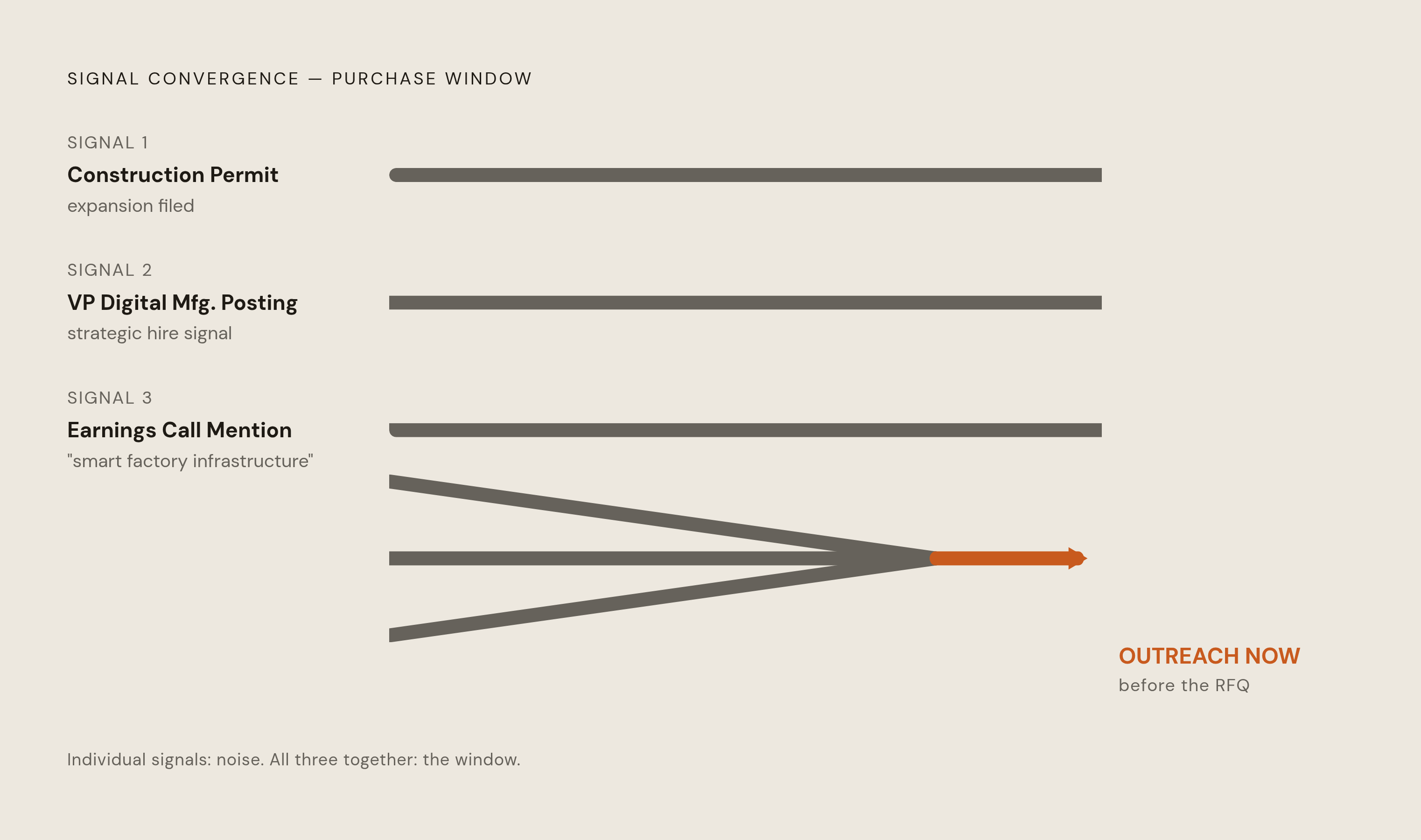
Nothing signals a multi-year procurement cycle like a new plant or an expansion. It shows up in construction permits, zoning filings, local business journals, trade press, earnings call transcripts, SEC filings for public companies, none of it hidden, just scattered across sources nobody watches all at once.
What rides along with an expansion? New production equipment obviously, machinery, tooling, process lines. But also chemicals, coatings, and consumables scaled to the new line's volume, water treatment and waste handling sized for the bigger footprint, materials handling and packaging built for higher throughput, compliance work for the newly expanded operation.
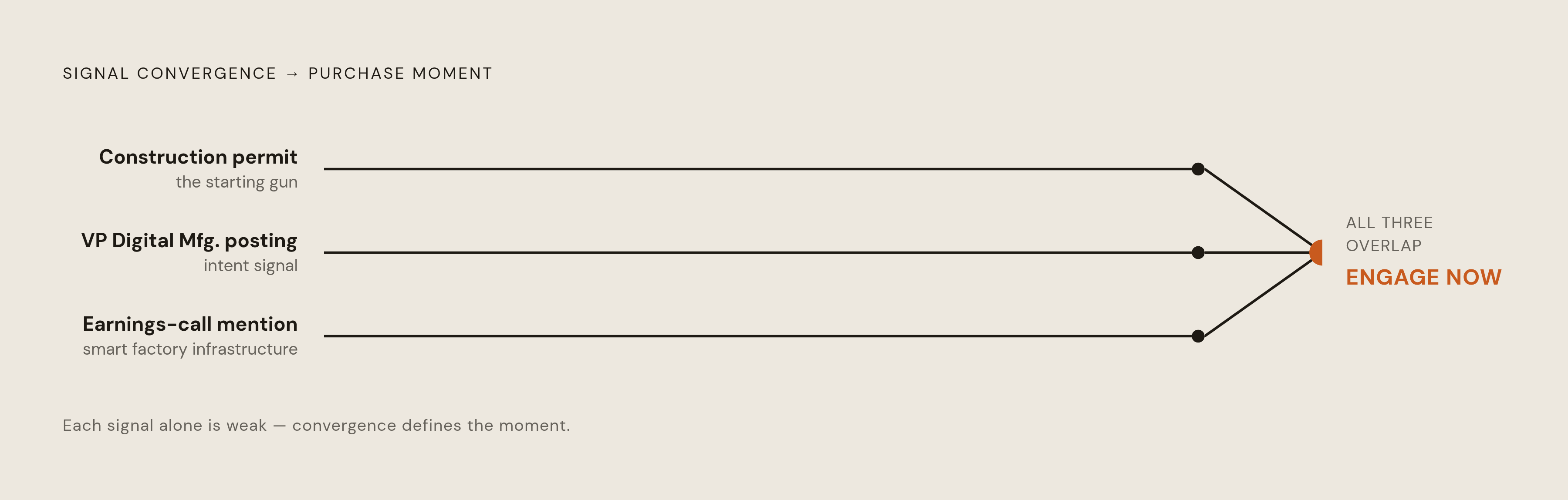
Say a manufacturer announces a $200 million EV components expansion. Same quarter, it posts a VP of Digital Manufacturing role, and the next earnings call mentions "smart factory infrastructure." Three signals converge into one purchasing moment: the permit marks the starting gun, well ahead of the finish line, and showing up at the announcement puts you ahead of whoever's still waiting for the RFQ to land in their inbox.
Nobody sits around refreshing permit databases and trade journals across a full territory by hand, though, and without something surfacing this automatically, it never reaches the rep at all, so the moment passes.
What hiring patterns at a plant reveal about upcoming purchasing decisions
Job postings are public, specific, and mostly ignored. They reflect a budget decision someone already made internally, which is exactly why they're worth reading closely instead of skimming past on the way to LinkedIn's homepage.
A process or manufacturing engineer opening usually means a line change is coming. An EHS manager hire often tracks to a compliance investment, frequently tied to new chemical or fluid handling rules. A maintenance supervisor or reliability engineer points to equipment lifecycle decisions, lubrication and fluid management included. A capital projects manager means an expansion or major equipment cycle is close. A digital manufacturing or automation lead means smart factory spending is already underway, technology purchasing to follow.
One posting alone is just a data point, but several relevant postings at the same plant in a short window signal scaling, and scaling tends to produce one consolidated purchasing decision rather than a string of small orders. The strongest read comes from stacking two facts: an EHS hire at a plant that just announced a new line qualifies far better than either fact sitting by itself. Research on trigger-based selling puts a majority of 2025 B2B sales engagements as starting from events like hiring surges, and yet plenty of teams still fixate on one signal type instead of stacking them.
Equipment investment and automation announcements as signals of adjacent purchasing need
New capital equipment never shows up self-sufficient. A CNC line, a robotic welder, an automated assembly cell, all of it needs process fluids, lubricants, coatings, or cleaning agents matched to its exact operating parameters. Automation investment signals that the plant is entering a stretch of reconfiguration, and that stretch is when adjacent suppliers actually have room to matter.
Watch for announcements of new CNC, robotic welding, or automated assembly lines. Watch the equipment OEMs too; they often issue press releases naming the customer plant directly. Watch trade press for coverage of a modernization or tech refresh at a specific site.
Timing matters more here than almost anywhere else on this list. The best entry point runs one to three months after adoption begins, early enough to help shape the fluids and consumables spec, late enough that the internal decision has already settled. Show up at spec time with a clear read on what the new equipment runs and what it needs, and there's real room to shape the outcome, but show up at RFQ time instead, and the conversation is just price, every time.
Sustainability commitments and regulatory filings as early signals of environmental input purchasing
Carbon targets, water usage commitments, waste reduction programs, all of it gets disclosed publicly, and it tends to arrive before a shift in chemical, water treatment, or process input purchasing. Look for it in sustainability reports, investor disclosures, press releases, and state environmental agency permit filings.
What follows a commitment like that? Reformulated chemistries built to hit lower VOC or hazardous waste limits. Water treatment upgrades to meet discharge standards. Coolant and fluid swaps driven by new OSHA or EPA rules. Packaging changes driven by recyclability targets.
A regulatory citation or a new permit condition reads even sharper than a voluntary pledge, and a facility hit with either is usually deep in active evaluation for the relevant input category within weeks, not months. Plenty of sales teams write ESG signals off as soft background noise instead of real pipeline, and that dismissal hands an opening to whichever rep bothers to understand what a sustainability pledge actually requires once it hits the plant floor.
Leadership changes and how they reset incumbent vendor relationships
A new plant manager, VP of Operations, or procurement director ranks among the highest-value signals on this list. New leaders run a supplier review in their first few months on the job, as a near rule, because they want to own the vendor relationships they're inheriting rather than just accept them as handed down.
This shows up in LinkedIn updates, company press releases, local business coverage, industry association announcements. The review window is narrow, and the rep who reaches the new leader before competitors re-engage the account gains a structural edge that outlasts simple timing.
It matters for existing accounts too, maybe even more, since a leadership change is often the moment a cross-sell conversation that had been stuck under the old relationship opens back up. The signals stack here the same way they do everywhere else: a new operations VP landing at a plant that's also expanding its footprint deserves a place at the top of the account list, flagged well before the next quarterly review.
How signals compound: reading multiple indicators at one facility to score purchase readiness
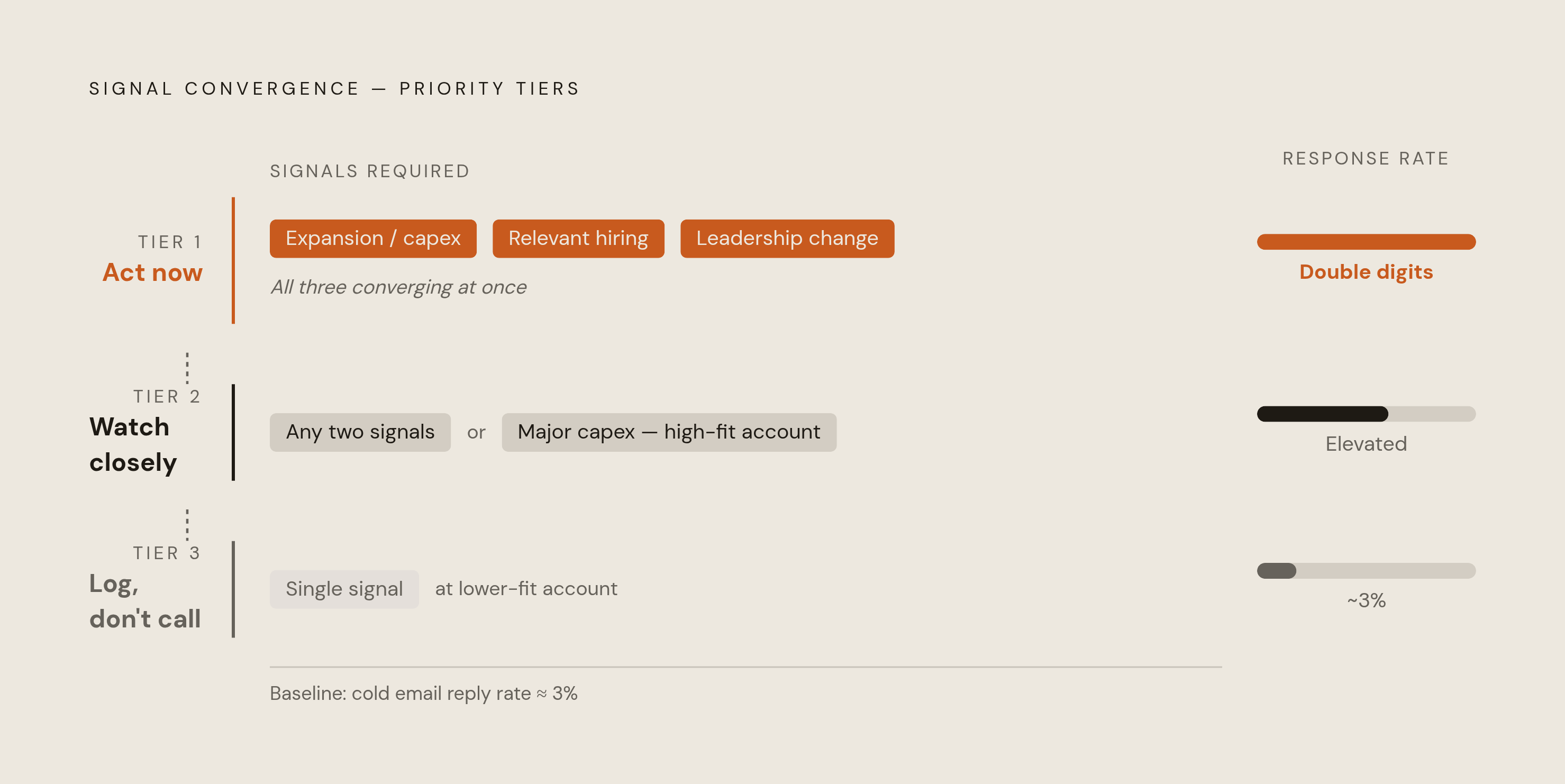
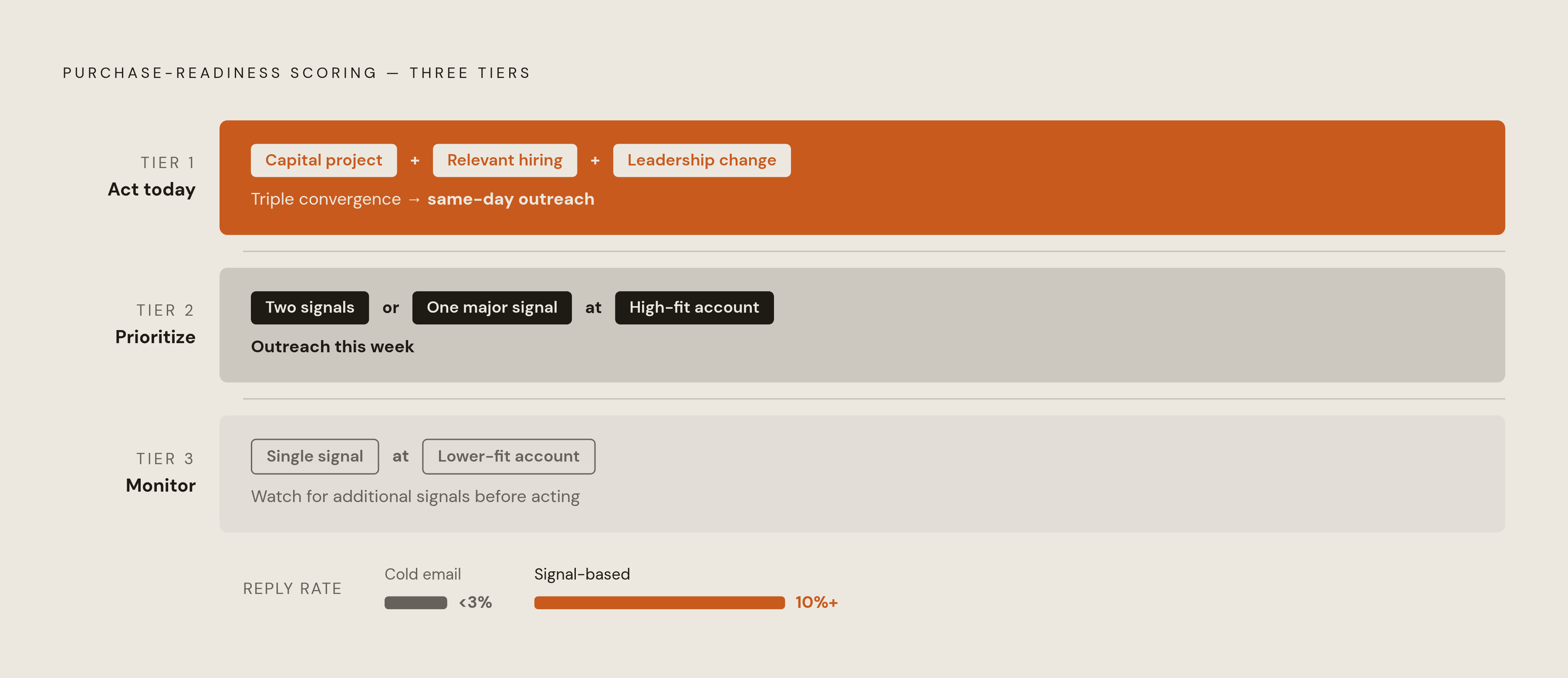
No single signal closes a deal by itself. Stacking is what separates a real opportunity from background noise worth a glance and nothing more. A facility with one signal, a hiring surge, say, deserves monitoring, while a facility with three converging signals, an expansion plus a leadership change plus an automation investment, deserves outreach today.
The payoff for getting this right isn't subtle. Signal-based outreach built on real personalization produces response rates well into the double digits, against a cold email reply rate that barely clears 3%. Companies working from trigger events see conversion rates several times higher than teams running generic blasts, and the lift tracks closely with knowing what actually triggered the message.
A rough scoring hierarchy helps organize the noise. Top priority: an expansion or capital project, plus relevant hiring, plus a leadership change, all converging at once. Second priority: any two of those, or one major signal, a large capital project, say, at a high-fit account. Third priority: a single signal at a lower-fit account, worth a note, not worth a phone call yet. The hard part isn't spotting any one of these signals; it's tracking six categories of them across dozens or hundreds of accounts with any consistency, and that doesn't happen by hand, not reliably.
Why most sales reps miss these signals and what it costs them
Almost everything covered here is public record: permits, job boards, earnings transcripts, press releases, trade coverage. It's scattered across hundreds of separate sources, though, and no rep managing a real territory can check all of them by hand at a frequency that matters. Nobody's paying a sales rep to be a research analyst, either, so it doesn't happen.
The cost isn't abstract. It means entering a buying cycle after most of the research is done, after the shortlist is set, after preferences have hardened into habit nobody plans to reconsider. Recall that 94% of buying groups had already ranked a preferred vendor before talking to any seller. Late entry, in this context, is close to a synonym for losing.
Trade shows don't fix this. Even a major industry event is a single point-in-time interaction, not an ongoing feed of intelligence. The deeper problem is the absence of a system that pulls plant-level signals together, ties them to specific accounts, and puts them in front of the rep while they still matter. Without plant-level context (what a facility actually makes, what equipment runs there, what volume it produces), and platforms like Corvus, which indexes more than 500,000 manufacturing facilities at the plant level, are built specifically to supply that context, a hiring signal or an expansion announcement is nearly impossible to qualify fast enough to act on.
Building a signal-monitoring practice into territory and account planning
Signal monitoring works best as a standing habit, folded into the regular territory review and account planning cadence rather than treated as an occasional project someone gets to when things are slow.
Start by picking which signal categories actually matter for the specific product line. A water treatment seller should prioritize expansion permits and ESG filings. A metalworking fluid seller should prioritize equipment investment and engineering hires. From there, map the facilities in the territory with enough context, what they make, what they run, what they currently buy, to read a new signal fast instead of starting from zero every time.
Set a cadence: monthly review for high-priority accounts, a full territory sweep at least once a quarter, and alerts built into the CRM so a detected trigger creates an actual task rather than a note nobody opens again.
Signals also land at different levels of the organization, and that matters for who gets contacted first. A permit filing is a facility-level signal, a leadership change is a person-level signal, an earnings call mention is corporate-level. With anywhere from five to eleven stakeholders typically in the room for a significant purchase, a rep walking in with a signal-informed account brief can speak to several priorities at once instead of opening with one generic pitch that fits none of them precisely.
A CRM built around plant-level production data, active signal tracking, and real facility context turns territory planning into something closer to demand sensing than geography management. The rep who shows up during the expansion announcement instead of the RFQ has built a real edge over the one still waiting by the phone.