Cross-Sell Opportunities in Existing Manufacturing Accounts
Manufacturers leave 70% of wallet share untapped by missing plant-level buying signals.

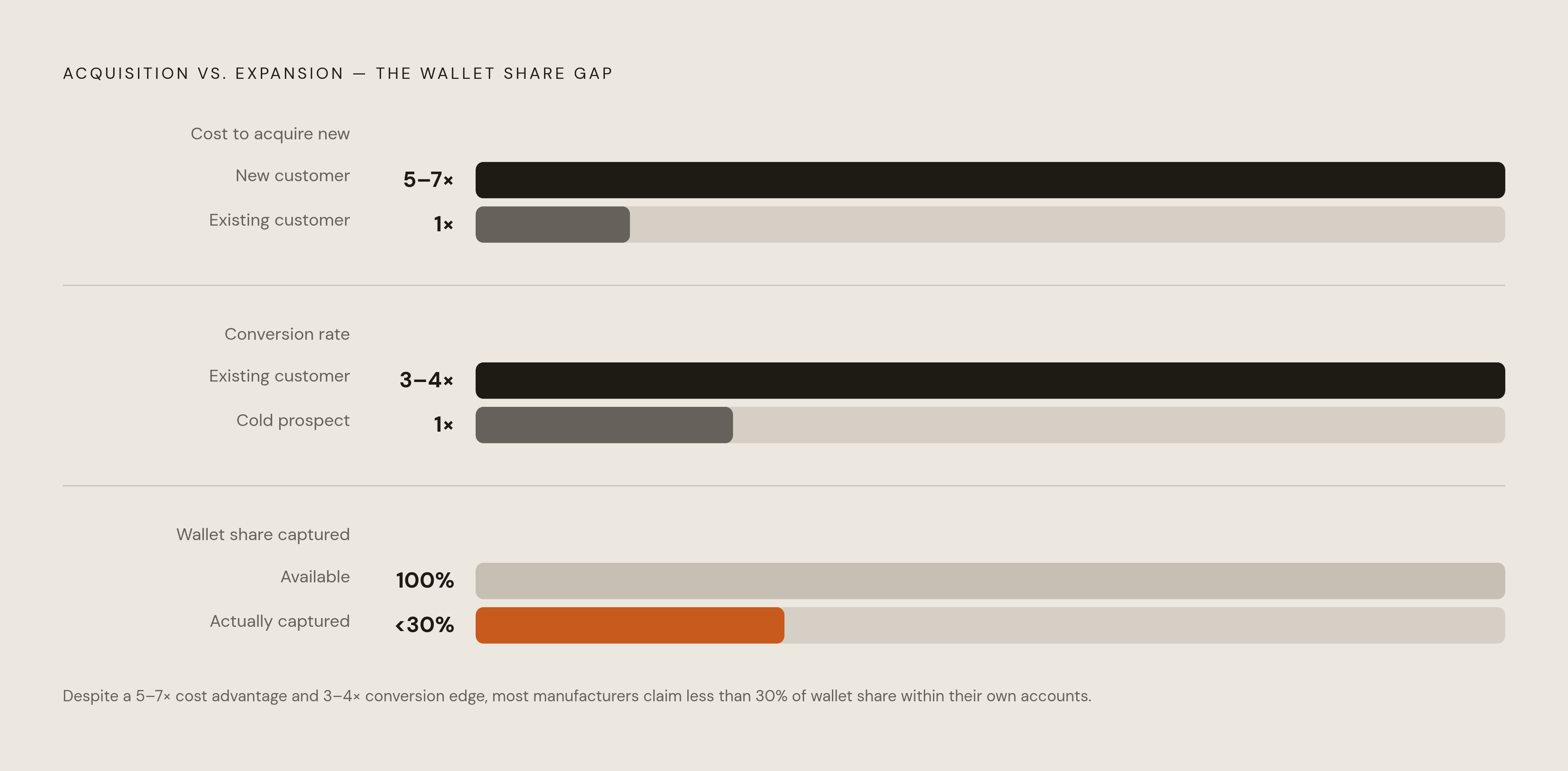
Cross-sell opportunity in manufacturing hides in plain sight, and most teams walk right past it. Acquiring a new customer costs five to seven times more than expanding one you already have; existing customers convert at three to four times the rate of cold prospects. Yet most organizations still capture less than 30% of available wallet share across their own accounts. I've sat in enough pipeline reviews to know why: the typical manufacturing account is an underused asset sitting on the books, invisible to any team working off company-level data instead of what's actually happening on the plant floor.
What makes cross-selling in manufacturing structurally different from other B2B contexts
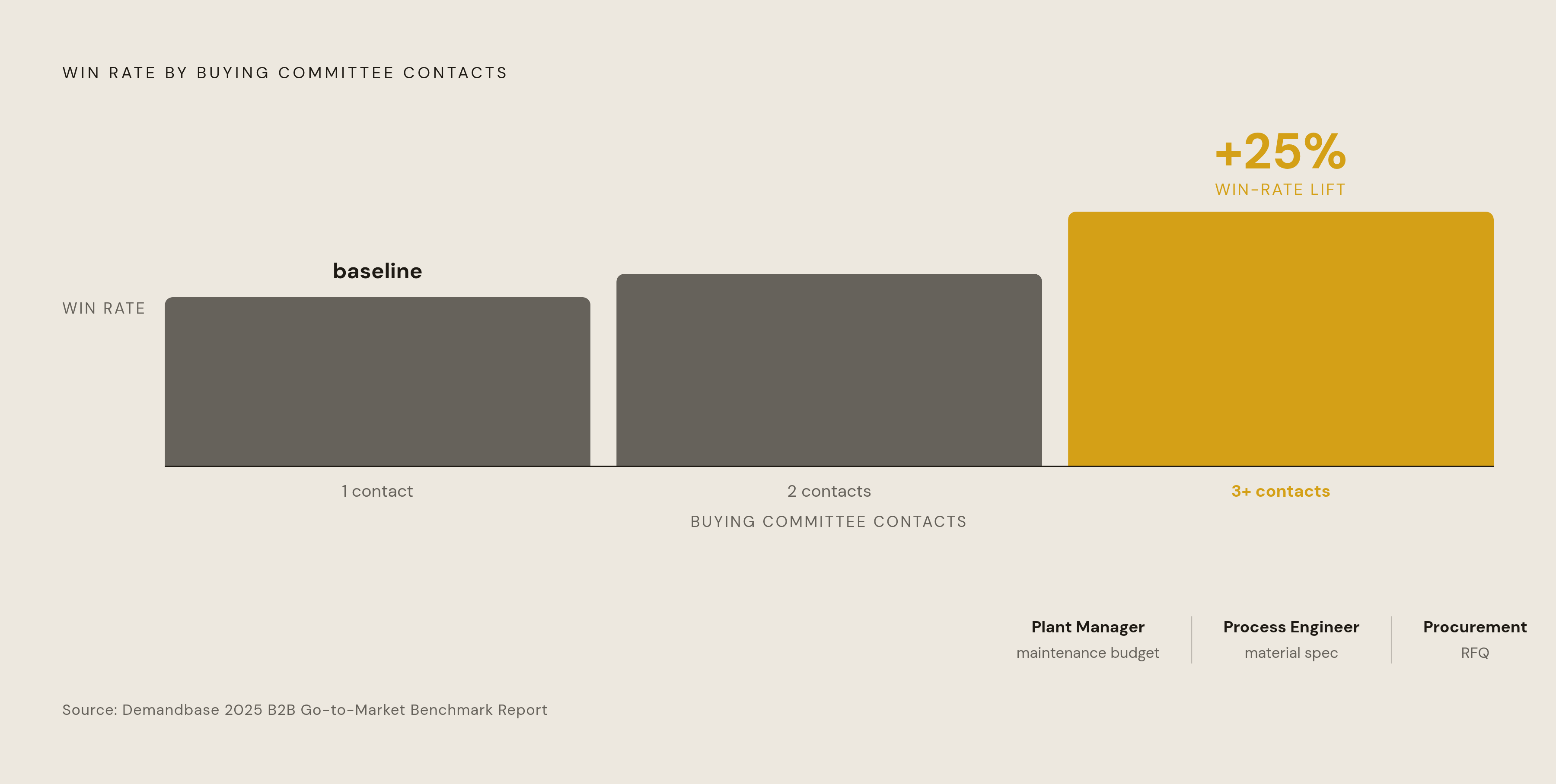
Manufacturing purchases get decided on the floor, not in a boardroom. A plant manager owns the maintenance budget. A process engineer specs the material. A procurement person runs the RFQ. Each one controls a different slice of spend, for a different reason, on a different clock. Build a cross-sell motion around "the account" and you've already lost the thread. The account was never one buyer; it's several people scattered across different corners of the plant, and none of them are thinking about the same problem at the same time.
Scale makes it worse. A corporate parent might run forty facilities, each with its own equipment, its own process, its own purchasing history built up over a decade of decisions nobody ever wrote down. Win a cross-sell at one plant and you've learned next to nothing about the plant three states over. Different equipment, different output, and a buyer who's never heard of you.
Field selling compounds it further. Only 7% of industrial manufacturing sales happen through digital channels, so the rep standing in front of a plant contact is still the primary vehicle for the whole conversation. Whatever gap exists in what that rep knows walking in shows up immediately: a worse call, a colder pitch, a missed opening. Demandbase's 2025 benchmark data found win rates run 25% higher on accounts where the selling team engages three or more members of the buying committee. That committee, in manufacturing, is large and cross-functional, and a rep who doesn't know who's on it walks in unprepared no matter how good the product is.
It never really finishes, either. Manufacturing relationships throw off years of service, maintenance, and expansion revenue after the first sale, so cross-sell starts over every time a plant's production changes. Selling into a plant means understanding it. Everything else here sits on that foundation.
Why most industrial sales teams systematically miss the cross-sell signals that are already present
Look at the data reps actually work from. Generic business databases describe a company by NAICS code and headcount. Neither tells a rep what a specific plant makes, what sits on that floor, or what it needs to keep running. A code and an employee count are a company-level abstraction; a cross-sell opportunity lives at the level of one production line.
CRM records don't help much either. Most industrial CRMs get populated at the account level: a contact, a revenue figure, maybe a note from the last call. There's rarely a structured record of what a given facility produces or what changed there last quarter. So the cross-sell conversation ends up running on whatever the customer happens to volunteer, and the rep reacts when they should be arriving with a plan.
Buyers aren't waiting around for the rep to catch up, either. TREW Marketing and GlobalSpec's 2026 data puts the number at 62%, the share of technical buyers in industrial markets who complete most of their purchase journey online before ever talking to a vendor. By the time the call happens, the buyer has already framed the problem their own way, and a rep without plant-level context is chasing a conversation that started without them.
Underneath all of it sits a systems problem nobody wants to own. CRM and ERP platforms in manufacturing rarely sync in real time, so the account manager has no visibility into what a facility is actually consuming or what changed operationally last month. Most sales organizations are looking at the account level when the opportunity sits one level down, at the plant.
The plant-level signals that indicate a cross-sell window is open
Manufacturing throws off physical signals that have no clean digital equivalent, and most of them are knowable well before a customer picks up the phone: permit filings for a new production line, job postings for process engineers or maintenance techs (these tend to spike right when a plant is gearing up for some kind of operational shift), equipment modernization projects, capital investment announcements, land acquisition or new construction next to an existing facility. Every one of these is a public breadcrumb pointing at a purchasing decision that hasn't happened yet.
Production changes translate directly into purchasing needs, and a rep paying attention can see the translation coming before the customer says a word. A plant switching materials, or adding a line, needs different fluids, coatings, or packaging to match. A capacity expansion that boosts throughput usually pulls more consumables across nearly every input category the plant buys, not just the obvious one. Equipment upgrades reset the spec sheet entirely. The product that fit the old line may not fit the new one, and that mismatch is worth a phone call.
Regulatory shifts add another layer. New discharge limits, tighter emissions rules, a reclassified waste stream, all of it forces reformulation decisions at the facility level on a timeline the plant doesn't control.
Public filings, job boards, and permit databases all carry signal well before the customer volunteers anything. The rep who shows up already knowing converts at a different rate than the one who has to ask first, and plant-level intelligence is what produces that edge. Company-level data can't replicate that head start.
How white space analysis maps what you actually sell against what a facility could buy
White space analysis starts from a plain question: of everything you could sell a customer, how much are they actually buying? The gap between those two numbers is the opportunity. The usual way to see it is a grid, facilities down one side, product families across the top, each cell marked active, in discussion, churned, or never sold.
Build that grid at the corporate level and it lies to you. A cell reading "active" for the parent account might read "never sold" for three plants in the same region, and those three plants are exactly where the cross-sell sits. The grid only tells the truth when it's built facility by facility, which is more work up front and considerably less wasted motion later.
Peer benchmarking sharpens things further. Group plants by production type or process, work out average spend per product family across that peer group, then find the plants buying below average in specific categories. Those cells are direct targets, and they come with a number attached, since you can size the gap against what similar plants already spend.
Not every white space cell deserves a rep's time. Some plant profiles just don't fit a given product structurally, and chasing them anyway burns capacity that should go toward accounts that will actually close. A working "no-sell" list, cells deliberately marked off-limits, protects that capacity the same way a target list protects the pipeline.
The matrix rots fast, too. White space built off last year's account notes amounts to a guess dressed up as a plan. Without a live feed of facility data underneath it, the grid shows where the opportunity used to sit, not where it sits now. Done right, the output is a ranked list of facility-level targets, sorted by fit, signal strength, and estimated wallet size, something a rep can work down on a Tuesday morning instead of a spreadsheet nobody trusts.
What the cross-sell conversation looks like when a rep arrives with plant-level context
Without plant-level context, the rep spends the first ten minutes asking questions: what do you make here, what do you run, what do you need. The customer ends up doing the vendor's homework for them, which is a strange thing to ask of someone you're trying to sell to. Arrive with that context already in hand, and the conversation moves straight from discovery into recommendation, because the rep already knows the production process, the current product relationship, the equipment on the floor, and whatever changed recently.
The shift looks a little different depending on the vertical, but the pattern holds. A specialty chemicals rep who knows a plant runs a particular metalworking process can open with the relevant product line instead of walking through a catalog page by page. A packaging rep who knows a facility just added a line for a new SKU can bring a capacity-matched solution before the customer has even drafted an RFQ. A water treatment rep who's tracked a plant's recent expansion, and knows what it produces, can anticipate the wastewater profile before the first meeting starts.
The buying committee gets easier to navigate too. Knowing what a plant actually does lets you map which stakeholder, engineering, procurement, operations, owns which piece of the decision. That beats guessing at the org chart on the first call and getting it wrong, which happens more often than most sales leaders want to admit.
Prepared reps skip a round of discovery, hit fewer objections, and get to a recommendation faster. Do that consistently across a territory and the effect stacks; it isn't a one-time win.
How to build a cross-sell motion that runs systematically across a territory, not just account by account
A rep carrying 80 accounts with no facility-level data is really carrying 80 unknowns, and prioritizing among unknowns is closer to guessing than planning. Give every account a facility profile, though, and the territory becomes something you can sort, by signal strength, white space size, production fit, how recent the activity is. The weekly call plan starts writing itself instead of getting assembled from memory and gut feel on a Monday morning.
The upside isn't theoretical. Harvard Business Review research on territory design found that optimizing how territories are structured can lift revenue 2 to 7% without adding a single rep. The same logic applies inside an existing book of business, once you're deciding where the cross-sell effort actually goes.
The intelligence needs to live somewhere reps already look. White space cells, facility signals, cross-sell priorities, all of it belongs inside the CRM a rep opens every morning anyway. Anything requiring a separate tool or a second login gets ignored within a month; that's just how field reps operate, and no amount of training changes it. Quarterly territory reviews should track it directly: how many cells moved from "never sold" to "in discussion"? Which facility signals came in and went unacted on? Where is wallet share actually shrinking, and why?
This is a design problem, and it belongs to RevOps and sales leadership, working alongside individual reps rather than leaving them to push harder against the same broken process. Gartner's 2025 CMO Spend Survey found manufacturing marketing budgets climbed back to 9.5% of revenue in 2025, up from 6.7% the year before. Money is coming back into the system. Whether it lands against real facility-level opportunity depends on whether the intelligence infrastructure exists to point it there.
What to look for in a manufacturing intelligence platform built to support cross-sell
Start with the baseline: facility-level coverage rather than company-level records. A platform that profiles individual plants, capturing production type, equipment, output, and environmental footprint, sits in a different category of tool than a database organized around NAICS codes and headcount. The difference shows up the first time a rep tries to use it to prep for a call and either finds what they need or comes up empty-handed.
Freshness matters as much as depth. A cross-sell trigger tied to a plant expansion or an equipment swap has a shelf life, and stale data turns into stale pipeline fast, no matter how thorough it looked when someone first collected it.
Scale matters too. Industrial Info Resources' PECWeb indexes more than 338,000 industrial plants and over 253,000 capital and maintenance projects worldwide, and that kind of scale is what determines how much of a rep's territory is actually visible versus sitting in the dark.
CRM integration is the line between a tool that gets used and one that quietly dies. Intelligence that requires a separate login or a manual export won't get checked consistently by a field rep running between plant visits, which is why HubSpot, Salesforce, and Dynamics 365 integration have become table stakes. Beyond that, check whether the platform hands a rep plain-language signals they can act on directly, or whether it spits out raw data that needs an analyst to translate before anyone in the field can use it.
A platform built from the ground up for manufacturing, one that indexes facilities individually with real production data (what a plant makes, what it runs, its throughput, its recent activity), gives a cross-sell motion a structural edge that a generic business database retrofitted for industrial use struggles to match. The good ones are built to be read by the account manager standing in a parking lot before a call, not just by the analytics team sitting behind a dashboard three time zones away.