Account-Based Selling in Specialty Chemicals
Target selling at the plant level, where process chemistry is actually decided and bought.
Account-based selling in specialty chemicals only works when you define the account as a plant, not a company. A facility's process decides what it buys; the corporate logo on the building tells you almost nothing. I've watched reps chase a "strategic account" for a year because the parent company looked good on paper, while the plant three miles away with an open PO cycle never got a call. This piece walks through what plant-level thinking actually demands, from picking targets to running a CRM that can keep up with it.
What makes a manufacturing facility the right unit of analysis in specialty chemicals
Manufacturing was the largest end-use segment for specialty chemicals in 2025, holding roughly a third of the market. That's where the money sits.
A parent company can run a dozen plants that have almost nothing in common with each other. Take a single automotive OEM: it might run a stamping plant, a casting plant, a machining plant, a paint shop, and a final assembly line, and each one runs completely different chemistry. The stamping plant needs draw lubricants. The machining plant needs metalworking fluid, and even inside that category the type matters; soluble oils held about a third of that market in 2025, while synthetic fluids grow faster than any other segment. The paint shop needs resins, pigments, and solvents matched to its own coating line. Coatings and paints were the single largest specialty chemical category by type last year, the largest share. Drive from an aerospace parts supplier to a food plant down the road and you're under a completely different set of regulatory and formulation rules, even though both show up as "manufacturing" on the same spreadsheet.
Chemical need follows process. Corporate identity, brand, the master service agreement someone signed at headquarters three years ago, none of that registers against what's actually running through the line. Corporate procurement contracts describe what a company intends to buy. They rarely describe what a plant manager is actually ordering and burning through week to week, and that gap between contract and consumption is exactly where a sharp rep finds an opening. A usable plant profile tracks production type, the equipment actually installed on the floor, output volume, environmental footprint, and whatever operational signals proxy for how much chemistry that facility runs through in a month.
How to identify and tier target facilities before any outreach begins
Most ideal customer profiles in this industry still run on firmographics: revenue band, headcount, NAICS code. These filters spit out long lists of companies that look right on paper and tell you nothing about whether the plant behind the listing consumes what you sell. A NAICS code can't tell you if a facility runs a five-axis CNC line or a hand-assembly operation, and that distinction is the one that actually decides the deal.
A working ICP for specialty chemicals combines process type (machining, coating, casting, food processing, semiconductor fab) with a throughput signal, since a high-volume machining shop burns metalworking fluid at a totally different rate than the low-volume job shop down the street. Add equipment age and type; older lines often need different maintenance chemistry than a plant that just installed new CNC equipment. Regulatory posture matters too, since PFAS exposure, sustainability commitments, and state discharge permits all narrow the list of formulations a plant can legally buy in the first place.
Once that list exists, not every qualifying plant deserves the same attention right now. Tier 1 is high process fit, high volume, and an active trigger: new equipment going in, an expansion underway, a regulatory deadline forcing a switch. Tier 2 is good fit and decent volume with no urgency attached, which means a nurture cadence rather than a full-court pursuit. Tier 3 is partial fit, worth watching for a signal that bumps it up later.
At any given moment, only a small fraction of B2B accounts sit in an active buying window. Skip the behavioral and operational signals and a rep ends up chasing an account that won't move for eighteen months, while ignoring one that just entered its decision cycle. Watch for facility expansions, new line installations, regulatory changes forcing reformulation, a distributor switch, new product lines demanding new process chemistry. EV-related retooling deserves its own mention here: something like battery housing machining creates a metalworking fluid requirement that didn't exist on that line a year ago.
Reshoring is worth calling out on its own. Roughly 38% of manufacturers cited avoiding geopolitical risk as a driver behind reshoring in 2025. New or returning domestic plants are, by definition, greenfield, with no incumbent supplier and no entrenched relationship to dislodge.
Mapping the buying committee to the plant, not the corporate org chart
Manufacturing purchases routinely involve multiple stakeholders across functions. Single-threading through one procurement contact is one of the fastest ways to lose a deal you thought you'd already closed.
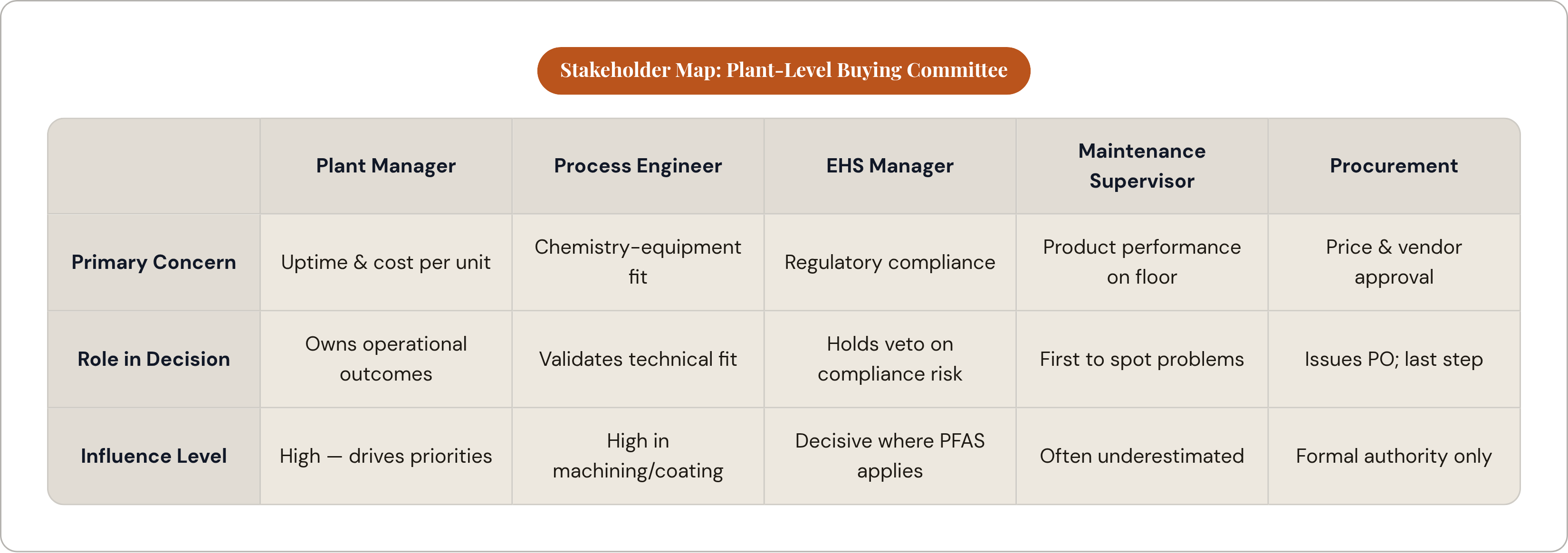
Corporate procurement sets the approved vendor list, but it rarely decides who actually gets the volume. That decision lives at the plant, spread across people who never show up on the org chart a rep pulls from a database. The plant manager cares about uptime and cost per unit of output, not the unit price on a quote. The process engineer cares whether a chemistry performs against the equipment on the floor and how long a fluid lasts before it needs changing. Compliance authority sits with the EHS manager, a role that's only gained weight as PFAS restrictions and state discharge rules multiply. The maintenance supervisor has more physical contact with the product than anyone and sees a problem before it shows up anywhere else. Procurement issues the PO and negotiates price, and that's usually the last step, not the first.
A rep who has mapped only the corporate procurement contact has mapped one node in a system with five or more. Any of the others can kill the deal without procurement ever knowing why it died.
Getting this map right starts with knowing what the plant actually does, because process decides who holds real weight. In a precision machining operation, the process engineer and maintenance supervisor often outrank procurement in practice, whatever the org chart says. In a coatings or surface treatment operation, EHS effectively holds veto power over anything with a compliance question mark on it. For multi-plant enterprise accounts, a three-tier team usually beats one rep trying to cover everything: a global account lead who owns the corporate relationship and contract strategy, regional reps who handle plant-level execution, and technical specialists who come in as overlays for application-specific conversations. All of it depends on data that can say whether a given plant even has an EHS manager or a dedicated process engineering group.
Building the account conversation around production reality, not product features
The leading specialty chemical suppliers compete on demonstrated value, and that shows up directly in how their reps talk. The job is to frame the conversation around the plant's own bottom line: lower cost per part, higher throughput, fewer rejects, less waste going out the back door.
That changes the actual sentence that gets said in the room. Compare "here's what a significant extension in fluid change interval saves you in labor and disposal costs, given the volume of aluminum alloy machining running on your line" against a generic claim about sump life. Or compare "your new EV battery enclosure line runs a conversion coating step before powder coat, and here's exactly where that chemistry interface creates an adhesion risk" against a broad pitch about carrying a full coatings line. One of those gets a second meeting; the other gets a polite email back in three weeks, if that.
Technical fluency is the entry fee, not the differentiator. Buyers test whether a rep understands their process before they take anything else seriously, and that test happens fast, usually inside the first two minutes. Walk in without knowing what the plant makes, which process steps involve chemistry, what equipment sits on the floor, and what metrics that process gets measured against, and you've walked in with nothing worth saying.
Regulatory pressure sharpens all of this. A plant actively reformulating away from PFAS-containing products is in a forced transition, and the rep who already knows that, who shows up with compliant alternatives already in hand, gets access a generic pitch never earns. Semiconductor fab expansions carry their own version of the same dynamic: chemicals make up somewhere between 9% and 14% of a device's bill of materials, and the ultra-pure chemistry requirements attached to that figure are specific enough that no amount of general product positioning will land.
Nothing here holds still, either. What a plant makes today may not be what it makes in eighteen months, since production mix shifts, new lines go in, and regulations force transitions. A rep who actually tracks that has a real reason to call again, one grounded in something that changed rather than a routine check-in.
Territory design when the demand signal is plant production density, not geography
Territory maps in specialty chemicals still get built on geography or vertical, region by region, industry by industry. Both are blunt instruments, and both produce wildly uneven opportunity across territories that look balanced on a spreadsheet.
Build the territory on manufacturing density and process type instead, and a different picture shows up. A Midwest territory dense with precision machining and stamping plants is a fundamentally different metalworking fluid opportunity than one dominated by assembly and distribution operations, even when the two carry a similar company count. Gulf Coast food and beverage processing density represents its own distinct cluster of demand for lubricants, sanitizers, coatings, and cleaning chemistries, a pattern geography alone would never surface.
The scale here isn't small. The U.S. metalworking fluids market is projected to grow from $2.45 billion in 2025 to $4.06 billion by 2033, a compound growth rate above 6.5%, led by precision machining, automation, and aerospace work. Territories weighted toward those plant types carry structurally more upside than territories with the same account count but a different process mix.
Reshoring compounds the problem for anyone still working off old maps. New plant density is showing up in regions that historically had little of it, and a territory plan built on last year's data, or worse, on a historical company list, misses it completely. A rep who has ranked every facility in a territory by process fit, volume, and buying-window signal can point most of their selling time at the smallest share of accounts most likely to close, instead of spreading effort evenly across a list that treats every account as equally worth a call. Territory design in this industry is an ongoing exercise, not an annual planning ritual. It has to move as plants expand, retool, or hit a regulatory deadline, and doing that at scale takes a data platform that indexes facilities by process type and production signal across the hundreds of thousands of manufacturing sites in the country. A spreadsheet somebody updates every January just won't cut it.
Growing existing accounts by finding what the plant buys that you aren't selling
Here's the whitespace problem, and it's a common one: a rep holds a strong relationship with a plant's procurement team on one chemistry line, while the process step right next door, inside the same building, buys a competing product from someone else. Nobody on the selling side ever mapped the plant's full chemical footprint, so nobody noticed.
A complete plant profile surfaces what a CRM record never will on its own: every process step that touches chemistry, not just the one the rep currently sells into; volume signals across those steps; regulatory exposure that may be quietly creating a replacement need the plant hasn't acted on yet; and new lines or process additions that open a chemistry requirement that didn't exist last quarter.
Strategic account management has a well-documented gap between intention and result. Most B2B companies treat it as critical to growth, yet results consistently fall short of expectations once a program actually launches. The root cause is usually visibility, plain and simple: reps don't have enough insight into what the account does on the floor to find the expansion sitting right next to the business they already have.
The chemical distribution market, valued at roughly $265 billion globally in 2024, stays remarkably fragmented. Even a top-five distributor typically holds a fraction of a large manufacturer's total chemical spend. The wallet-share opportunity inside accounts a rep already sells into is underexplored almost everywhere, not just occasionally.
Treated as an expansion motion alongside the acquisition motion, this version of ABS means mapping every facility inside a current account's portfolio, not just the ones already generating a PO. It means profiling each facility against what it needs versus what it's currently getting, prioritizing outreach by the size of that gap and whatever buying-window signal is attached to it. It means using the plant relationship that already works as a warm introduction into the plant down the road that nobody's called on yet. A conversation with a plant manager who already trusts you carries far more weight than a cold call, but the plant-level intelligence has to hand the rep something specific enough to actually bring into that room.
What the CRM needs to reflect for plant-level ABS to work at scale
Most CRM records in specialty chemical sales organizations are still built around the company, not the facility. So the system can't answer the two questions a rep actually needs answered: which plant to call, and what changed there since the last visit.
That gap widens over time rather than closing. A company-level record goes stale the moment a plant opens, closes, expands, or retools, and a generic CRM has no way to flag that a facility just added a new machining line or dropped a PFAS-restricted process. The record sits there, technically accurate at the corporate level and useless at the level where the buying decision actually happens.
Plant-level enrichment fixes this by tying account records to specific facilities rather than corporate parents. It makes process and production type searchable, filterable fields instead of notes buried in an activity log somewhere. It surfaces buying-window signals directly in the rep's daily workflow instead of demanding a separate research project every single time. And it maps stakeholders to plant roles rather than corporate titles that don't reflect who actually influences the purchase.
None of this replaces the sales conversation; it just makes sure the rep walks in knowing something true. Take away the underlying data, and account-based selling in specialty chemicals is a framework built on nothing. A rep working off a company-level record is guessing, hoping the guess lands before the competitor's rep, the one who already mapped the plant, gets there first.