What a Plant's Environmental Footprint Tells You Before You Pitch
Public EPA data reveals what actually happens on a plant floor before you call.

A manufacturing plant's environmental filings are a public map of what that facility makes, what it burns through to make it, and where regulators are squeezing it hardest. Every one of those filings sits behind a data point a sales rep can pull before ever picking up the phone.
Most pre-call research stops at the company website, a LinkedIn scroll, whatever's sitting in the CRM notes field, and maybe a Google News search for the account name. That stack tells a rep what a company says about itself, but it says nothing about what actually happens on the plant floor: how much solvent moves through a degreasing line, whether a wastewater permit is about to force a chemistry change, whether the plant is running three shifts or barely limping through one. The federal government already collects this information and publishes it, facility by facility, chemical by chemical. No analyst subscription required, no gatekeeper, just records sitting in EPA databases waiting to be read correctly.
The rest of this piece works through what's actually in those records and how each layer of them turns into something a sales rep can act on.
What the TRI actually reports and why it covers the industrial universe a rep cares about
The Toxics Release Inventory is EPA's annual accounting of chemical releases and waste management activity, mandated under Section 313 of the Emergency Planning and Community Right-to-Know Act. More than 21,000 industrial and federal facilities file into it every year, reporting on close to 800 chemicals and chemical categories. That's not a niche dataset covering a handful of heavy polluters; it's a working census of the chemical-consuming side of American manufacturing.
The chemical list itself moves with the regulatory landscape. The 2024 reporting cycle added seven PFAS compounds, which matters directly to anyone selling into water treatment, specialty chemicals, or environmental health and safety services, since PFAS reporting is now a live compliance question for a wider set of facilities than it was a few years ago.
A single TRI record for a facility gives the chemical name, the quantity released or managed, the pathway it took (air, water, or land), the waste management method applied, and the facility's address and NAICS code. The data refreshes annually, keyed to the prior calendar year, which makes it current enough to anchor an actual territory review rather than something that sits stale in an appendix.
Here's the interpretive leap that makes all of this commercially useful: every chemical listed in a TRI filing is standing in for a process technology, and every process technology comes with a known, fairly predictable set of consumable needs.
Reading a facility's process fingerprint from its reported chemicals
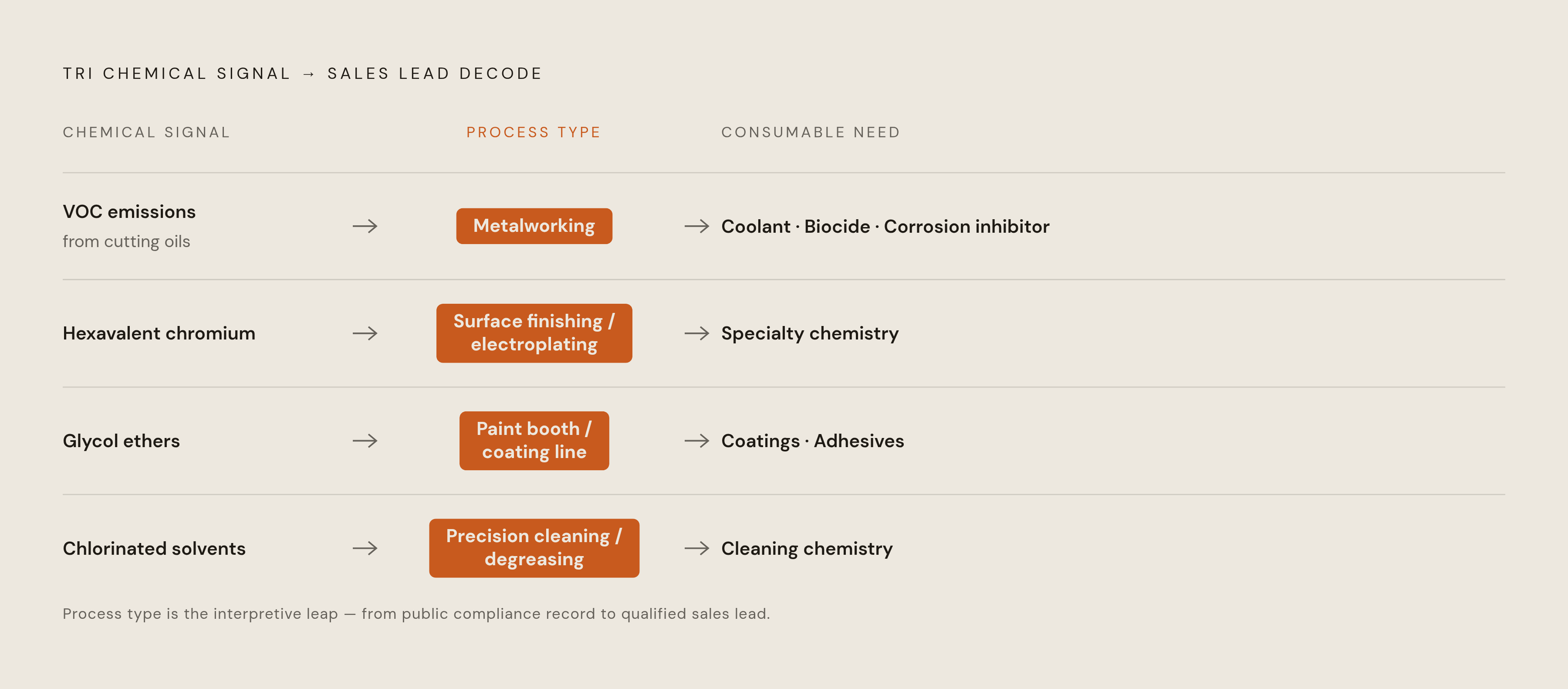
Reported chemicals aren't random. They're byproducts of specific operations, which means they tell a rep what equipment and what chemistries the plant actually depends on to run.
VOC emissions tied to cutting oils point to metalworking, and metalworking means ongoing demand for coolant, biocide, and corrosion inhibitor. Hexavalent chromium showing up in a TRI release points to surface finishing or electroplating, which is a specialty chemistry account worth a much closer look. Glycol ethers in an air permit usually mean a paint booth or a coating line, opening the door for coatings and adhesives, while chlorinated solvent releases point to precision cleaning or degreasing, and nitrogenous compounds point toward fertilizer production or food and beverage processing. None of these are guesses; they're standard associations between chemical class and process type that show up consistently across facility records.
Air permits add another layer of confirmation. A facility running boilers or furnaces needs combustion chemistry, fuel treatment, scale inhibitors, while one running scrubbers or oxidizers is actively managing air pollution control, which means its purchasing cycle is compliance-driven rather than purely production-driven. Fugitive emissions logged from pumps and valves suggest a continuous-flow process plant rather than a batch operation, a distinction that changes what kind of chemistry and what kind of dosing system makes sense to pitch.
The upstream material decisions matter here too. Choices made early in product development, about substrate, about alloy, about base material, end up determining most of a product's downstream environmental impact. In practice that means the metal or polymer a plant works with predicts the chemical package it needs to buy to work with it. A plant machining titanium for aerospace parts is not shopping for the same additive package as one stamping mild steel automotive brackets, and the TRI record makes that distinction visible before a rep ever walks in.
One more wrinkle worth tracking: a single parent company can own several TRI-reporting facilities, each with its own footprint and its own separate purchasing profile. That's a built-in map for account expansion, not just first-call targeting.
How permit status and compliance timelines create time-bounded buying windows
Every facility operates inside a stack of permits, and each one runs on its own clock. Title V air operating permits, NPDES wastewater discharge permits, RCRA hazardous-waste generator requirements, plus whatever the state layers on top. Each has a renewal cycle, and each renewal is a trigger event.
Title V renewals run on a multi-year cycle, and the renewal filing tends to force a process review that often leads to capital spending or a chemistry change. An NPDES permit modification signals something changed operationally: an expansion, a process shift, tighter discharge limits handed down by the state. That kind of modification often comes right before a plant starts shopping for water treatment chemistry. A consent decree is the sharpest signal of all, since it comes with a hard remediation deadline, and procurement has to happen on schedule to meet it. A new chemical listing, PFAS being the clearest recent case, creates compliance uncertainty overnight and tends to speed up substitution decisions that might otherwise have sat on a shelf for years.
A few other signals corroborate the timing. Job postings for EHS specialists, process engineers, or sustainability managers tend to lead compliance activity rather than follow it, expansion announcements buried in press releases or permit applications usually precede an equipment purchasing cycle, and a facility rolling out an MES or a sustainability software module is, by definition, modernizing, which means it's evaluating process chemistry at the same time.
Put together, a rep who knows a plant's permit renewal date isn't showing up with a cold introduction. There's an actual deadline attached to the conversation, and that changes the entire framing of the first call.
Where sustainability mandates are compressing the timeline for process chemistry decisions
The regulatory pressure isn't only domestic. The EU's Corporate Sustainability Reporting Directive requires more than 50,000 companies to meet stringent emissions and reporting standards starting in 2024, and that requirement reaches non-EU manufacturers with any exposure to EU supply chains. The SEC's climate-disclosure rules are building similar pressure on U.S. public manufacturers. And Scope 3 requirements from large customers are pushing decarbonization criteria down into supplier qualification, which means the pressure lands on the plant floor even when the plant itself isn't the one facing the regulator directly.
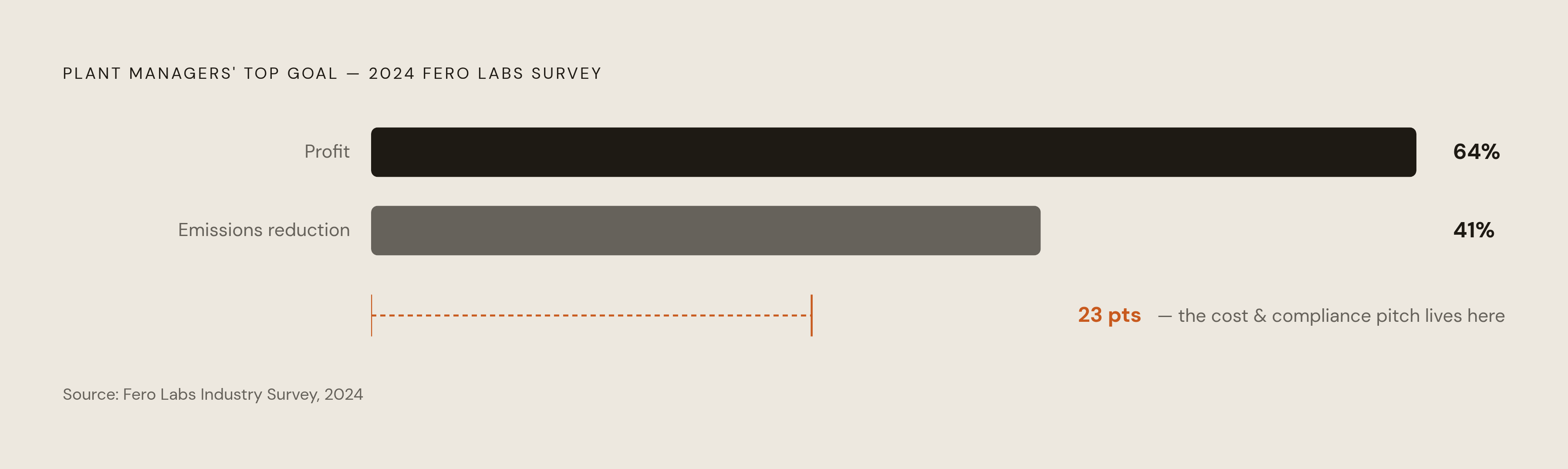
But plant managers aren't uniformly bought in yet. A 2024 Fero Labs industry survey found 64% of plant managers name profit as the top goal, while only 41% put emissions reduction near the top. That 23-point gap is exactly where a rep's pitch lands. The case for a lower-footprint metalworking fluid or a greener process chemistry doesn't need to be made on environmental grounds at all. It's cost-per-part, it's compliance risk the plant would rather avoid, and it's customer retention, because the plant's own customers are increasingly the ones asking for Scope 3 numbers.
A facility's TRI history doubles as a rough proxy for its ESG posture. One with documented pollution prevention investment, low-toxicity substitutions already on record, and a declining release trend is a plant that has already bought into this argument, and it's the highest-probability early adopter of a bio-based reformulation. The opposite pattern is just as useful to know going in. A facility with flat or rising releases and nothing on record for prevention activity is either sitting on pressure it hasn't acted on yet, or it needs a different kind of urgency conversation entirely, one built around risk rather than optimization.
The specific markets where environmental footprint signals convert most directly to pipeline
Metalworking fluids are as good a place as any to see this play out in dollar terms. The global market reached $13.90 billion in 2026 and is headed toward $18.82 billion by 2034, according to Fortune Business Insights. The additive side of that market, biocides, corrosion inhibitors, extreme-pressure additives, emulsifiers, is projected to grow from $15.86 billion in 2024 to $22.85 billion by 2035.
TRI data is unusually well-suited to this vertical. VOC and metal compound reporting flags facilities running machining, grinding, and finishing operations directly, no inference required. Transport equipment manufacturing, automotive, aerospace, and rail, are among the prominent end-use segments, each carrying its own distinct chemical signature in the TRI and permit record.
The competitive landscape here rewards preparation over scale. The top five players in metalworking fluids hold something like 35 to 45% of the global market, which means the majority of it is fragmented across regional and specialty sellers. Those sellers win on knowing the process, not on size. Showing up already able to name a plant's chemistry and its permit status is exactly the kind of edge that makes a smaller vendor look like the most prepared person in the room.
Industrial manufacturing is a major distribution segment for specialty chemicals, covering water management chemicals, metalworking fluids, pulp and paper chemicals, and rubber processing, which argues for weighting territory plans by manufacturing density in those specific sub-verticals rather than by generic headcount. Food and beverage plants carry wastewater intensity signals worth tracking, coatings and adhesives accounts show up through VOC permit complexity, water treatment accounts show up through effluent permit stringency, and plastics and polymers accounts show up in the hazardous-waste logs.
Turning environmental records into an account-enrichment layer inside a CRM
B2B contact databases decay steadily, and for manufacturing sales teams working a narrow total addressable market, that decay is expensive. Every outreach wasted on a stale contact is an outreach not spent on a live one, and the opportunity cost compounds when the whole territory only has so many qualified accounts in it to begin with.
Environmental data doesn't have that problem, structurally. It's keyed to a physical facility address rather than a person, so it's immune to the churn that wrecks a contact database when someone changes jobs. It refreshes annually because a reporting obligation forces it to, not because a company happened to update its own profile. And it reflects actual process activity on the ground rather than a self-reported headcount or a revenue estimate pulled from a third party.
Layered on top of a standard NAICS code, environmental data adds process class (machining versus coating versus casting, each pointing to different relevant product lines), chemical consumption profile (which sets up cross-sell adjacency, a biocide account is a corrosion inhibitor account waiting to happen), a compliance pressure score for weighting urgency in the pipeline, and a trend direction that shows whether a facility is investing in improvement or sitting on deferred pressure.
TRI data is filterable by NAICS code, geography, and chemical class, which makes it straightforward to append to existing account records in Salesforce, HubSpot, or Dynamics 365. Set it up as account-level fields rather than contact fields, and the enrichment survives personnel turnover instead of evaporating with it.
For territory planning, that means weighting coverage by manufacturing density and process intensity instead of raw account count; a tight corridor of heavy metalworking facilities running active VOC permits outranks a much larger stretch of light assembly work. For account growth, existing parent accounts with multiple TRI-reporting facilities are close to the cheapest expansion path available: same relationship, new facility, a new footprint to decode.
What a rep should walk away knowing before the first conversation
Five questions, answered before the first call: What does this facility actually run, based on the chemical species in its TRI filing and the emission sources in its permits? What does it consume to run it, based on the process fingerprint? How hard is it running right now, based on release volumes, waste management quantities, and the year-over-year trend? Where is regulatory pressure building, based on permit status, consent decrees, and new chemical listings? And is it already investing in process improvement, or is that pressure still sitting unaddressed?
Answering those before the call changes what the call actually is. A rep walks in with a hypothesis instead of a blank questionnaire, and discovery questions confirm what the data already suggests instead of fishing for it live, which gets to value faster and builds more credibility with a technical buyer who can tell the difference. And the permit timeline itself gives the call a reason to exist, something better than a cold introduction with no anchor.
Most reps working these verticals are still qualifying accounts on revenue and headcount, the same two numbers everyone else is looking at. A rep who can name a plant's reported process chemistry, point to its permit renewal window, and connect both directly to the product on the table is working from a different set of facts entirely. That's not an edge limited to the handful of accounts a rep happens to know inside and out. It's a method, and it's replicable across a whole territory.