From SIC Descendants to Plant Operating Profiles How Chemical Suppliers Retarget Manufacturing Accounts
Chemical suppliers need plant operating profiles, not just industry codes.
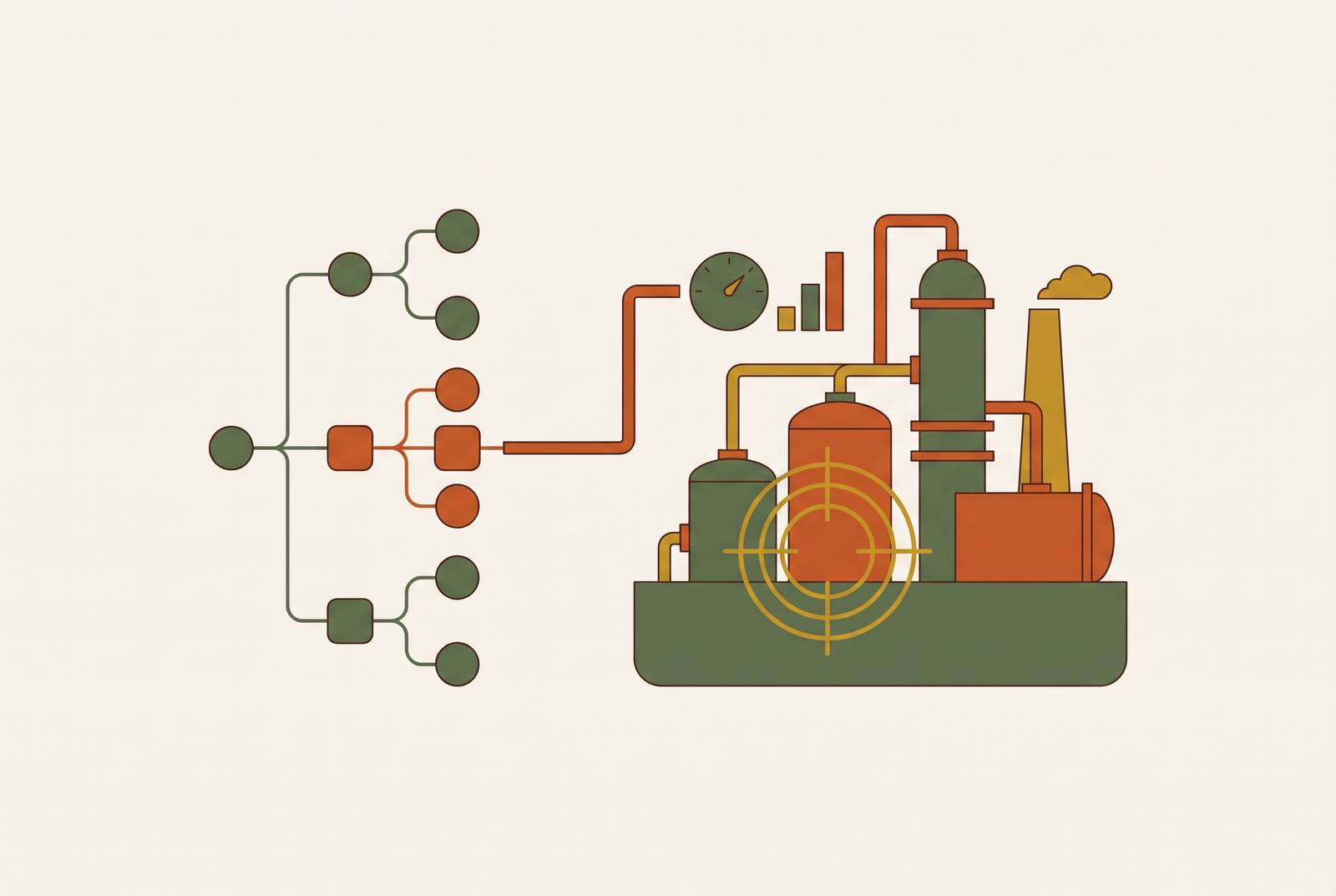
Plant-level manufacturing intelligence for industrial sales teams describes what a facility produces, the processes and equipment it runs, and the conditions that shape its chemical purchases. SIC and NAICS codes establish the prospecting boundary, but a product must fit a facility’s plant operating profile. For chemical suppliers, effective retargeting connects that operational fit to a purchasing trigger and the people who control the specification.
Why SIC codes still matter as a first filter for chemical supplier prospecting
SIC codes are still useful because they appear throughout the records chemical sales teams use to find manufacturers. Supplier databases, credit files, safety records, SEC filings, and prospect lists retain them, even though the federal government adopted NAICS as the federal statistical standard in 1997. A supplier can define an initial manufacturing universe without first researching every facility’s operations.
The OSHA SIC Manual places manufacturing in Division D, covering major groups 20 through 39. That range sets the outer boundary for chemical suppliers, from food plants to miscellaneous manufacturers. The SEC’s SIC groupings also allow suppliers to identify public-company filers by primary industry. For named-account research in chemicals, fabricated metals, or transportation equipment, this is a legitimate shortcut. It establishes which businesses belong in the initial search.
Within that boundary, the hierarchy separates broad markets into more useful purchasing categories. SIC 28, Chemicals and Allied Products, includes SIC 2851, Paints, Varnishes, Lacquers, Enamels, and Allied Products, and SIC 2891, Adhesives and Sealants. These categories imply different buyers, process chemistries, and value propositions. For code-based targeting, the four-digit level is the practical floor.
Where the SIC hierarchy runs out — the gap between classification and process reality
The limitation begins when a supplier needs to identify a production process. SIC 2899, Chemicals and Chemical Preparations, Not Elsewhere Classified, includes boiler compounds, metal-treating compounds, water-treating compounds, rust-resisting compounds, heat-treating salts, and foundry chemical supplies. Those outputs signal real purchasing categories. The code does not establish which activity a particular plant runs, however, so it cannot establish the plant’s need for a particular chemical.
The same distinction applies within metal manufacturing. SIC 34, Fabricated Metal Products, Except Machinery and Transportation Equipment, places a sheet metal enclosure shop and a valve manufacturer under the same broad category despite their different tolerances, quoting cycles, buyers, and chemical purchases. Two plants with the same four-digit code can still need different chemistry because they run different operations. A stamping operation and a high-speed CNC precision machining operation illustrate the importance of the process.
An ideal customer profile built from industry code, revenue band, and employee count therefore describes only part of what a supplier needs to know to qualify an account. That view leaves out process type, installed equipment, certification status, and purchasing triggers. Closed-won deal analysis can expose shared operational characteristics that were never captured in the CRM. Without it, a representative must discover which facility actually runs the process that needs the product before a filtered prospect becomes a qualified account.
What a plant operating profile actually contains and why each element is a purchasing signal
A plant operating profile connects an account record to the operating conditions that govern chemical demand. Corporate structure shows the parent entities, subsidiaries, and operational headquarters, which helps teams work out who controls buying and whether a plant is part of a larger customer relationship. That distinction shapes the scope of the opportunity. An account with a standalone facility differs from a multi-site relationship that offers a chance to cross-sell. The production profile then adds what the facility makes, how much it makes, and whether it operates make-to-stock or engineer-to-order, which helps explain consumption rates and demand patterns.
Machine tooling brands, equipment age, and asset type help identify the fluid specification required by the operation. A plant running high-speed machining of aerospace alloys signals demand for synthetic, oil-free metalworking fluids, while a job shop doing ferrous stampings signals mineral oils, rust inhibitors, and drawing compounds. The software environment adds another purchasing dimension because ERP, MES, and PLM systems signal procurement process maturity and the possibility of integration with digital purchasing workflows.
Certifications help define the qualification burden before a product can be considered. ISO 9001, AS9100, and IATF 16949 address process documentation, traceability, and supplier management rather than directly prescribing chemical formulations. Chemistry restrictions come from separate regulatory requirements and schemes that apply to the plant. An AS9100-certified aerospace supplier faces tighter material compatibility requirements than an uncertified general job shop, narrowing the relevant product set before the first call.
Facility footprint and active capital events add scale and timing to that technical picture. Square footage and capacity utilization help show the scale of the production opportunity, and high utilization can point to demand in the near term while making it harder to change suppliers mid-run. Timing changes the commercial approach as well as priority. Expansions, line additions, and new product introductions identify plants approaching a chemistry specification decision for new equipment. Together, these fields distinguish a routine maintenance conversation from an opportunity to influence a new production requirement.
How regulatory change turns plant-level data into an urgent retargeting trigger
Accelerating regulatory action against PFAS and chlorinated paraffins makes current fluid chemistry a time-sensitive targeting signal. Manufacturers running affected formulations represent a defined opportunity for replacement products, whether or not they have begun a supplier search. Industry classification cannot identify that exposure on its own. The relevant fact is the chemistry in use at the facility, combined with the process that a replacement must support. This turns operational data into a way to identify accounts whose need is being driven externally.
Replacement economics can also differ sharply from the existing purchase pattern. Some plant operations that switched to non-chlorinated metalworking fluids reported fluid usage increases of a factor of 10 to 20, a range specific to their experience, because replacement products had shorter service lives. It does show why the opportunity cannot be assessed only as a formulation trial or a comparison of unit prices. Consumption volume and fluid performance can reshape the account economics.
Suppliers that invest in fluorine-free chemistry, bio-based base stock development, and advanced fluid monitoring systems are well placed to meet these replacement needs. Their commercial opportunity nevertheless depends on locating plants using affected products. Chlorinated solvents used in cleaning and certain biocides used in cooling water treatment can also lead to prospects that need to buy because of regulatory action. Plant-level intelligence connects the affected chemistry to the facility without assuming that every account in its industry faces the same requirement or timetable.
How Quaker Houghton and Element Solutions use process-level account intelligence to drive cross-sell at scale
Quaker Houghton’s commercial model links fluid and surface-treatment performance to manufacturing economics. Technical service and formulation knowledge support the relationship where the supplier understands how its chemistry affects production outcomes. That understanding also supports growth within existing accounts. The company’s strategy emphasizes wallet-share expansion through additional products, applications, and services across customer footprints. Finding those opportunities requires a map of the processes already present in the relationship.
Quaker Houghton’s April 2025 acquisitions of Dipsol Chemicals Co., Ltd. and Natech, Ltd. expanded the products available for that approach. Natech is a manufacturer of surface treatment chemicals for industrial applications. The company framed the acquisitions as “providing ample opportunity to cross-sell and meet the evolving needs of the Company's global customers.” Its CEO also stressed cross-selling newer technologies and making brand positioning clear.
Eastman Chemical illustrates how customer interactions can supply the intelligence behind the next sale. Eastman extracts insights from salesforce call notes to identify cross-sell opportunities, understand competitor positioning, and benchmark prices. The accumulated account record becomes a prospecting asset.
Element Solutions provides a reinforcing example through its Specialties segment, which connects product categories to manufacturing processes across aerospace, automotive, construction, consumer electronics, and oil and gas. The commercial connection is to production steps within those markets. An industry category identifies the customer’s broad setting, but it does not identify every application the supplier can serve.
What the buying committee looks like at a manufacturing plant and how process knowledge changes who gets called
Industrial chemical buying committees span engineering, operations, quality, procurement, and finance. Procurement alone does not define the technical specification. Engineering and operations decide whether a product suits the process, while quality requirements set the work needed for documentation and supplier management. Even when a product suits a prospect’s process, a sales conversation can fall short if the representative speaks only to the person who manages the purchase.
The entry point also shifts with purchase size. Smaller chemical purchases go through the plant manager, mid-range purchases go through the operations director or VP, and larger contracts involve corporate procurement. How much the plant makes and how complex its products are help teams work out that route before the first call. Corporate structure then shows whether the discussion is with one plant or is part of a wider account relationship.
For sales execution, the lesson is to use that context to shape the opening conversation. Knowledge of high-speed machining of aerospace alloys and AS9100 certification supports a discussion of fluid stability and material compatibility with a process engineer. Account-based marketing aimed solely at the financial decision-maker is weak in manufacturing when engineering and operations have already defined the specification. Call records can preserve this process context so that the next contact begins with a more relevant understanding of the plant.
Where can industrial sales teams find plant-level data and build it into targeting?
Plant-level data comes from operational enrichment, specialized manufacturing intelligence platforms, and the records built up through contact with customers. Each supplies a different part of the profile. Enrichment adds machinery specifications, facility footprints, compliance standards, and procurement contacts to raw prospect records before technical sales teams spend time on custom quoting. Customer call notes add details about the process, competitors, and possible chances to cross-sell. These inputs extend company-level firmographics into information a representative can use to qualify a facility.
Industrial Info Resources’ GMI platform is one of these specialized intelligence tools. It tracks the lifecycle of assets, projects, and contracts across global chemical sectors, providing continuously verified capital and maintenance activity. Its use case is opportunity timing and decision-maker access. That differs from a classification database, which establishes the initial account universe, and from a CRM, which organizes the account information supplied to it.
For a chemical sales team, the workflow starts with a SIC or NAICS filter to establish the outer boundary. Plant operating profile data then qualifies facilities within that universe, while regulatory and capital-event signals determine priority. Deal size and buying committee mapping guide the sales motion. This sequencing places discovery work in the data layer rather than leaving every representative to reconcile systems and assemble the same context manually. The CRM brings together what teams know about process fit, when to approach the account, and who to contact.
Teams also need to keep checking the data in that workflow because plant conditions change. Equipment is replaced, certifications lapse, and capital projects move through lifecycle stages. The targeting record must remain connected to those changes so that a previously relevant account is not approached on an obsolete premise. The decisive improvement is not a longer prospect list, but a current explanation of which plant needs which chemistry, why the opportunity is timely, and who must evaluate it.