Why SIC and NAICS Codes Fail Chemical Sales Teams and What Facility-Level Enrichment Fixes
Facility-level data reveals what plants actually produce and buy.

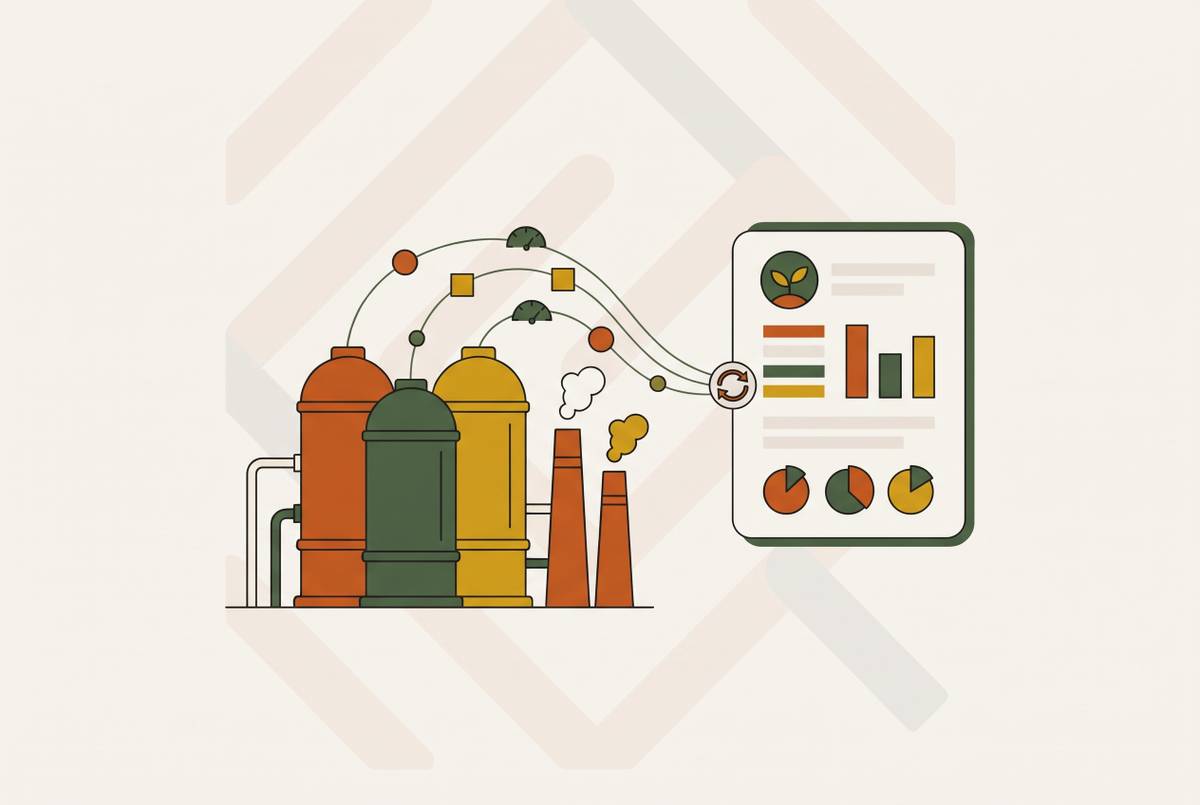
Salesforce and HubSpot enrichment with real manufacturing facility data means adding plant production activity, equipment, shifts, compliance requirements, and demand signals to company records. SIC and NAICS codes cannot supply that purchasing context because they classify economic activity. For chemical sales teams, facility-level enrichment turns a sector-based list into accounts that can be qualified, ranked, and routed around what each plant actually makes, runs, and buys.
What SIC and NAICS codes were built to do, and what that means for a sales team
Standard Industrial Classification, or SIC, uses four-digit codes to group establishments by the kind of work they do. The North American Industry Classification System, or NAICS, uses six-digit codes and was introduced in 1997 to replace SIC for federal statistical programs. SIC organizes activity into divisions, major groups, industry groups, and individual industries, while NAICS adds subsector and national-industry layers. Those layers provide finer distinctions within the economy. They do not describe purchasing behavior, readiness to buy, or production intensity.
SIC was last updated in 1987, but it has not disappeared from commercial records. The SEC still files public companies under SIC, and legacy credit databases, safety records, and many commercial CRM datasets retain it. Chemical sales teams therefore encounter both systems, sometimes within the same account workflow. Age is only part of the problem. Even an up-to-date NAICS code assigned to the right business is part of a system built for governments and statisticians, while a seller needs to know what an individual plant needs to buy.
Why the codes break down at the level where chemical sales actually happens
A two-digit SIC major group is too broad to route chemical sales accounts reliably. SIC 28, “Chemicals and allied products,” includes industrial chemicals, plastics, pharmaceuticals, paints, and soaps. Those businesses buy on different cycles and have different people who decide what to buy. Going deeper into six-digit NAICS narrows the category, but it still does not identify a plant’s equipment, production processes, or operating intensity. Greater classification detail is not the same as operational detail.
A holding company, distributor, or sales office can have a manufacturing-related code even when the location being targeted does not produce anything. The distinction is fundamental for consumables and specialty chemistry. An industry label does not establish that the location uses the product a representative wants to sell.
Many commercial platforms assign codes through keyword analysis of website content, so a business “providing industrial solutions” may receive a manufacturing NAICS code even if it is a distributor. SIC-to-NAICS crosswalks are not one-to-one, and a broad SIC category may map to several NAICS options while several SIC categories may collapse into one NAICS code. Merging legacy credit files with newer datasets can consequently produce classification drift that reduces account-profile accuracy.
How code-level gaps translate into lost revenue for chemical and metalworking-fluids sales teams
Territory mismapping begins when a corporate record substitutes for the plants beneath it. For consumables and specialty-chemical sellers, purchasing happens at the plant, so a multi-plant OEM represents several account opportunities under one headquarters address. Enriching only that address compresses distinct facilities into a single record and misdirects coverage. The plants left out can include those that are expanding. Representatives may then miss purchases already under way because the CRM leaves out plants the company runs.
Cross-sell and upsell opportunities can also be lost when records hide how plants differ in the way they work. A plant running three shifts loads equipment harder, replaces consumables faster, and buys more specialty chemistry than a single-shift site with the same NAICS code. The code treats both sites alike. Shift patterns, equipment load, and machining process type distinguish their likely consumption, but none is visible in the classification. Within an existing account base, disconnected CRM data and distributor channel opacity further obscure opportunities that sales and marketing teams could otherwise pursue.
Contact selection compounds the loss because codes classify activities. The right contact for a metalworking fluid depends on the plant’s purchasing process, while generic contact records may direct outreach to corporate buyers or titles that do not control the purchase. Operational knowledge makes role selection more precise. The sharpest example is NAICS 336111, automobile manufacturing, which does not reveal whether a plant still builds engine blocks or is moving to EV battery enclosures. The code can stay the same while fluid and additive requirements, supplier relationships, and procurement timelines change.
Why the metalworking fluids and specialty chemicals markets make precise account intelligence unusually consequential
Metalworking fluids and specialty chemicals are segmented by process type in ways that directly shape purchasing decisions. Knowing the kind of machining a plant does gives a seller more to work with than its industry category alone. Process knowledge changes the starting point of a conversation. A seller who knows the work being performed can assess chemistry and consumable requirements, while a seller relying on a code must first establish whether the assumed application exists.
Automotive electrification makes those differences harder to infer from historical classifications. Automotive manufacturing accounts for a large share of metalworking fluids demand, but EV production reduces some engine-related machining while increasing work on battery housings and lightweight alloy components. An automotive label cannot identify which side of that shift a facility occupies. Sellers need to know what happens at each plant to tell where demand for one application is falling and where demand for another is growing.
Changes in what suppliers offer also affect how they compete as production shifts. Quaker Houghton announced acquisitions including Dipsol Chemicals and Natech Ltd., as well as automation technology launches. These moves are not evidence that every manufacturing account is reconsidering its suppliers. A competitor’s expanded capabilities can create a reason to reassess an account, but identifying an opening requires knowledge of which facilities use the affected processes and whether their equipment or production plans are changing.
How to enrich Salesforce and HubSpot accounts with real manufacturing facility data
Facility-level enrichment replaces a categorical approximation with fields that describe the production site. The first field is what the plant actually makes, recorded separately from the parent company’s primary business. Equipment type then connects that output to machinery and its chemistry or consumable requirements. Shift patterns and production volume add operating intensity. These fields let a chemical sales team judge application fit and how much a plant is likely to use before a representative spends time on it.
Environmental footprint and compliance obligations also set limits on which products a plant can use. Plants subject to VOC or PFAS reporting have constrained formulation choices that a supplier needs to understand before proposing a product. Certifications add the quality and environmental standards procurement will require. These are not merely descriptive account attributes. They help distinguish a commercially relevant formulation from one that does not meet the plant’s requirements, even where the production process otherwise appears suitable.
Trigger-event fields show when the account may be ready to buy. Facility expansion, equipment procurement, engineering hiring spikes, and ERP or MES migrations can signal new demand or a possible change of incumbent supplier. ERP and MES technographic data also serves as a qualifying gate because a modern system and a legacy on-premises MES imply different procurement sophistication and integration requirements for a supplier’s service platform. System context complements the physical production picture. When CRM firmographic data and ERP order data are not aligned on account identity and pricing, representatives also lack a dependable view of existing account volume.
The CRM structure must preserve the distinctions enrichment reveals. A parent account for the corporate group, with child records for each plant or subsidiary, allows activity and revenue to roll up without hiding separate production sites. This is the structural repair for territory mismapping. The same structure is needed when enriched records go into Salesforce, HubSpot, or Dynamics 365, though a list of fields alone does not show that a tool updates those systems automatically. AppendSolutions distinguishes purpose-built industrial sourcing through official registries, customs databases, and trade association memberships from keyword inference, making sourcing method another concrete criterion for evaluating enrichment.
How codes and facility-level data work together in practice — and where codes still belong in the workflow
Codes remain useful for defining an ideal customer profile and estimating the market within it. SIC 28 and the NAICS categories for the sector set the bounds of a list and save time when building it. Teams go wrong when they treat an account’s sector as enough to judge it for account qualification, territory routing, or pre-call research. Those decisions need facts about each plant that the classification systems were never built to hold.
A company may have years of customer data organized around SIC, and replacing those labels without improving targeting does not improve the sales process. NAICS nevertheless offers finer granularity and is the current federal standard for new workflows. Esri’s Business Analyst migration to NAICS-only in its June 2026 release reflects that direction. The practical response for SIC-dependent teams is to migrate while preserving useful historical relationships.
Four-to-six-digit codes define the sector boundary and support an estimate of total addressable accounts, while production activity, equipment, shifts, and trigger events support ranking and qualification. Facility identity and account hierarchy then support routing. This division shows what a code-based list can and cannot tell the team before representatives start reaching out. Codes open the door, and facility data tells the team what is on the other side.
Building a qualification process that starts with codes and ends with plant-level truth
The practical recommendation is to begin ICP definition and market sizing with four-to-six-digit NAICS codes, retaining SIC equivalents where legacy records require them. The selected sectors and subsectors should match the product’s chemistry and application requirements. Codes are reliable at this stage because broad market boundaries change slowly. Their role is to define the initial audience for subsequent qualification.
Facility verification and deduplication should come next, before production fields are appended. Each record needs to correspond to an actual production site rather than a holding company address, distributor, or corporate office. Each plant should then have its own child-account record under the parent. This exposes the multi-plant OEM hidden inside one entry. It also preserves independent purchasing decisions that would otherwise disappear when records are grouped only by corporate identity.
Production-reality enrichment should then append actual output, equipment, shift patterns, environmental and compliance profiles, and certifications. These fields establish application fit and likely consumption. Trigger monitoring should build on that profile through facility expansion announcements, equipment procurement signals, engineering hiring patterns, and regulatory filing changes. A suitable plant becomes a more immediate opportunity when its operating changes indicate that it is creating demand or evaluating suppliers.
The final step is to push enriched, ranked facility records into Salesforce, HubSpot, or Dynamics 365 with account hierarchy intact. Territories should be assigned based on manufacturing density and how much each account could buy as well as geography, while representatives get the facts about production they need to prepare for calls. Existing accounts belong in this process too. Their equipment, operating intensity, and order history can expose cross-sell opportunities that a corporate record conceals. The resulting pipeline is organized around the plant that consumes the chemistry, the conditions governing its purchase, and the changes that make a sales conversation timely.