Marketing Plan Template for Manufacturing Suppliers
Target plant-floor operations, not company profiles, to find real buyers.
A marketing plan for a manufacturing supplier fails the moment it treats an industry vertical or a sales region as the unit of analysis. The right unit is the plant floor: a specific building running a specific process on specific gear, at a specific volume, that either buys what you sell or doesn't. I've watched good sales teams burn a whole quarter chasing accounts that looked right on paper and turned out to run nothing close to what they sell. That mistake is where this piece starts.
What the industrial buyer actually looks like before your rep calls
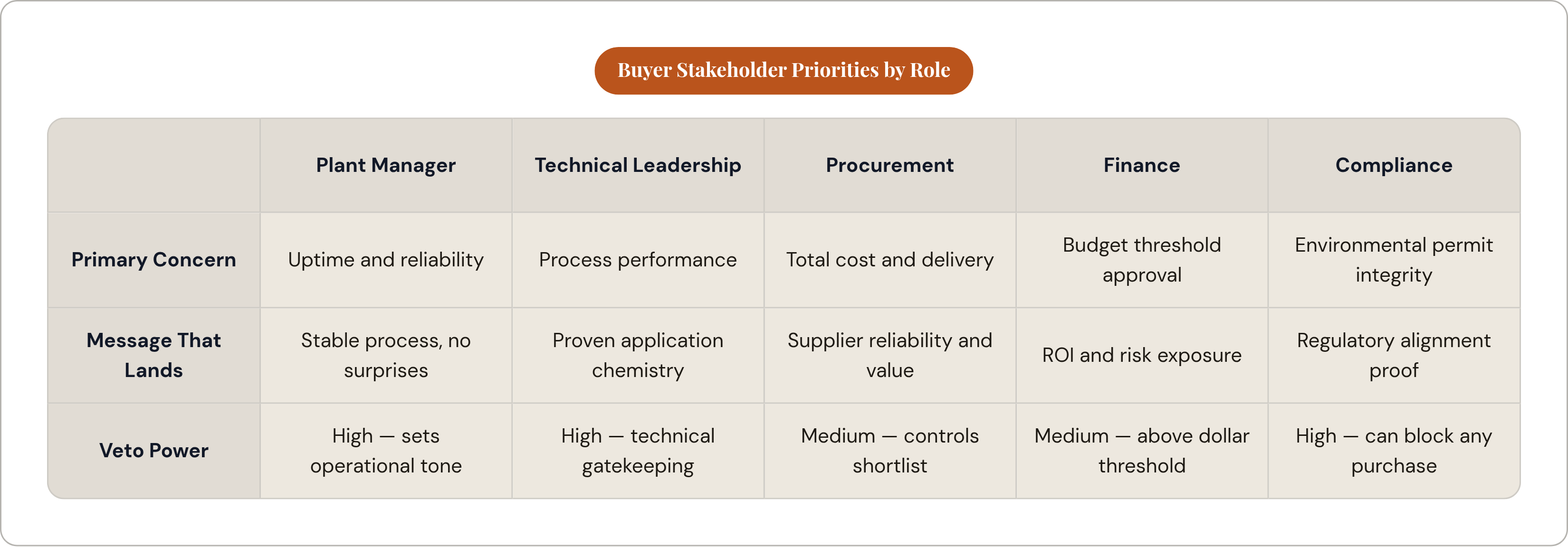
Purchasing authority in a manufacturing account rarely sits with one person. A plant manager cares about uptime. Technical leadership wants to know if a material or chemistry actually performs on their line. Procurement watches total cost and delivery, finance signs off above a certain dollar threshold, and depending on the facility, someone in compliance can veto anything that touches an environmental permit. Most U.S. manufacturers are privately held, so real decision-making tends to sit with a small circle of owners and plant managers instead of a formal purchasing department. That doesn't make the buying process any less cross-functional. It just means the circle is smaller and harder to see from outside the building.
By the time anyone in that circle picks up the phone for your rep, they've already done most of the work. They've searched, compared, and probably built a shortlist. This is the central fact of industrial selling: if the visible sales cycle looks short, that's because the invisible research phase already ate most of the calendar. The plan's job is to win that invisible phase.
Industrial buyers don't search the way a generic B2B buyer does. They type in material grades, spec tolerances, process names, a number pulled straight off an engineering drawing. Nobody googles "metalworking fluid supplier." Someone searches "coolant for high-speed aluminum machining," and the moment they start typing usually traces back to something happening on the floor: new equipment coming online, a compliance deadline creeping closer, an expansion, or a supplier relationship gone sideways. Suppliers who catch that trigger early get a seat at the table. The ones who find out when the RFP lands are already behind, and no product is good enough to close that gap alone.
Defining your ideal customer at the plant level, not the company level
Company size, revenue band, industry vertical: these filters tell you who to exclude more than who to pursue. Take a parent company running six plants. One stamps automotive body panels; another, down the road, assembles similar-looking metal components, and the two share nothing but a logo. Same NAICS code, same corporate parent, completely different process, completely different chemistry and consumable needs. A plan built at the company level misses that split every time. One built at the plant level catches it on the first pass.
The traits that actually predict fit live at the facility: what the plant makes, what equipment sits on the floor, how many lines run and on how many shifts, what rules govern its waste stream and emissions, what throughput looks like on an ordinary week. Throughput and shift count aren't just descriptive color. They signal spend directly. A single-shift job shop and a three-shift stamping plant running the same equipment need the same product, but they buy it in wildly different volumes, and pricing a proposal without knowing which one you're talking to is a guess dressed up as a quote.
SIC and NAICS codes still earn a place in the process, mostly for ruling accounts out. Pull any raw NAICS list for a specialty chemical or metalworking fluid category and you'll get contract manufacturers, distributors, component makers, and OEMs all mixed together under one code, with the real buyer maybe a fraction of the total pull. The ICP exercise should end with a paragraph describing a facility, not a company: what it runs, what it makes, what that implies it needs from a supplier. That paragraph, more than any spreadsheet filter, is what sharpens targeting, territory design, content, and account selection downstream.
How plant-level data turns market sizing into a workable target universe
Specialty chemicals and metalworking fluids are both large markets, and both are growing. That fact does little on its own, because market size answers a different question than the one a sales team needs answered. The gap between total market size and addressable opportunity is the targeting problem, and it's where most marketing plans quietly fall apart before anyone notices.
Generic business databases return accounts by headcount and industry code, and neither field tells you what a plant makes or what chemistry runs through its process. Plant-level data reframes the question from "which companies sit in my industry" to "which facilities run a process that uses what I sell." A facility profiled by production process, equipment class, and output type gets matched directly against a supplier's product line, the way a machinist matches a tool to a job, not a category. Environmental and operational signals, waste stream type, permit status, sharpen that match further, either qualifying a facility or knocking it out of the list.
Commercial intelligence platforms built around facility-level indexing, profiling plants by what they actually produce and what activity they generate, give sales and marketing a target list grounded in real demand instead of loose industry adjacency. What matters at the end is a tiered account list, where Tier 1 means a match on process and equipment, not a shared SIC code. That list becomes the shared spine for territory planning, campaign targeting, and account prioritization. Skip it, and nothing downstream works.
Territory design built on manufacturing density rather than geography
Most industrial territories get drawn the way they've always been drawn: state lines, zip codes, drive times. Geography stands in as a proxy for opportunity, and it's a poor one, because manufacturing density doesn't spread evenly across a map. A cluster of qualifying plants might sit inside three counties while the surrounding several hundred miles hold almost nothing worth calling on.
A rep assigned "the Southeast" might spend half a year covering dozens of accounts with no process match at all, while a dense cluster of exactly the right kind of plant sits one county over, uncovered, sitting in someone else's territory or nobody's. Build the territory instead on where matching facilities actually cluster: process type, equipment class, production volume. The resulting map looks nothing like the org chart's regional boundaries. Hybrid models, geography layered with process type or vertical, show up more often for exactly this reason, and they tend to beat maps drawn on one dimension alone.
Territory design also has to be honest about rep capacity. How many reps you actually have, which roles sit open, how long a new hire takes to ramp before carrying a full book, all of it matters. Draw territories against projected headcount instead of real headcount, and you leave gaps, and competitors fill gaps fast. Facility-level signals, new plants, expansions, closures, equipment swaps, should feed a quarterly territory review, not sit untouched until next year's planning cycle. Better territory design has been shown to lift revenue without adding a single rep. The gain comes purely from coverage precision, from putting the right person in front of the right building.
Channel and content strategy mapped to a long buying cycle
Since most of the buyer's decision happens before a rep ever gets involved, marketing's real job is to show up, credibly, at every point along that self-directed research path. Content and SEO, email, LinkedIn, account-based campaigns, and a short list of trade events that actually matter: these work as one system. Treated as separate campaigns running in parallel, they mostly waste budget.
Content in manufacturing marketing has a known gap between plan and payoff. Most industrial marketers have a content plan on paper; far fewer would call it highly effective, and the usual reason is that the content doesn't match where the buyer stands or how they actually talk. Early on, the buyer is still defining the problem rather than shopping vendors, so educational material on process challenges, regulatory pressure, and application performance does the work. In the middle, they're building evaluation criteria and a shortlist, which calls for technical comparisons, case studies sorted by process type, and real formulation performance data, not marketing copy dressed as data. Late in the cycle they're managing internal consensus, and what moves that along is proof of compliance, help with implementation, and a reference from a genuinely comparable sub-vertical, weighed far more heavily than a generic logo wall.
SEO in industrial B2B rewards specificity. Ranking for a precise application query, a process name, a material grade, an equipment type, puts a supplier in front of a buyer at the exact moment they're working the problem, in a way category terms rarely manage. Account-based marketing pairs naturally with a facility-level target list: a campaign built around one plant's actual production context beats a broad vertical campaign built for nobody in particular. Trade shows still earn their keep for relationship maintenance and late-stage conversations, but they're a weak primary awareness channel for a buying cycle this long. Go-to-market motions that tie channels together and measure against pipeline, rather than judging by activity volume, tend to post higher win rates across B2B companies generally.
Messaging built around production context, not product features
Buyers on the plant floor respond to suppliers who can show they understand the process, not just the product category. "Our fluid extends tool life" is table stakes, a line every competitor already runs. "For crankshaft machining on cast iron at high volume, here's what changes" signals someone who has actually stood on a floor and watched the process run. That distinction earns attention in a way feature copy never manages.
Messaging has to flex along a few real axes. Process type matters, since machining, forming, and surface treatment behave nothing alike, and material matters just as much, since aluminum, steel, and titanium each carry their own handling and chemistry limits. Regulatory context matters too, because a facility facing PFAS restrictions is having a fundamentally different conversation than one that isn't. Stakeholder layer matters most of all: the plant manager wants uptime and compliance, procurement wants total cost and supplier reliability, and operations wants a stable process that doesn't throw surprises into the shift schedule.
A message written to satisfy all three at once usually satisfies none of them. Messaging aimed at each stakeholder's actual lens builds the internal consensus that closes deals; an averaged message just gets ignored by everyone in the room.
Purchasing triggers should set the timing and the angle. A plant that just installed a new machining line is having a different conversation than one quietly reviewing its incumbent supplier's contract. Plain-language technical writing, aimed at a plant manager who knows the process cold but isn't reading a data science report, beats jargon-dense or analytics-heavy copy in outreach, almost without exception. On the floor, clarity reads as competence.
Growing existing manufacturing accounts by reading what a plant runs
The economics here are old news but still true: selling more to an existing customer succeeds far more often than winning a new one, and landing a new logo costs several multiples more than keeping and growing an account you already have. Most industrial sales teams still underexplore that opportunity, not from laziness but from a real blind spot. The rep often has no idea what else is running on that plant floor beyond the one product line they already sell into.
A facility-level account review closes that gap. It surfaces production lines the rep has never quoted, new equipment installed since the last contract cycle (which usually means new chemical or consumable needs nobody's flagged), regulatory shifts affecting the current product stack, and volume changes, up or down, that should be reshaping contract size. The useful question at renewal isn't "what else can we sell this company." It's narrower: what does this specific plant run, what part of that do we already supply, and where's the gap.
Account reviews triggered by real facility signals, an equipment addition, a new permit filing, a shift change, outperform reviews triggered by the calendar, because they're pegged to something that actually happened rather than the fact that a year passed. A CRM is only as good as the facility data feeding it. Records enriched with plant-level production context generate sharper outreach and better-qualified expansion conversations than records carrying nothing but firmographic fields like headcount and revenue.
Metrics that reflect whether the plan is working in industrial markets
Website traffic, MQL counts, email open rates: none of these hold up in industrial B2B, because none of them account for a buying cycle that runs long or a buying committee that runs wide. A plan needs metrics built for the actual shape of the sale.
Pipeline sourced from ICP-matched facilities matters more than total pipeline volume. A smaller number of well-matched opportunities beats a bigger pile of loosely qualified ones every time. Stakeholder engagement across the buying committee is worth tracking on its own, since deals pulling in multiple functions tend to close at higher rates than deals stuck with a single champion. Time to first meaningful conversation works as a leading indicator of whether content and outreach reach buyers before they've built a shortlist without you on it. Expansion revenue as a share of total revenue tracks whether the account growth work above is actually landing. Territory coverage, the share of qualified facilities in a territory that have actually been contacted, exposes the white space a competitor is quietly working while your team looks elsewhere.
Manufacturing marketing spend as a share of revenue has climbed sharply in recent years, and scrutiny on that spend will only tighten from here. Plans that trace budget to pipeline at the facility level are the ones that survive the next round of cuts; plans that can't will get cut first, regardless of how the campaigns actually performed. Territory and account data deserve a review every quarter at minimum, not once a year, since facility-level signals move faster than the planning calendar. A plan reviewed once a year is stale for most of it. Signals that generate pipeline should feed straight back into ICP refinement, territory adjustment, and content priorities, on a loop that never really closes.