How to Build a Sales Strategy When Your Customers Are Manufacturers
Build territory plans around what plants actually produce, not industry codes or headcount.

Selling to manufacturers is not just harder B2B sales. The buyer, the buying process, and the kind of evidence that earns trust are all structurally different from what a generic B2B sales playbook assumes, and a strategy built on that playbook will misfire at nearly every stage.
A B2B sales strategy targeting manufacturers has to be built around three structural realities that generic playbooks ignore. First, the average industrial buying committee runs to 13 participants, each evaluating a proposal against different criteria, so the selling effort has to carry multiple proof formats simultaneously and actively help the buyer's own stakeholders reach internal consensus. Second, territory design has to be organized around what each facility actually produces and what that production implies it needs to buy, not around NAICS codes, headcounts, or geography, because those proxies cannot distinguish a live prospect from a facility that will never close. Third, the first call should start from a specific, process-informed premise rather than a discovery exercise, which requires verified plant-level contact data matched to real production signals before any outreach begins.
What should a B2B sales strategy targeting industrial or manufacturing companies look like?
Who is actually making the decision is the first difference. Forrester's 2024 research puts the average industrial buying committee at 13 internal participants, spanning engineers, procurement officers, operations leaders, and executives, and each of them evaluates a proposal against a different set of criteria.
How those people test what a seller tells them is the second difference. Engineers do not respond to persuasion the way a marketing-qualified lead might; they check a claim against application compatibility, material specs, performance tolerances, and integration requirements before they decide whether the rep understands the plant. Generic copy, the kind that could describe any supplier in any industry, gets filtered out almost immediately because it signals the opposite of competence.
The third difference sits in the economics of the deal itself. Industrial sellers typically work high-value, low-volume accounts, and a handful of facilities can make up most of a territory's revenue. Chasing lead volume, the metric that works for a high-velocity B2B motion, produces exactly the wrong pipeline here: more contacts, not more of the right contacts, and a funnel that looks busy while missing the handful of plants that would actually move the number.
Put together, these three differences don't just make manufacturing sales more complicated. They describe a different kind of selling problem, one where the committee, the verification standard, and the deal shape all demand a purpose-built strategy rather than an adapted one.
The industrial buying committee
It fails deals because its members frequently disagree with each other, and that disagreement is something a seller can either leave alone or actively manage. Gartner's 2025 survey found that nearly three-quarters of B2B buyer teams had unhealthy internal conflict, and when the groups reached consensus, they were far more likely to report a high-quality deal. That finding reframes what a sales team is responsible for, and internal alignment among the buyer's own stakeholders is not something to wait out; it's a problem the seller has to help solve.
Part of solving it means recognizing that the person who first gets excited about a product is rarely the person with the authority to approve its purchase. Modelon, which builds simulation software for aerospace, automotive, energy, industrial equipment, and related sectors, ran into this directly. Its marketing reached engineering managers with messages built around cloud collaboration and team productivity, and those messages were well-suited to the approver, but they were not the messages that had originally driven the tool's adoption among the engineers actually using it. The advocate and the approver are two different jobs with two different sets of concerns, and treating them as one audience means writing a message that half-fits both and fully convinces neither.
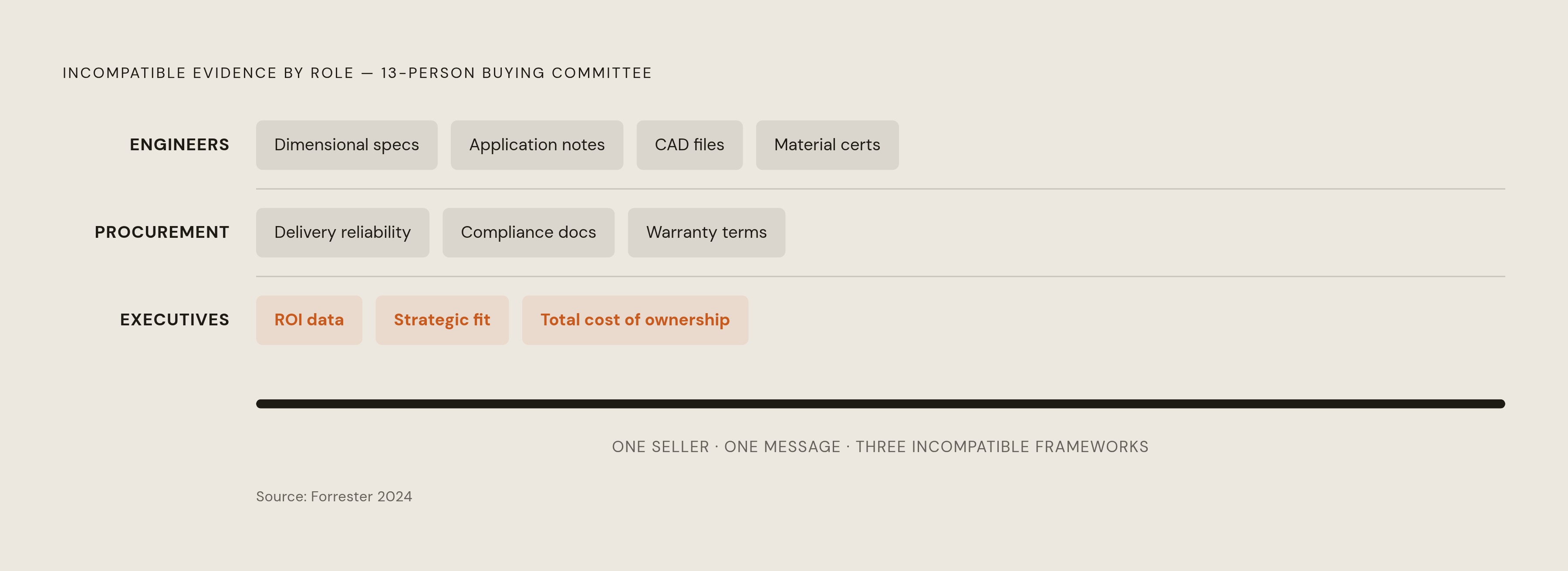
Each role on the committee needs a different kind of proof. Engineers want dimensional specs, application notes, material certifications, CAD files, and detailed product documentation, and they can tell within a few sentences whether the person writing understood the application or is guessing. Procurement wants delivery reliability data, compliance documentation, warranty terms, and the total cost of acquisition. Executives want ROI data, strategic fit, and total cost of ownership. None of these audiences will accept the other's evidence as a substitute for their own.
Insulgard's experience shows what it costs to get this mapping wrong. Its marketing was built around building owners, the people who write the checks, while architects, who specify glazing choices years before a building owner is ever meaningfully involved, were the real point of influence. By the time the check-writer entered the conversation, the decision had effectively already been made elsewhere. The deal was won or lost long before the audience Insulgard was targeting had any say in it.
The practical conclusion is that a sales strategy for manufacturers has to carry multiple proof formats and multiple entry points at once, and it has to do the coalition-building inside the account that moves a fragmented committee toward consensus. A single rep with a single contact at a plant cannot cover a 13-person committee with incompatible evaluation criteria. That's a structural mismatch between the size of the buying group and the size of the selling effort, and no amount of rep skill closes it on its own.
Territory planning built on plant-level reality
If the buying committee is the first place generic sales logic breaks, territory design is the second, and it breaks earlier in the process than most sales organizations notice. You can't build a territory plan on NAICS codes, headcounts, or geographic boundaries and still tell which facility actually buys what you sell and which one just shares its industry classification, so rep capacity ends up allocated on a proxy that was never built to measure buying likelihood.
A NAICS code describes what category a company sits in and a headcount describes its rough size, but neither one says what a specific plant makes, what equipment runs the floor, what processes generate purchasing demand, or what the plant is already buying and from whom. Two plants can share the same NAICS code, sit in the same city, and carry roughly the same headcount, and still have completely different production realities: one is a live prospect and the other isn't a fit at all. A territory plan that treats them as equivalent ends up overinvesting rep time in the account that was never going to close while underinvesting in the one that would have.
The problem compounds in multi-product manufacturing sales, where territories are often segmented by product category rather than by geography alone. That kind of segmentation only works if someone knows what each facility makes, because if a plant gets assigned to the wrong category, the account is misrouted from the start.
The standard that holds up is mapping opportunity density by what plants actually make and what that production implies they need, not by zip code or SIC code. That's a different kind of territory map entirely, one organized around production reality rather than administrative geography, and it's the only version that puts rep capacity where real demand actually lives.
What plant-level production data reveals
Once production reality replaces geography as the organizing principle, you can ask what that production-level view actually contains, and what it lets a sales team do that was not possible before. Plant-level data captures what the facility actually produces, no matter what category its parent company gets filed under. It captures the equipment and processes running on the floor, which points directly to the consumables, fluids, coatings, chemicals, packaging, or treatment products that plant needs to buy. It captures production volume and operational footprint, which signal how large a deal might be and how urgent it is. It also captures environmental and regulatory exposure, and that often creates a compliance deadline that forces a purchase decision on a timeline the seller doesn't control. And it captures real-time activity: production changes, expansions, new lines, regulatory filings, the signals that tell a rep a plant has just entered a buying window.
The commercial logic here is straightforward: process determines need. A plant running a specific machining process needs specific metalworking fluids. A plant coating a specific substrate needs specific adhesives. If a plant produces a specific food category, it faces specific water treatment requirements. Knowing the process means knowing the need before a rep ever picks up the phone, which turns the first call from a discovery exercise into a conversation that starts from an informed, specific premise.
None of that intelligence does anything without a direct line to the person who controls the budget at that facility. Verified contact data for plant-level decision-makers, operations VPs, plant managers, engineering leads, is the execution layer that turns a buying signal into an actual conversation. A correct read on a plant's process is only useful if there's someone to call.
For existing accounts, the ERP is an underused source of the same kind of intelligence. Connecting ordering patterns, service tickets, and inventory data to account records reveals churn risk and expansion opportunity that no external database can match, but only if the CRM is fed facility-level detail rather than company-level summaries. The scale of investment going into this kind of plant-level visibility shows how seriously the industry takes the problem: the data layer behind it is a fast-growing market, moving from its 2025 valuation toward a considerably larger projected scale by 2033.
How plant-level intelligence changes the account growth motion
The same logic that finds new customers also finds revenue inside the accounts a company already has, and most industrial sales teams leave that revenue unclaimed because they can't see it at the facility level. Account expansion is structurally more efficient than new-logo acquisition in industrial sales: the odds of selling something additional to an existing customer run well above the odds of converting a new prospect, and the aftermarket for parts and service is far more profitable than the initial equipment sale that opened the account.
Group customers by what they actually buy, compute the average spend profile by product family within each peer group, and look for accounts spending below their peers in a category they're already in, which marks an upsell, or buying nothing at all from a category their peers are active in, which marks a cross-sell. That analysis only works if the peer group is defined by production process rather than by company size or geography. It depends on knowing what each facility actually produces. A specialty chemical rep who knows a plant runs a specific polymer extrusion process can look at that plant's purchase history, compare it to what plants running the same process typically buy, and name the gap directly.
Mapping the full product portfolio against the customer base at the facility level, not the account level, turns "there's probably more we could sell them" into a list of specific, named expansion opportunities tied to specific plants and specific product families. That's a different kind of pipeline than the one most industrial sales organizations are working from, one built on structured comparison rather than a rep's memory of a relationship.
The expansion motion still depends on organizational alignment to function. Clear ownership and shared metrics have to exist first, so the mechanical whitespace analysis can turn into closed revenue. The metrics worth tracking here, separate from new-logo pipeline metrics, are expansion revenue, net revenue retention, attach rate for add-ons, time-to-upgrade, and pipeline velocity for expansion opportunities, and tracking them separately shows whether the motion is actually working.
CRM data quality and whether intelligence reaches the rep
Everything described so far, the committee mapping, the plant-level territory design, the production signals, the expansion whitespace, depends on one unglamorous precondition: the CRM has to hold accurate, current, facility-level records. A CRM filled with company-level records, outdated contacts, and generic industry codes does more than waste the intelligence you have. It sends reps to the wrong contact at the wrong facility with the wrong message.
Contact data decays constantly, and a meaningful share of any B2B database is wrong, outdated, or incomplete at any given moment. For an industrial sales team, that decay breaks the specific link plant-level intelligence depends on: the match between a verified buying signal and the actual person at that facility who controls the budget.
If you want a concrete place to start fixing this, do facility-level SIC and NAICS enrichment at the plant rather than the corporate level. It replaces manual research into whether a given plant belongs in automotive, aerospace, or medical device manufacturing with structured, verified classification, and that classification drives correct territory assignment, correct messaging, and correct product fit from the first touch.
CRM-ERP integration for existing accounts delivers this kind of data discipline's clearest return, visible at Litens Automotive, which put in Dynamics 365 Finance & Supply Chain Management alongside Dynamics 365 Sales, stabilized its warehouse and sales processes quickly, and gained real-time inventory visibility across multiple warehouses. That operational picture gave the sales team what it needed to win bids faster, because the rep quoting a deal could see actual inventory and fulfillment reality rather than guessing at it.
Fixing CRM data quality is not a one-time project. It requires ongoing enrichment rather than periodic cleanups, integration across multiple data sources to cross-check facility-level records against each other, and a feedback loop that lets reps flag bad data as it appears through AI-assisted tools. Only a minority of executives use CRM data for strategic decisions now, but that's not because CRM systems are flawed in principle. Most manufacturing CRMs just aren't built to reflect the facility-level reality an industrial sales strategy needs. Plant-level intelligence only produces results once the system carrying it to the rep is built to hold that kind of detail.
Applying this in the verticals where plant-level logic matters most
In certain verticals, plant-level intelligence gives you no edge over competitors who lack it. It's the baseline requirement for making a credible recommendation.
Specialty chemicals is the clearest case. The correct product recommendation depends on the substrate, the process temperature, the regulatory environment, and the production volume at a specific plant, none of which can be recovered from a NAICS code no matter how carefully it's read. A rep who understands a plant's process before the first conversation can walk in with a specific recommendation instead of a general one, and in a vertical where the wrong fluid or coating can fail outright under the plant's own operating conditions, that specificity is what earns the right to a second meeting. The same logic extends to any manufacturing vertical where what a plant runs determines what it must buy: the process is the data point that matters, and a sales strategy that can't see it is working blind.