Food and Beverage Plant Profiling for Ingredient and Packaging Suppliers
Suppliers should profile plants, not parent companies.
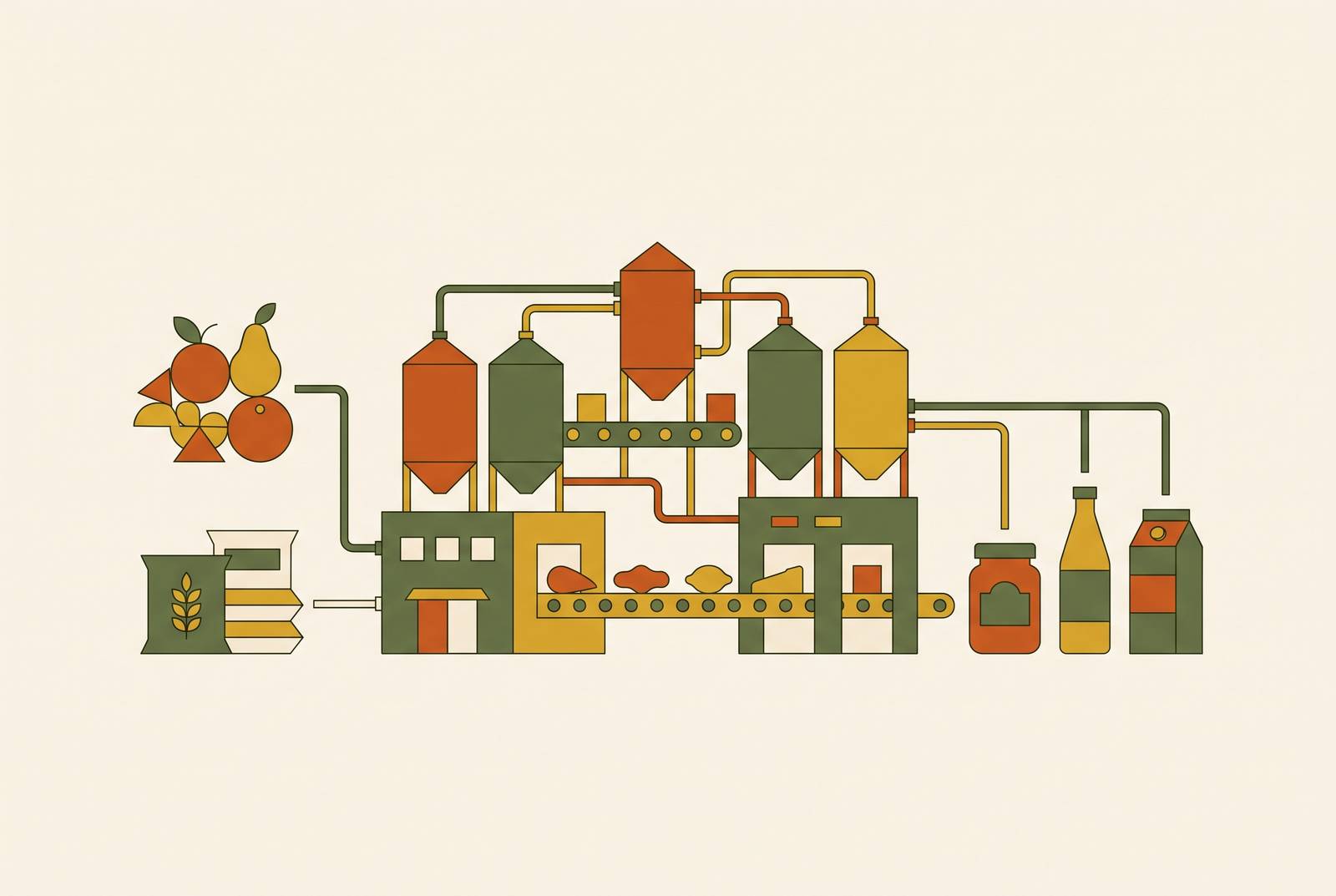
U.S. food and beverage manufacturing runs on roughly 3.5 million jobs and generated more than $534.3 billion in GDP. That scale hides a basic fact suppliers keep missing: the plant, not the corporate office, is where most ingredient and packaging decisions actually get made. Sell to the parent company and you're pitching a mailing address. Sell to the plant and you're pitching the place that runs a purchase order through its own budget, and most reps still get this backwards.
Most plants make more than one product, and facility size ranges from small regional operations to industrial-scale complexes. A single parent company can own five plants with five completely different production profiles, and each one buys differently. A corporate database entry telling a rep that "Company X operates 40 facilities" says almost nothing about what any one of those facilities needs to buy this quarter. Calling only on a corporate buyer misses the volume differences, the line-specific specs, and the reformulation work that happens at the plant level. Read the facility wrong, or skip reading it at all, and the call was never going to land.
What a plant's product mix immediately tells a supplier about what it buys
Product category is the single highest-leverage data point in the whole profiling exercise, and most reps skip it in favor of company-level facts that don't predict a purchase order. A beverage plant and a bakery plant aren't comparable prospects just because they share square footage and a parent company. Treating them as interchangeable wastes the call before it starts.
Look at what the plant actually formulates and the purchase list writes itself. A non-alcoholic beverage plant working with probiotics, botanicals, or plant-based waters is buying specialty ingredients right now, because consumer demand for functional ingredients translates into active procurement needs at the plant level, not as a line item in an annual report. A plant running protein-fortified SKUs needs pea, soy, or oat protein, plus binders and emulsifiers to hold the formulation together.
A dairy plant signals a need for stabilizers, preservatives, and packaging that holds up under refrigeration. A bakery adding a clean-label line needs natural flavorings, natural sweeteners, and preservatives that match that label promise. None of this stays fixed. Plants reformulate, drop SKUs, add SKUs, and shift category focus constantly, and every one of those moves resets the buy. The question is what the company does across a specific part of its footprint. It's what this specific plant makes right now, and what that forces it to purchase this quarter.
How production volume and line configuration determine packaging format and ingredient scale
Volume decides format, full stop. A high-throughput beverage line filling at industrial scale needs different packaging than a craft or co-manufacturing line running short batches, even if both plants technically make "beverages" under the same NAICS code.
Line configuration tells you even more, and it's the detail most reps never ask about. A plant running aseptic filling needs specific cleaning-in-place chemicals and high-barrier packaging materials, so one line type opens two separate supplier categories at once. A plant commissioning a new protein-fortified line triggers ingredient decisions (the proteins, binders, emulsifiers above) and packaging substrate decisions at the same time, often inside the same capital project. A dairy plant expanding cold storage is telling you, directly, that it needs more stabilizers and more refrigerant-compatible packaging.
Pack size is its own opportunity, and it's underused as a signal. Price pack architecture is pushing sizes toward both ends of the spectrum at once: bigger value packs, smaller single-serve formats, per Circana's 2025 CPG growth leaders report. Every new size is a new packaging spec, and every new spec is a potential new line item for a supplier already in the account or trying to get in. Packaging can run 10% or more of a product's retail cost, which makes it one of the most watched numbers in any plant's procurement budget. A rep who understands the plant's line configuration walks in already speaking to the number the buyer is under pressure to hit, instead of a deck built for nobody in particular.
The market shifts that are actively changing what plants need to buy right now
Private label is reshaping procurement, and suppliers still calling on national-brand buyers are fighting the wrong war. PLMA and Circana data put private label sales growth at 3.3% year over year in 2025, a record $283 billion, now holding 24% value share across food and beverage aisles. Packaging companies have noticed, and they're partnering directly with co-packers to catch that volume, because private label growth doesn't run through the same channels as national brand growth.
New product launches matter more for smaller manufacturers than most reps assume. Smaller manufacturers are disproportionately active buyers tied to launch cycles, not steady-state production, which makes them better prospects per call than their revenue alone would suggest.
Reformulation keeps working as a standing trigger, not a one-time event. Clean-label demand, plant-based growth, and tariff pressure on imported ingredients have pushed manufacturers into reformulation cycles and new regional sourcing relationships. That demand runs deeper than any single number can capture, but it explains the wave of beverage reformulation still moving through plant floors right now.
The non-alcoholic beverage category is consolidating fast, too, and the M&A activity inside that curve creates real procurement disruption. Celsius Holdings closed an $1.8 billion acquisition of Alani Nu in April 2025 (a net purchase price of roughly $1.65 billion after tax benefits), and Molson Coors took a majority stake in ZOA Energy for $53 million in November 2024. Acquisitions like these mean plant integration, line retooling, and a fresh procurement cycle, all detectable well before any of it shows up in a public filing.
Capital investment events as the earliest and most actionable prospecting signals
Plant-level signals beat intent data on timing, and it isn't close. Research from origami.chat found 73% of mid-market manufacturers started at least one digital transformation project in 2025, but only 11% of those projects showed up in traditional intent data platforms at the moment budget got approved. The real signal, hiring patterns, expansion announcements, infrastructure spending, showed up months earlier, and most reps simply weren't looking there.
Three confirmed 2024 examples make the pattern concrete. Nestlé committed $200 million in February 2024 to expand Purina PetCare manufacturing in Webster County, Iowa, a project that opens new ingredient and packaging specs the moment the expanded lines come online. Kikkoman committed $800 million across two Wisconsin facilities, meaning a full procurement setup built from scratch. Schwan's, under CJ Corporation, announced a new 700,000-square-foot facility in South Dakota in June 2024 to produce Bibigo-brand foods, expected to employ around 600 people. A new facility built for an Asian food brand carries its own ingredient and packaging requirements from day one, none of them inherited from an existing line.
Timing discipline matters more here than volume of leads does. The practical implication is to prioritize the most recent signals; anything older has likely already converted into an existing vendor relationship. Beyond the headline capital announcements, engineering hiring spikes, facility permit filings, equipment procurement activity, and leadership turnover in operations or procurement roles are all worth tracking at the plant level. A supplier who shows up after a plant has run three months of production on a new line is competing against whoever already won the business. A supplier who shows up when the permit gets filed is shaping the specification itself, and that's a different sale entirely.
Sustainability and regulatory mandates as plant-level specification triggers for packaging suppliers
Sustainability isn't optional anymore for a large share of F&B plants, and treating it as a soft, someday priority costs suppliers real accounts. Major brands have made public commitments to 100% recyclable or reusable packaging, according to Umbrex, and those commitments cascade down into active packaging retooling at the plant level, not just a line in a corporate sustainability report.
Materials suppliers are already moving to meet that demand, and some have been for a decade. Tetra Pak launched its Tetra Rex Bio-based carton, made from plant-based material, back in 2014-2015, earning independent bio-based certification. That's an old launch by now, and it proves regulatory-compliant alternative materials have been commercially viable for ten years running. The plants that still haven't switched are the ones worth profiling closely, because they're the ones still in transition, still deciding, still buyable.
Cost pressure is stacking on top of the sustainability push, not replacing it. Packaging Corporation of America put through a $70-per-ton linerboard increase (and $90 per ton on corrugating medium) effective January 1, 2025, to offset higher input costs. Plants are managing rising material costs and sustainability mandates at the same time, and that squeeze rewards a supplier who can solve both problems in one conversation instead of asking the plant to pick a side.
Consolidation is also narrowing who plants can even buy from, and that's an opening, not a footnote. The Smurfit Kappa and WestRock combination, plus International Paper's acquisition of DS Smith, has concentrated the packaging supply base considerably; in Europe, the top five producers now hold roughly 65 to 70% of capacity. Plants sourcing heavily from that consolidated base have a real incentive to diversify, and that incentive is an open door for specialist packaging suppliers willing to walk through it. Profiling a plant's current packaging spec, material type, recyclability status, any certification already earned, tells a supplier which plants are early in the transition and which have already committed elsewhere. That distinction decides which conversations are worth having at all.
How to build a working plant profile from the data points that actually drive purchase decisions
A usable plant profile comes from six data layers working together, not any single one in isolation, and skipping straight to firmographics is where most profiling efforts fail before they start.
Product category and SKU mix identify which ingredient and packaging categories are even relevant to the plant. Production volume and throughput set the format requirements, the order sizes, and whether the account is worth the sales team's time at all. Line configuration, meaning filling technology, processing method (aseptic, hot-fill, retort, freeze), and line age, tells a rep which chemical, ingredient, and packaging categories are actively in play. Reformulation and new launch activity open specific buying windows tied to clean-label transitions, protein fortification, or new SKU introductions. Capital investment and expansion signals carry the highest urgency of the six, since they're the earliest indicator available before a specification locks in. Sustainability and compliance posture, current materials, stated commitments, regulatory exposure, determines which packaging alternatives a plant is actually ready to evaluate versus which ones it'll ignore outright.
NAICS codes and headcount figures can't surface any of this, and leaning on them is the single most common mistake in plant-level prospecting. Two plants sharing an identical NAICS code can have entirely different ingredient and packaging profiles depending on what they make and how they make it. A profile built only on code and headcount is a profile built on almost nothing. Pulling all six layers together produces a shorter, prioritized list where every entry already carries the production context needed to open a conversation that matters, instead of a long list nobody has time to work.
How plant profiling changes the sales conversation itself
The opening minute of a call gets decided long before the call happens, by how much production context the rep carries in. A rep who knows the plant runs aseptic filling, is adding a protein-fortified line, and just filed a permit for a capacity expansion isn't pitching a generic deck. That rep is responding to a specific, current production reality, and the buyer can tell the difference immediately, usually inside the first thirty seconds.
Territory planning built around manufacturing density and production profiles consistently beats territory planning built around geography or headcount. Territory planning built on production context consistently puts reps in front of conversations where their pitch matches actual plant needs, rather than where the org chart happens to be tidy.
Profiling also compounds inside accounts a supplier already holds. A packaging supplier already on-site for one format can see which other lines in that same plant run formats it doesn't yet supply. An ingredient supplier already providing one input can spot which reformulation project just created demand for an adjacent one. Prioritizing signals from the last 60 to 90 days keeps the rep in front of specs that are still open, before an incumbent quietly locks the business down.
None of this produces a better list for its own sake. It produces a higher share of conversations that actually convert, because the rep's relevance to the plant's real situation gets established before the first call ever gets made.