Territory Planning for Specialty Chemical Distributors Versus Direct Sales Forces
Territory planning in specialty chemicals fails for a simple reason: distributors and direct sales forces are not variations on the same model, they are two different businesses wearing the same job title. The signals that tell a distributor where to focus will mislead a direct sales force, and the reverse is just as true.
Two Selling Models in the Specialty Chemicals Market
Both models persist because each one solves a problem the other one can't. Direct sales holds the relationship and the margin at the top of the market. Complex formulations require an engineer on-site, tuning fluid chemistry to a specific piece of machinery, and that kind of technical depth only works when the producer owns the account directly, controls pricing, and keeps the customer data in-house. A distributor selling a dozen product lines from a dozen principals cannot offer that depth to any single customer, and a producer trying to run that relationship through a reseller loses the thing that makes the account defensible.
Distribution survives for a different reason: a typical mid-sized manufacturer needs several specialty chemicals from several different producers, but the volumes are often too small to justify a direct sales call. That manufacturer also wants a short lead time and someone local who can answer a technical question without routing through a national account team. No single producer's direct sales force can profitably assemble that bundle for a small buyer, so distribution exists to break bulk, cover the last mile, and give technical guidance at a scale direct sales can't reach.
What results is not competition between two selling strategies but coexistence within the same commercial architecture. Many producers run both at once: distributors handle the long tail of small, frequent orders, while the direct sales team holds the handful of strategic accounts large enough to justify dedicated technical support. Each track answers to a different kind of demand, and that division is structural. Neither model is trying to replace the other, and neither one is likely to. The market is serious enough in scale to support both. Global chemical distribution reached $265 billion in 2024, growing at a 4.6% CAGR, with specialty chemicals now making up roughly a third of that volume as customers pay for technical service. That scale gives both models room to operate without crowding each other out. Territory planning has to be built separately for each one rather than treated as a single discipline with two names.
Defining "Territory": Distributor Model vs. Direct Model
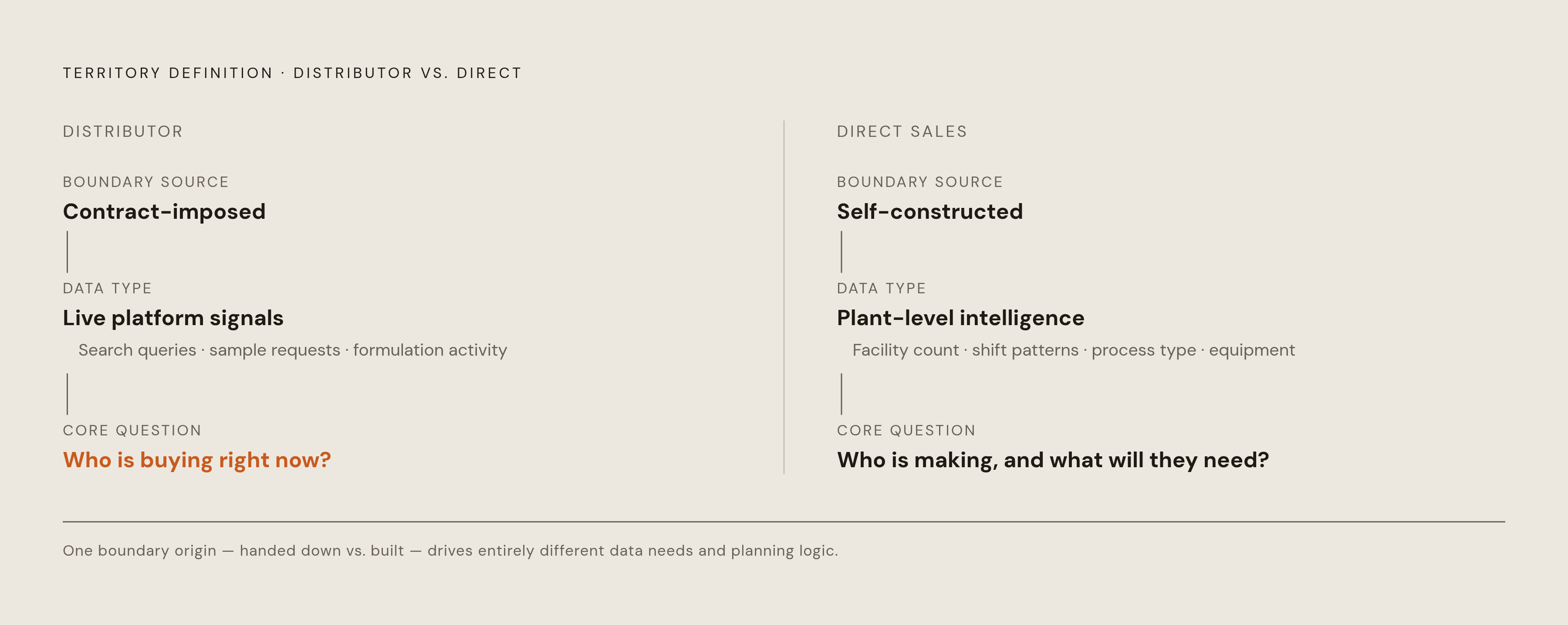
The word "territory" carries two unrelated meanings once you cross from one model to the other, and that gap is where most planning mistakes start. For a distributor, a territory is a contract: a defined geography and a defined product portfolio, set by agreement with the producer, inside of which the distributor is expected to capture whatever demand already exists. The boundary is handed down from outside. A distributor actually has to determine how much of the demand already moving through those contracted categories and that geography is slipping past them because they're not positioned to catch it.
For a direct sales force, a territory is something built from scratch. The team draws its own lines: it weighs accounts by production volume and chemical consumption potential, then decides how many reps the opportunity justifies and where those reps should sit. There's no external document defining the boundary. The territory is itself a planning output, built from data about accounts and potential, not a constraint the sales team has to work inside of.
An externally imposed boundary and a self-constructed one differ, and that changes what data each side needs before planning can even start. A distributor needs to know who is actively specifying the products it carries, right now, inside its contracted geography. That's a demand-side question, and it has to be answered with live activity, not last year's invoices. A direct sales force needs to know which plants make what, how much chemical they consume, and which of those plants are currently underserved by a competitor or by nobody at all, a supply-side question rooted in production reality. One model asks who is buying. The other asks who is making, and from that, infers who will need to buy.
The demand signals that drive distributor territory planning
Distributor territory planning only works when the distributor can see formulator demand before a purchasing decision gets made, because the shortlist is already locked in by the time an order is placed, and a distributor who was invisible during that evaluation has already lost the business regardless of price or service quality.
The behavioral pattern is specific: when a formulator identifies a product and can't confirm that a local source exists, or can't request a sample directly, the most common next step is to move to the next product on the shortlist rather than go hunting for a distributor's contact information. Local availability has become a selection criterion in its own right, not a logistics detail to be sorted out after the chemistry decision is made. A distributor that doesn't show up during that evaluation window never gets the chance to compete on service or price, because the formulator has already moved on.
That behavioral pattern dictates what kind of data a distributor's territory planning actually needs. It has to reflect real-time platform activity: search queries, product comparisons, sample requests, and formulation project signals. Historical sales records tell a distributor what it already sold. They say nothing about the demand currently passing by unseen. The SpecialChem Distributors Analytics Dashboard is built around exactly that gap: it tracks active specifier volume, the geographic concentration of demand relative to a distributor's contracted territory, and an estimated count of qualified contacts per month, giving a distributor a quantified baseline of demand already in motion within its own boundaries. You capture this signal before a purchasing decision locks in, so it stands in sharp contrast to the plant-level production data that drives territory planning on the direct side, captured well before any purchasing conversation begins.
The demand signals that drive direct sales force territory planning
Direct sales territory planning in specialty chemicals has to be built on plant-level production reality, because the buying decision happens at the facility, not at corporate headquarters. A territory built from corporate-level data will systematically miss the accounts actually consuming chemicals, no matter how accurate that corporate data is on its own terms.
The most common failure here is that accounts get scored by corporate HQ address. A rep following that logic drives right past a nearby plant that never made it into the CRM, because the territory was built around a company name rather than the physical sites where chemicals get purchased and used. One parent company often runs multiple facilities, and each one has its own plant manager, its own production budget, and its own chemical requirements. So if a territory plan treats the parent company as the account unit, it understates how many real buying locations exist and assigns coverage based on a map that doesn't match the ground.
The signals that actually matter for direct territory design sit at the facility level: what the plant makes, what processes it runs, how many shifts it operates, and what equipment sits on the floor. These determine both the type and volume of chemical consumption directly. A 40-person plant running a single shift buys nothing like a 400-person plant running three shifts, and you can use shift count alone as a rough proxy for equipment load and chemical demand. Process matters just as much as scale. A plant running soluble oils for machining, synthetic fluids for grinding, and protective fluids for storage has a predictable chemical requirement stack, and a rep who understands the process can map it out before making a single cold call.
Timing matters as much as scale and process. A plant expansion, a new production line, or a hiring spike in operations flags an account at the start of its purchasing window, before the RFP has gone out. Capital-equipment decisions in industrial specialty chemicals unfold over months or years, so catching that signal early is what separates competing for the business from finding out after the fact that it's already been awarded to someone else.
What all of this means for data is straightforward: plant-level firmographics (facility count per site, shift patterns, headcount by location), process and equipment type, certifications and compliance status, and real-time activity signals carry the weight, not NAICS codes or corporate headcounts, which classify a company without describing what any one facility actually produces. Corvus, for instance, indexes a large share of manufacturing plants with dozens of data points per facility, covering production volume, equipment, and consumption patterns, which gives a direct sales team the supply-side signal that generic firmographic databases simply don't carry.
How account coverage math differs between the two models
A distributor rep and a direct rep do different jobs, so the arithmetic behind how many accounts each one can carry has to be different too. A distributor rep's time is split across multiple principals, multiple product lines, and a broad customer base, which compresses how deep that rep can go with any single account. A direct rep's time is built around the opposite: fewer accounts, held much longer, penetrated much more deeply.
Distributor coverage is horizontal by design. You keep product moving across the whole portfolio with many customers, many products, and moderate depth at each stop. If you size a territory for a direct rep carrying 50 strategic accounts, you starve a distributor rep, who typically needs hundreds of active accounts to keep volume at a sustainable level. Direct coverage runs vertical instead: fewer accounts, deeper formulation lock-in, longer qualification tenure, and switching costs high enough to make the relationship durable. If a direct rep's territory gets distributor-style breadth, that rep is spread too thin to build the technical relationships that justify running a direct model.
The technical-service layer complicates distributor coverage math further. L.E.K.'s Executive Insights article, drawing on its U.S. Specialty Chemicals Executive Survey, found that manufacturers are shifting toward end-market-specific distributors and regional partners and away from broadline distributors, placing real value on technical knowledge, formulation support, and local insight. A distributor offering that kind of technical depth per customer can only handle fewer accounts per rep than a distributor competing purely on logistics, and that tradeoff has to be built into the territory math rather than treated as a shortfall against some generic account-count benchmark.
Cross-sell works differently in each model, too. On the direct side, a rep who understands a plant's machining process can map the entire fluid requirement stack, soluble oils, synthetics, rust inhibitors, finishing fluids, and sell the full portfolio into a single account. One model of fully owning the technical relationship at a plant illustrates how far this can go: by engineering that depth, a direct model can reach cross-sell potential that a transactional relationship never reaches. On the distributor side, cross-sell depends on which principals a distributor carries and on whether the formulator is willing to consolidate sourcing through a single regional partner. Neither coverage model is better than the other in the abstract. Each is correctly sized for the kind of value it delivers, and the planning error comes from borrowing one model's math to size the other.
Planning Errors by Model
The most damaging territory planning mistakes in specialty chemicals aren't random. These mistakes appear when one model's logic is applied directly to the other's commercial structure, and the same two failure modes occur repeatedly across the industry.
On the distributor side, the common error is treating territory as a fixed geography when it is a moving demand signal. If a distributor plans territory once a year off historical sales data, it is planning around demand it has already captured. The actual gap sits in active project volume currently crossing that distributor's contracted categories and geography, and there the distributor stays invisible as a local source. A formulator comparing grades right now can't confirm local availability, so they move on before a sales conversation ever starts. The SpecialChem territory diagnostic exists for exactly this problem: it quantifies demand currently flowing through a distributor's categories and geography, surfacing not what's already been won but what's currently being missed. Territory planning that only looks backward addresses retention. It does nothing for visibility in the pre-commercial window, where the business is actually decided.
On the direct side, the recurring error is building territories on company-level data when the buying decision happens at the plant. A territory drawn around corporate parent companies understates how many real buying locations exist, because plants carry their own budgets, their own managers, and their own chemical requirements, and a CRM built on corporate addresses never captures that. So reps end up driving past plants the data never showed them, and they burn windshield time on accounts they can see while nearby, qualified accounts go completely uncovered. The map looks complete. The coverage underneath it has structural gaps at the facility level. Industry benchmarks on manufacturing data staleness show that a territory list built on static corporate data degrades materially within a single fiscal year, as plants open, expand, change ownership, or shift what they produce.
A third failure occurs when producers run both channels at once. Managing distributor accounts and direct accounts from a single CRM view, built on corporate-level data, leaves both sides underserved: it fails to surface the formulator intent signals the distributor channel needs, and it fails to reflect the plant-level production reality the direct team needs. Running both models well requires keeping their planning logic separate, even when both report into the same commercial organization. L.E.K.'s 2026 survey data shows this consequence playing out at the market level: manufacturers are moving away from broadline distributors toward technically capable regional partners, a shift driven in part by the recognition that the wrong coverage model leaves real end-market demand sitting unserved.