Realigning Sales Territories After a Manufacturing Customer Base Shifts
Reshoring is remaking the manufacturing map faster than most sales territories can track.
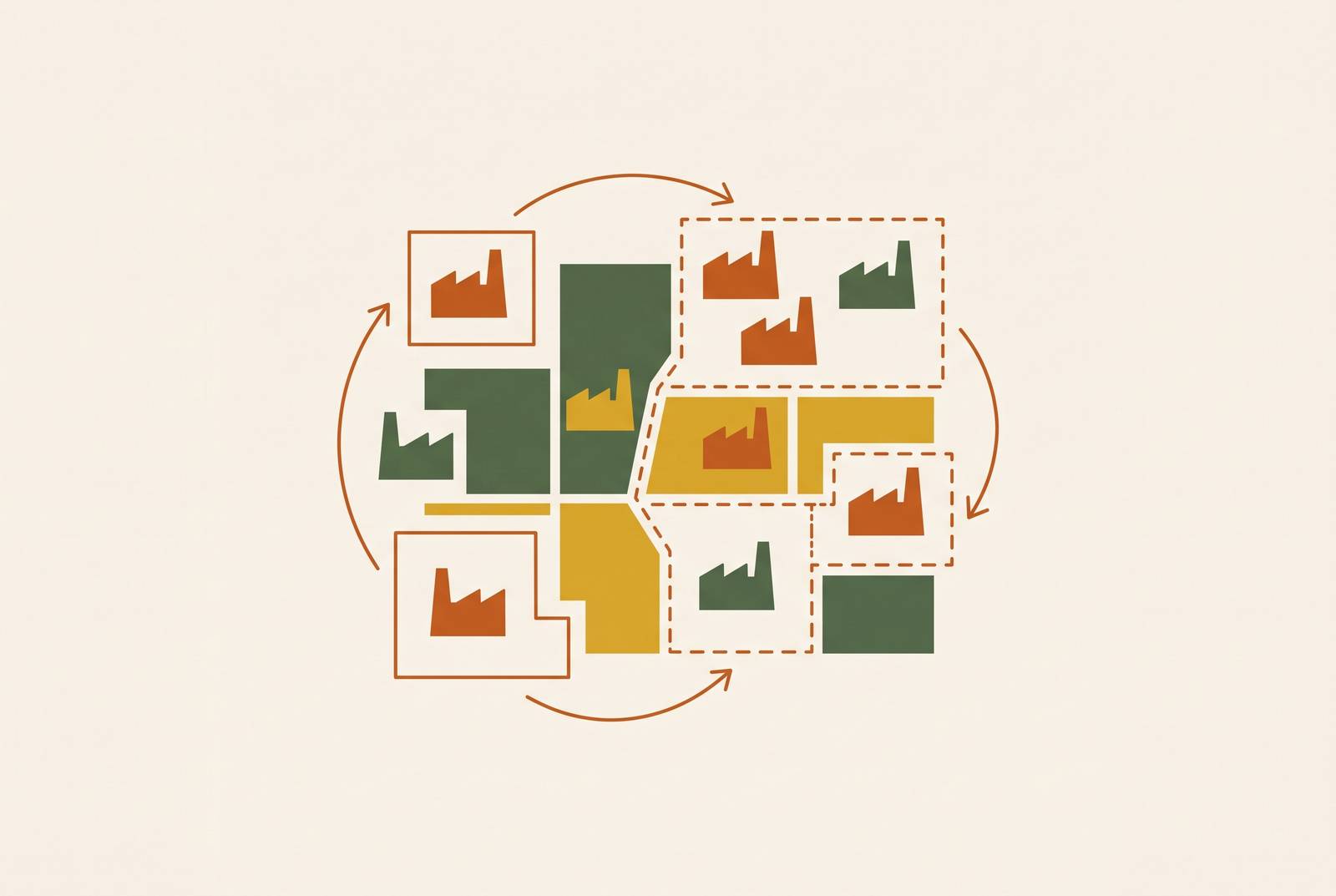
Manufacturing's customer base is moving faster than most territory maps can track, and the companies capturing the new demand are the ones rebuilding coverage around where production actually happens now, not where it used to happen. Reshoring, plant consolidation, and supply-chain risk management have redrawn the domestic industrial footprint over the past two years. Sales organizations still running territories off static geography and NAICS codes are missing it.
The driver isn't cheaper labor. Surveys of manufacturers point to government incentives, access to skilled workers, proximity to end markets, and the desire to cut supply-chain disruption risk as the top reasons companies are bringing production back to the country where they primarily sell. or shifting it closer to home. The Reshoring Initiative tracked significant reshoring and foreign-direct-investment job creation in 2024. That pace slowed in 2025 as tariff uncertainty weighed on some decision-making, but even the slower year represents a real, sustained shift in where things get made.
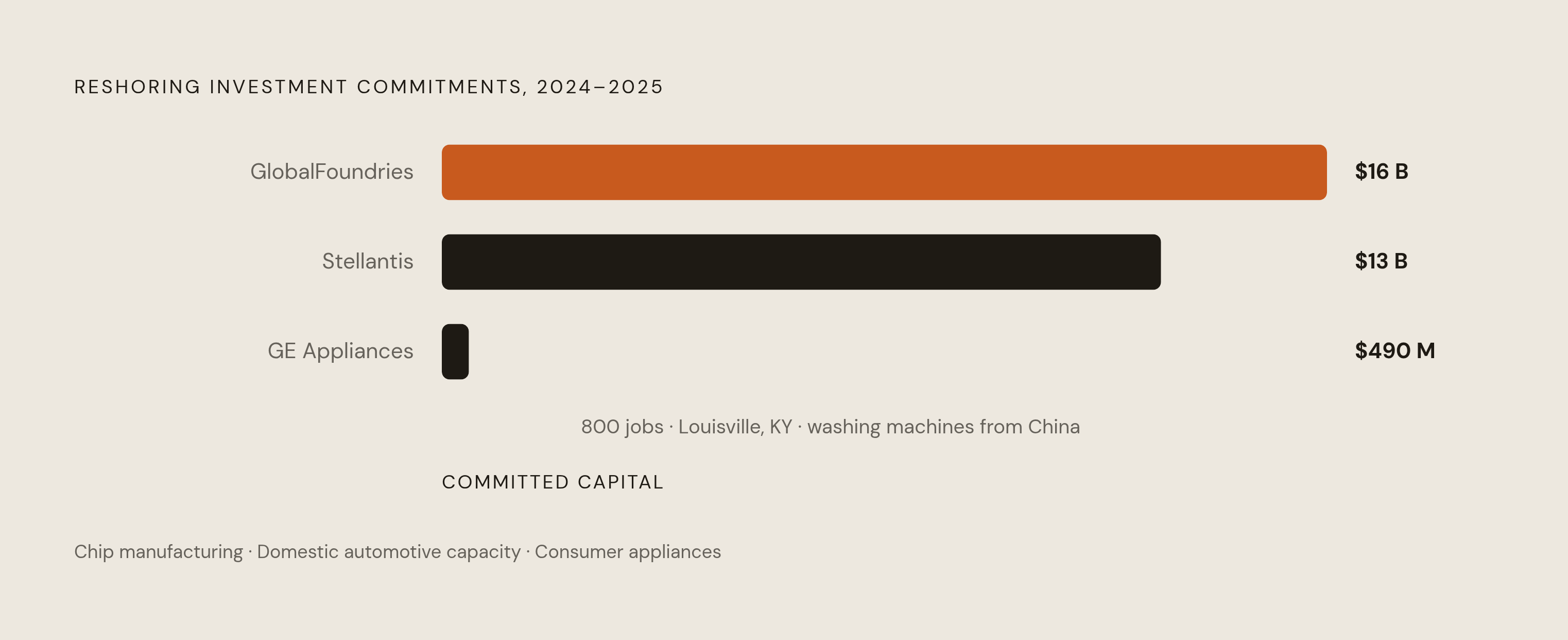
GlobalFoundries' $16 billion reshoring investment, Stellantis's $13 billion domestic manufacturing commitment, and GE Appliances' $490 million announcement raise the scale visible in individual investment decisions. GlobalFoundries committed $16 billion to reshore chip manufacturing. A major automaker put $13 billion into domestic manufacturing capacity. manufacturing capacity. GE Appliances announced a $490 million move of washing machine production from China to Louisville, Kentucky, in June 2025, adding roughly 800 jobs. Apple has a new Houston facility slated to open in 2026 to build AI servers that used to come from overseas plants. None of these are small, symbolic gestures. They're structural changes to where demand originates, and surveys suggest roughly 69% of domestic. manufacturers have already begun reshoring some part of their supply chain, with most reporting the move is paying off.
How uneven this shift is across sectors matters for territory design.
None of this is happening evenly, and that unevenness is the whole problem for anyone drawing sales territories.
Semiconductors, defense, automotive, and AI infrastructure are absorbing most of the reshoring investment. Other sub-sectors are flat or shrinking. Specialty chemicals is a useful case: the vast majority of basic and specialty chemical demand comes from industrial buyers, yet the broader chemical market is in a prolonged downcycle. Global chemical production growth is expected to remain subdued through 2025 and 2026, with specialty chemical output remaining under pressure in the near term.
Inside that flat topline, the split matters more than the average. Chemicals feeding semiconductor fabs, data centers, and healthcare production are still expanding. Chemicals tied to general manufacturing or construction are stuck in weak demand. A rep whose territory bundles every chemical-consuming plant together, without distinguishing which ones sit in the growing lane, ends up spending call time on accounts that are shrinking while the accounts that are actually expanding go uncovered.
Metalworking fluids show the opposite pattern: broad, sector-wide growth. That market moved from $13.5 billion in 2025 to a projected $14.5 billion in 2026, a 7.4% compound annual growth rate, and is projected to continue expanding through 2030 at a similar rate, driven by broad industrial demand growth. A territory model that treats "chemicals" or "industrial fluids" as one bucket erases the distinction between a rep chasing a shrinking pool and a rep chasing an expanding one.
What breaks in a territory when the underlying customer base moves
Territories built on geography or fixed account lists describe where customers used to sit, not where they sit now. Coverage quietly drifts away from real demand, and nobody notices until quota attainment starts missing across the board.
Three structural problems follow directly from a shifting customer base. First, equity gaps: reps assigned to regions where plants have closed or consolidated end up competing for a shrinking pool of business, while reps in regions where new facilities are opening are stretched thin, unable to properly work a growing one. Second, overlap: when account lists aren't updated to reflect a plant relocation or a new facility opening, multiple reps can end up chasing the same corporate parent, while the new plant that's actually doing the buying goes uncovered by anyone. Third, and hardest to catch, territory drift: the map looks unchanged on paper, but the plants inside it have shifted their production mix, their purchasing needs, or the makeup of the buying committee that signs off on orders.
Named-account protection adds its own risk here. Keeping a strategic account fixed in a rep's book makes sense for continuity. If that account has closed or consolidated production at a facility outside the rep's actual coverage, though, the relationship is with an asset that's already diminished, and nobody updated the org chart to reflect it.
The cost of chasing the wrong plant is higher now than it used to be, because B2B buying committees have gotten larger. A typical complex purchase involves 6 to 10 decision-makers, and some buying groups extend well beyond that range. Every hour a rep spends building relationships inside the wrong facility is an hour not spent on the plant that's actually buying.
Why static geographic and firmographic data cannot support realignment
Most territory design in manufacturing still leans on static classification codes and firmographic figures. Both describe what an establishment was classified as at some point in the past, not what it makes today, what processes run on its floor, or what it currently needs to buy.
A plant that gets reclassified from automotive supplier to contract manufacturer can keep the exact same NAICS code before and after the change. The firmographic record stays static while the purchasing requirements shift completely. Contact databases built for prospecting have the same blind spot: they don't carry plant-level operational detail, no ISO 9001, AS9100, or IATF 16949 certifications, no record of which processes or equipment a facility runs.
The practical result is that reps build call lists off geography and company size, then spend field time doing research that should have happened before the first call, just to figure out whether a plant is even a relevant prospect.
The inputs that make facility-level territory realignment possible
Rebuilding territory around actual production activity takes three distinct layers of data, and most territory plans are missing at least one.
Internal data, pulled from the CRM, tells you where a team has already won and lost: opportunity histories, win rates by segment, pipeline-to-quota ratios, average days spent in each stage. That's useful, but it only describes past performance, not where new opportunity is forming. Third-party market data, which most plans skip entirely, must go past firmographics into facility-level production detail: what a plant makes, what processes it runs, what equipment sits on the floor, what's changed recently. Competitive presence data by region rounds it out, showing where coverage is saturated, where it is thin, and where new plants are standing up with no incumbent vendor relationship.
Facility-level data answers questions firmographics simply can't. Has a plant's production mix shifted, adding CNC machining or moving to multi-metal runs, in a way that opens new purchasing categories? Has capacity expanded, shrunk, or relocated, changing what the account is actually worth and how much rep time it deserves? Has a new domestic facility appeared in a region that previously had no industrial density at all, representing white space no historical account list would ever capture? For sellers in specialty chemicals or water treatment, where product selection is often compliance-driven, does the plant's environmental and regulatory profile even fit what's being sold?
That white space, new plants standing up in regions with no established vendor relationships, is the highest-value target in a reshoring environment. It's also invisible to anyone working off historical account lists, because there's no history to work from. A CRM is only as good as what feeds it: stale or generic firmographic data produces stale pipeline, while plant-level production data turns the CRM from a contact list into something closer to an actual account intelligence system.
How to structure the realignment process itself
Realignment should start with scenario modeling, before anyone touches a live territory. Simulate several territory configurations against market potential by facility density, rep capacity, travel time, and current workload. Heatmaps and geographic overlays will surface imbalances that raise a rep's missed quota before they occur.
Capacity math has to reflect who's actually on the team, not who's supposed to be. That means accounting for attrition, open reqs, and time-to-fill, along with realistic ramp times for new hires, typically ranging from a few months for a mid-market rep to closer to a year for someone selling into enterprise accounts. Assign territory based on planned headcount instead of actual headcount, and accounts sit uncovered long enough for a competitor to walk in.
A hybrid model, part static and part dynamic, fits manufacturing sellers better than a full rebuild every cycle. Named strategic accounts should stay static: vendor qualification cycles in manufacturing run long, relationship continuity carries real value, and disrupting an established account just to rebalance the map is a net loss. Whitespace and newly identified facility accounts should be treated as dynamic instead, assigned to whichever rep has the best fit and the open capacity the moment the account is identified, rather than held back for the next annual planning cycle.
Sharper ICP definition matters more during a realignment than at any other time. Logo acquisition runs roughly 8 times more efficient against accounts that actually fit the ideal customer profile. When new plants are opening across a region, the instinct is to try to cover all of them. The discipline is prioritizing the facilities whose production profile actually matches what's being sold.
Finding growth inside existing accounts whose production has changed
The most overlooked opportunity in manufacturing sales sits inside accounts that are already being called on. A plant that's added a process, switched materials, or expanded throughput now buys differently, but the CRM record still reflects what it used to buy before the change.
Metalworking fluids illustrate the mechanism well. A single facility running milling, grinding, and forming may need a distinct fluid formulated for each process. As contract manufacturers shift toward mixed-material production runs, one account that used to need a single fluid type can end up needing several, a cross-sell opportunity created entirely by operational change inside an existing account, not by a new logo.
Terex Corporation ran into a version of this directly: its sales teams lacked visibility into which customers were likely candidates for replacement and add-on parts. Pattern analytics run against a year of sales orders surfaced purchasing behavior that had been sitting in the data the whole time, and Terex pushed those insights into its online ordering system and broader sales workflow. The data needed to find the cross-sell was already there. It just wasn't organized in a way anyone could act on.
Multi-stakeholder coverage widens that opportunity further. A manufacturing buying committee typically spans a plant manager focused on operational efficiency, a VP of supply chain worried about disruption risk, a procurement director focused on cost and compliance, and increasingly a technology executive thinking about digital transformation, each one responding to a different kind of signal. Manufacturers using Demandbase's platform to align marketing and sales around these buying groups report win rates 2 to 3 times higher, not by finding new accounts, but by covering more of the people already inside the ones they have.
Maintaining real coverage as the ground keeps shifting
None of this is a one-time fix. The plants driving the reshoring wave today will keep changing, adding lines, shifting suppliers, consolidating with other facilities, at a pace that a territory map redrawn once a year will always lag behind. Coverage built on facility-level production data has to be refreshed on a cadence that matches how fast the underlying manufacturing base is actually moving. The alternative is a territory model that's accurate on the day it's built and wrong for most of the year that follows.