IBP Process Alignment Between Chemical Sales Forecasting and Production Planning
Three isolated teams planning separately keeps production from matching what sales actually sells.
A sales team closes a large specialty chemical account, the deal checks every box on the forecast, and production tells them the order cannot ship on time. That scenario is common enough in chemical manufacturing to count as routine, and it points to a gap that IBP alignment exists to close. Demand, supply, compliance, and production constraints in this industry rarely hold still one at a time: they move together. A forecast can be right at the account level and still run into raw materials that haven't arrived, tank capacity that's already spoken for, labor that's allocated elsewhere, or a batch sequence that simply has no room for it.
The timing makes this worse, not better. The chemical industry entered 2026 already deep into a prolonged downcycle, with specialty chemical output expected to stay essentially flat as end-use sectors continue to struggle. In that kind of market, planning mistakes cost more than they would in a growth year: building inventory against an optimistic sales call that doesn't pan out, or under-producing against a demand signal that reads weaker than it is, both eat into margins that have little room left to give. The exposure runs deep because more than four-fifths of basic and specialty chemical demand traces back to the industrial sector. That means the forecast rises and falls with manufacturing activity itself, not with consumer habits or seasonal patterns that modelers know how to handle. A better forecasting model doesn't close this gap, because the forecast was never the point of failure. The structure that evaluates it is.
Structural separation between sales and production planning
Sales, finance, and operations each build their own numbers from their own data, and by the time anyone sits down to reconcile the three, the market conditions that produced them have already shifted. Structural separation between sales, finance, and operations causes the paradox described above, and it appears with particular sharpness in specialty chemicals and metalworking fluids. Sales forecasts from pipeline: deal stage, expected close date, account history in the CRM. Production plans from prior-period shipment volume. Neither number describes what the customer's plant is actually doing right now.
Take a metalworking fluids rep calling on a Tier 1 automotive supplier. The rep tracks where the opportunity sits in the pipeline. Production planning, on its side, tracks what shipped last quarter. Neither one is tracking the plant's actual coolant consumption rate or its upcoming fluid changeover schedule. The distance between what a sales team expects to sell and what the plant will actually consume, and when, is exactly where production surprises come from.
Finance adds a third, independent layer to the problem. It budgets from its own numbers, built separately from both the sales forecast and the production plan. The reconciliation meeting that's supposed to bring all three functions into agreement ends up functioning as a negotiation between three plans that were never built together in the first place, rather than a refinement of one shared plan.
This is the gap that distinguishes IBP from traditional Sales and Operations Planning. S&OP, in its classic form, balances demand against supply. IBP goes further by weaving corporate strategy and financial targets directly into the planning cycle, and that extra dimension is what lets it catch the commercial-to-production gap that S&OP alone tends to miss. The diagnosis, at this point, is organizational before it is technical: three functions planning in isolation will keep producing forecasts that are correct in their own terms and wrong for the business as a whole.
IBP process alignment in chemical manufacturing
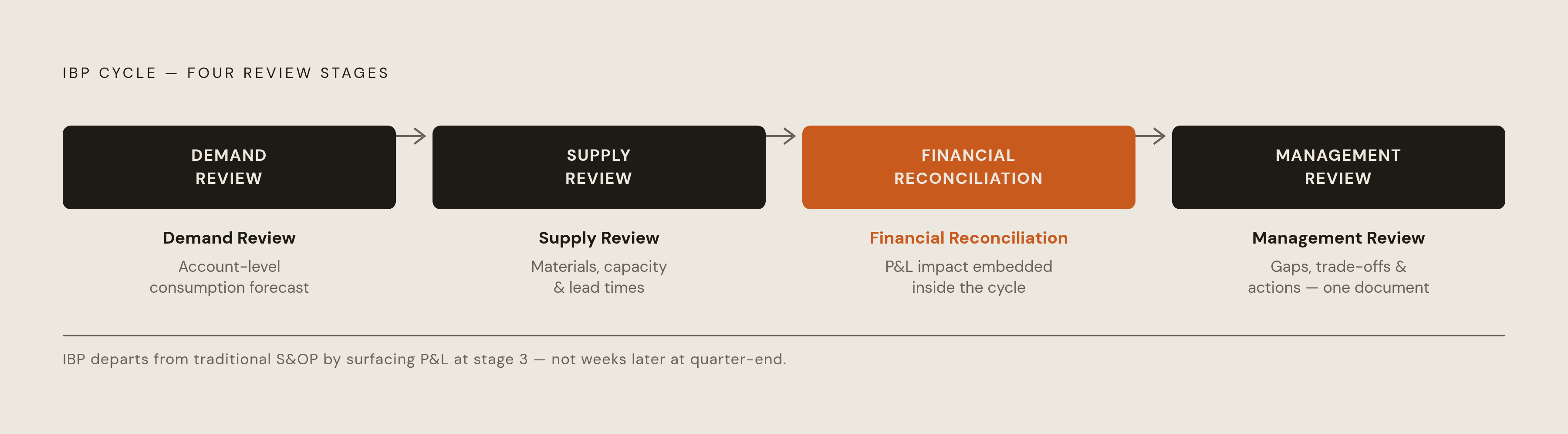
IBP alignment means commercial demand signals, production capacity constraints, and financial targets get evaluated together, continuously, rather than passed sequentially from one department to the next. In process-intensive manufacturing, this takes shape through a specific sequence of reviews, each one feeding the next.
Demand review comes first. Sales and marketing build a forward-looking consumption forecast, and in chemicals that forecast has to be built on account-level volume tied to what the customer's plant is making and at what rate, not simply on pipeline stage or past shipment patterns. Supply review follows: operations checks whether raw material availability, batch sequencing, tank capacity, and lead times can actually support the demand plan, and identifies the constraints in that review before they turn into missed deliveries. Financial reconciliation comes next, and this is where IBP distinguishes itself most clearly from older planning models. Financial planning gets built directly into the cycle, translating the demand and supply plans into revenue, cost, and profit projections so leadership sees the P&L impact of a planning decision as it's made, not weeks later at quarter-end. The cycle closes with management review, where the integrated plan, including its gaps, its trade-offs, and the actions it recommends, reaches leadership as one document instead of three competing slide decks.
An integrated process can show, in a single forum, how a drop in sales forecasts would ripple through production, inventory, and the P&L at the same time. In a siloed organization, that same question would take three separate analyses, run by three separate teams, arriving long after the window to act on them has closed. IBP also forces planning to operate across more than one timeline at once, monthly, quarterly, and annual cycles running in parallel. That matters in chemical manufacturing specifically because some production decisions, capital equipment purchases or long-lead raw material commitments among them, need a planning horizon longer than any single monthly S&OP cycle can give them.
Plant-level consumption data as the missing input for credible IBP demand signals
A demand plan is only as good as what feeds it, and in chemical manufacturing the input that's consistently absent is plant-level consumption data: what the customer's facility is actually making, at what rate, and what that implies for when and how much chemical product it will need. Pipeline data can't substitute for this. Deal stage tells production planning when a sale might close, not when the plant will actually draw the product down. Historical shipment volume tells production what was consumed in the past, but says nothing about whether the customer's output, product mix, or equipment has changed since. In specialty chemicals and metalworking fluids specifically, consumption tracks machine uptime, coolant sump life, fluid changeover schedules, and batch frequency, all of it plant-level activity that pipeline records were never built to capture.
Metalworking fluids make the stakes concrete because the category is close to a pure-play bet on manufacturing activity. Forecasting it accurately means knowing whether a customer's machining lines are running near capacity, whether a changeover to a new fluid specification is underway, or whether a new machining center is about to come online. A CRM opportunity record built around contacts and deal stages captures none of that.
The same gap exists at the macro level. The ISM Manufacturing PMI moved between 45 and 51 from January 2023 through August 2025, a leading indicator that a commercially integrated IBP process ought to be feeding directly into its forecast models. But a sector-wide index only becomes useful for a specific account once it's paired with account-level production intelligence that translates broad manufacturing activity into a specific customer's expected consumption. Companies pursuing IBP have responded by investing in data governance and analytics talent so they can make full use of AI-driven forecasting tools. The harder governance problem in industrial chemical sales isn't internal process discipline: account records simply don't capture production process type, equipment configuration, or operating rate, the details that actually predict reorder timing and volume. Platforms like Salesforce Manufacturing Cloud go some distance toward solving this, letting companies track rebates, volume commitments, and contract terms by account and combine pipeline data with run-rate business for demand planning. Even run-rate data stays backward-looking, though, unless it's enriched with current, facility-level production intelligence that tells a sales team what's happening on the plant floor right now.
The end-market preference for specialized distributors as an IBP alignment signal
A shift underway in U.S. specialty chemicals distribution makes this same argument from the market side. Manufacturers are increasingly favoring end-market-specific distributors and regional partners over broadline distribution, and they're choosing these relationships specifically because of the technical knowledge, formulation support, and local insight that come with them. That preference reflects demand for the exact kind of production-process-linked account knowledge that makes an IBP demand signal worth trusting.
The distributor's vantage point explains why: an end-market-specific distributor generates demand data that maps directly onto a customer's production process, because that's the only way the distributor can do its job well. A distributor focused on metalworking knows which customer is running which fluid, in which sump, on which piece of equipment, and roughly when that sump will turn over. That is structured, process-linked demand data, and it is precisely what an IBP demand review needs from the commercial side of the business: it turns relationship knowledge into a signal that production planning can actually plan against.
Broadline distributors operate at higher volume, but the resolution of their data drops accordingly. A broadline partner knows what sold. It doesn't know what process the product served or what was happening on the customer's production floor that drove the purchase, and that gap makes its data considerably less useful as an IBP input. The demand review stage of IBP needs a deliberate way to capture that intelligence and pull it into the planning cycle, because it won't arrive there on its own.
The source of the strongest objection to IBP alignment in chemical sales
The strongest pushback against IBP alignment in chemical sales holds that commercial teams operate on relationship logic and episodic demand, not on planning cadences, and that pushback is partially right. It's an argument for designing a smarter IBP loop, not an argument for abandoning alignment altogether.
The objection runs like this: forcing a sales rep's account forecast into a monthly IBP review cycle can distort accounts where volume is driven by one-time events, a reformulation project, a plant expansion, a regulatory changeover, rather than by steady, predictable consumption. A metalworking fluids rep calling on a Tier 1 automotive supplier during a model changeover year is reading demand signals that simply don't fit a historical run-rate model, however well-constructed that model is. Evonik's launch of an "Innovation Factory," built to accelerate the conversion of research into commercial products on a shorter timeframe, illustrates exactly this kind of event: a compressed qualification cycle that a standard monthly IBP review may not be agile enough to absorb on its own schedule.
Where the objection overreaches is in assuming IBP works by imposing a fixed forecast on commercial teams from above. That's not the design. IBP is meant to function as a feedback loop, where commercial signals about plant-level events, a new machining line coming online, a fluid consolidation, a capacity addition, trigger updates to the production plan rather than simply getting absorbed into a number that was already locked in. Intelligence in a well-built IBP process moves in both directions: sales tells production about episodic demand events as they emerge; production tells sales about capacity constraints that change what can realistically be committed to a customer; finance turns both into a P&L view leadership can act on immediately.
What the objection is really exposing is a trust problem, and it's a cultural one more than a technical one. Genuine IBP requires breaking down the usual silos between departments, and that depends on finance trusting supply chain's forecasts and supply chain trusting finance's numbers in a way that older, siloed planning processes never demanded of either side. The resistance coming from sales is a version of that same trust problem, not a sign that the episodic nature of chemical sales is incompatible with IBP. IBP succeeds or fails based on executive sponsorship, governance discipline, data integration, and sustained cross-functional collaboration. Read that way, the objection is really pointing at how badly a given company has implemented IBP, not at a flaw in the concept itself.
Evonik's compressed qualification cycles and M&A diligence trends as organizational stakes of IBP discipline
IBP discipline has stopped being purely an internal operating matter in chemical manufacturing. It appears in how fast a company can get a product to market, in how channel partners choose to work with it, and in how acquirers value it.
Evonik's own moves illustrate the first of these. In March 2026, the company launched its "Innovation Factory" specifically to shorten the time it takes to convert research into commercial products, with an explicit focus on bio-based, sustainable, and energy-transition solutions, biopolymers, biosurfactants, and membrane technologies among them. Compressing the lead time from R&D to commercial launch only works if sales and production planning cycles compress in parallel, and a mature IBP process is built to deliver that synchronized speed. A company still running sales forecasting and production planning as separate exercises, reconciled occasionally rather than continuously, cannot support an R&D cycle that has been deliberately shortened. The planning discipline either keeps pace with the commercial ambition or it becomes the constraint that quietly limits it.
The stakes extend into how the industry values itself in a downcycle. A sector facing flat specialty chemical output and thin margins through 2026 has less room to absorb the cost of planning functions that don't talk to each other. A forecast that looks sound in the sales organization but breaks against production capacity doesn't just cost a single order. It compounds, quarter over quarter, into the kind of margin erosion a prolonged downcycle makes much harder to recover from. IBP alignment, in that light, is the structural correction that turns a commercially accurate forecast into an operationally real one.
Sources
- Integrated Business Planning in the Pharmaceutical Industry
- Why Integrated Business Planning Is the Future of Supply Chain
- Integrated Business Planning 2026: Guide
- What Is Integrated Business Planning (IBP)? A Complete Guide
- Four Trends Shaping US Specialty Chemicals in 2026
- 2026 Chemical Industry Outlook