Systems-Level Thinking Applied to Manufacturing Procurement
Suppliers win by reading a plant's production system, not by waiting for a purchase order.
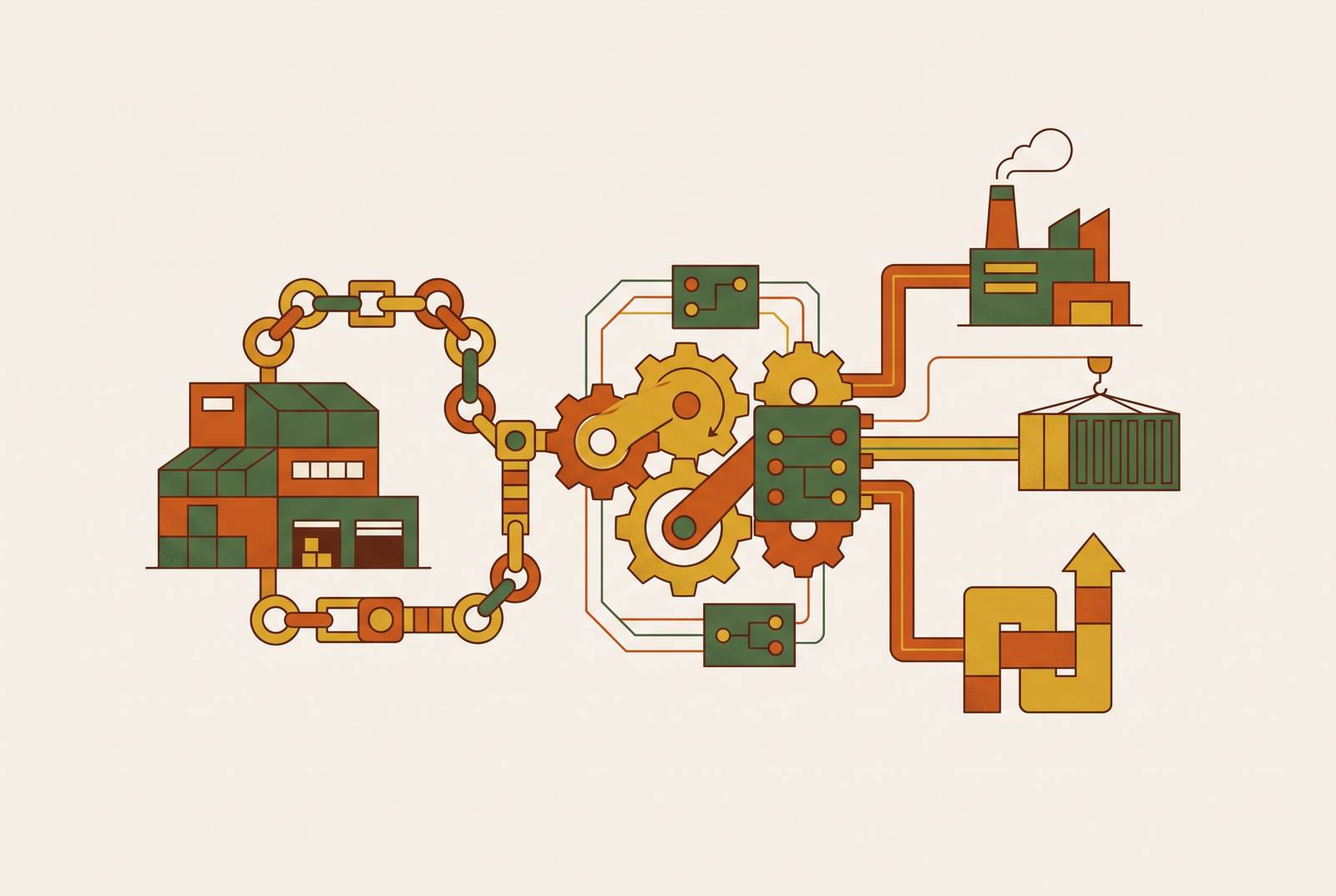
Manufacturing procurement is never an isolated transaction. Every purchase order sits inside a web of production schedules, equipment states, and supplier commitments, and a late or wrong buy stops a line and costs money. Read correctly, procurement is a map of a plant's operational needs. Vendors who learn to read that map get ahead of demand instead of waiting for an RFQ to tell them what to sell; the ones who don't are competing on price against people who do. That's the real divide in industrial selling today, and most vendors are still on the wrong side of it, still building pitches around a spec sheet rather than a process.
Manufacturing procurement works differently from procurement in most other industries, and treating it the same way is the first mistake. In retail or professional services, purchasing keeps the lights on. In manufacturing, nearly every purchase connects to a production outcome: a coolant order, a resin shipment, a filtration cartridge, each one ties directly to whether a line runs today. The function itself has moved from a purely tactical, transactional role, through a phase of strategic sourcing focused on cost and supplier consolidation, to an operational engine that leading organizations now run to drive change across the business. Procurement decisions carry information about production schedules, equipment condition, capacity plans, and risk exposure, and that information is readable if a seller knows where to look.
The persistent tension between procurement goals and production reality
Procurement teams get measured on cost and compliance. Production teams get measured on uptime and throughput. Those goals don't line up naturally, and the friction between them shows up constantly on plant floors.
When procurement and production don't share data well, procurement buys to a spec sheet while production scrambles for what it actually needs on the line that week. The gap produces reactive sourcing: expedited freight, emergency substitutions, purchase orders cut under pressure instead of planned in advance. A seller who understands what a stamping line needs mechanically, and what a procurement manager has to justify to finance, holds a structural advantage a purely transactional vendor never gets close to.
Bridging that gap takes more than good manners on a sales call. It's the actual mechanism by which a supplier stops being interchangeable and starts being strategic. It also explains why buying committees have gotten larger: operations, finance, and engineering sit in the room now alongside procurement, because few purchases touching production continuity get signed off by one department alone. Sourcing research from industrial markets backs this up directly. Vendors who pitch only to the procurement contact are already behind before the first call ends, and no amount of relationship-building after the fact fixes that.
How production systems create predictable procurement sequences
A plant is not a set of independent departments stacked next to each other. It's a system, and every part of that system runs on its own consumption rate, its own maintenance rhythm, its own input requirements. What a facility makes determines what it has to buy, and that relationship stays close to mechanical rather than probabilistic.
A plant running high-speed metal cutting generates steady, predictable demand for metalworking fluids, filtration media, and coolant management systems. A facility running high-temperature polymer processing has a completely different, equally predictable input profile. Neither is a mystery once you know what's on the floor.
Equipment lifecycle is one of the clearest signal generators available. Aging machinery drives demand for maintenance parts, lubricants, and eventually capital replacement. New equipment installs bring a wave of onboarding: consumables, operator training, process chemicals specific to that machine class. Capacity expansions ripple outward into higher consumption across every input category tied to the process being scaled. None of this is hidden; it's baked into how production systems age and grow.
Bill of materials data and production schedules, when shared with procurement, sharpen forecast accuracy and open the door to anticipatory sourcing. Sellers who time outreach to those rhythms show up before the RFQ exists. Planned maintenance windows work the same way: they're a purchasing moment for consumables and parts, and a decision window when a plant is genuinely open to evaluating a new supplier. A distributor whose inventory system shows recurring stockouts on a given input is signaling a forecasting gap, and an observant seller can open that conversation around supply reliability, leading with what the pattern reveals about the plant's needs.
What systems-level thinking actually requires a seller to know about a facility
Generic company data (an industry code, a headcount range, a revenue band) tells a seller almost nothing about what a plant actually makes or how it makes it. The useful unit of knowledge here is the facility, not the parent company sitting three org layers above it. Most sellers get this backward from the start, building territory plans off firmographic filters that describe the corporation and say nothing about the floor.
A seller needs to know what a given plant produces and at roughly what volume: what equipment categories sit on that floor, and how old that equipment runs; what processes production depends on (cutting, forming, coating, treating, filling) and what each of those processes consumes as a matter of course; what environmental or regulatory constraints shape which inputs are even allowed on-site.
Knowing a company operates in "plastics manufacturing" at the industry-code level tells a seller almost nothing useful. Knowing a specific plant runs high-volume injection molding with a particular resin family turns a cold pitch into an actual conversation. Activity signals matter alongside this static profile too. A plant adding a line, shifting its output mix, or picking up a new certification is broadcasting a near-term need whether it means to or not.
Sellers in specialty chemicals, coatings, metalworking fluids, and water treatment sit in an especially strong position to use this logic, because their products tie directly to a process rather than sell as discretionary spend. The purchase trigger is built into the production system itself, and the data needed to see that trigger is getting easier to reach. Most manufacturers have already put supply chain planning software in place or plan to invest in it soon, so the plants a seller calls on are producing more structured, more usable data than they were even a few years back.
How the shift toward supply chain resilience has changed what procurement values in a vendor
Supply chain resilience used to sit near the bottom of the risk management pile. It doesn't anymore. Deloitte's 2025 Global CPO Survey lists resilience among the priorities expected to deliver the most value to procurement organizations this year, and that shift changes what a "good vendor" looks like on paper.
Procurement leaders face direct pressure to cut single-source dependency, tighten lead-time predictability, and build supplier relationships that bend without breaking under stress. That pressure reshapes the vendor conversation. Per The Hackett Group's 2025 CPO Agenda report, 60% of procurement executives expect to lean more heavily on automation and digital procurement tools over the next several years, which means the buyers on the other end of a sales call are working from better data than they had before.
Price is losing ground as the thing that separates one vendor from another, and any seller still leading with a discount is fighting a losing battle. Capability, reliability, and a demonstrated grasp of the customer's production context carry more weight in that decision now. A supplier who can talk about total cost of ownership, uptime impact, or supply continuity is framing value in terms procurement leadership already uses when it talks to finance and operations internally. Competitive differentiation in industrial markets is moving toward innovation, technology integration, and supply chain reliability, so a vendor whose pitch never leaves the product spec sheet is competing on the dimension that matters least. The seller fluent in systems logic closes deals more easily and stays easier for a procurement contact to defend internally, because the pitch already speaks the language finance and operations expect to hear.
Reading procurement signals before the RFQ arrives
By the time a manufacturer issues a formal RFQ, the field has often already narrowed. Observed patterns in industrial B2B buying behavior show that buyers do extensive digital research before they ever pick up the phone to call a supplier. The seller who shows up after the RFQ lands is competing on price. The seller who shows up before it helps shape the specification itself, and that gap between the two is the whole game.
Several kinds of signals show up ahead of a formal event. New machinery installation opens a window before process chemistry and consumables get locked in. Capacity expansion announces higher consumption across every process-tied input, well before anyone drafts a purchase order. Regulatory or certification changes often force a full review of existing chemical, coating, or treatment programs. Recurring maintenance events or accelerated replacement cycles point to a process problem a supplier could actually solve, and a plant that has recently lost a supplier relationship is, for a short window, genuinely open to alternatives.
This changes how territory should get built too. The most valuable territory isn't the largest by square mileage. It's the one densest in facilities whose process profile matches what a seller sells, layered with current activity signals suggesting a need is forming. Harvard Business Review research on territory design finds that optimizing coverage this way can lift revenue by 2 to 7% without adding a single rep. In industrial sales, that lift runs strongest when territory logic reflects real production density and real activity, rather than a firmographic filter pulled from a database.
Why existing accounts are the most underleveraged application of systems thinking
Winning a new customer costs somewhere between five and twenty-five times more than keeping and growing one already on the books. In industrial sales, where cycles run long and trust builds slowly, that math favors expansion even more heavily than it does in most other sectors. Most sales organizations still chase new logos first anyway, and that habit gets the priority exactly backward.
A seller closing additional business with an already-satisfied customer succeeds at roughly fourteen times the rate of a seller working a brand-new prospect. And yet cross-sell and upsell inside B2B manufacturing accounts, as tend to happen by accident rather than by design.
The systems logic applies just as directly here as it does to new prospecting. A plant already buying one product from a supplier is almost certainly running adjacent processes that need related inputs; the production system connects those needs whether or not the commercial relationship has caught up. Equipment changes inside an account already being served are about as strong a cross-sell trigger as exists, because the seller is already trusted and already walking the floor when the new machine shows up. Tracking maintenance schedules and upgrade cycles inside known accounts turns re-engagement into a calendar instead of a guess.
The barrier here is rarely the relationship itself. It's internal coordination. Account teams often lack the facility-level context to know what else a plant needs, and marketing rarely has access to the production data that would surface the next obvious expansion play. Doing this well means combining known purchase history with current facility activity to spot the next adjacent need, framed as a reliability or efficiency conversation.
How plant-level intelligence platforms make systems thinking operationally practical
A seller with deep domain knowledge can apply all of this logic to a handful of accounts known cold. That doesn't scale across a full territory without structured data at the facility level behind it, and hoping reps will build this picture by hand is how territories end up covered unevenly, with some accounts worked hard and others left untouched for years.
The gap is real and persistent. Production lines throw off enormous amounts of operational data, but that data rarely reaches the supply chain in time to shape a sourcing decision, and it almost never reaches an outside vendor before the fact. Closing that gap takes a plant-level intelligence platform built around a specific set of facts: what the facility produces and at what scale, beyond what industry the parent company files under; what equipment classes are running and roughly how old they are; what processes are active and what those processes consume; near-real-time activity signals like expansions, equipment changes, and certifications; and a direct feed into the CRM tools reps already use daily, rather than a separate research tool nobody opens.
Building this picture by hand through rep research carries a real cost of its own, and it's a major reason industrial sales teams spend so much time on pre-call prep instead of actual selling. Structured facility data removes that tax. Platforms that index manufacturing facilities at the plant level, tying production profiles to equipment signals and activity data, let sales teams turn the systems logic described here into something repeatable: a working method for prospecting and account growth.
For teams selling into specialty chemicals, metalworking fluids, coatings, water treatment, or packaging, this isn't an abstract benefit. The purchase trigger for these products lives inside the production process itself, and a facility profile that captures what a plant actually runs functions, in practice, as a map of what that plant is going to need to buy next.