Structuring CRM Accounts to Separate Plants from Parent Companies
Separating plants from parent companies prevents duplicate sales efforts and hidden opportunities.
In manufacturing sales, the customer isn't the name on the letterhead. It's the plant floor: the facility where a maintenance superintendent picks a coolant, where a process engineer signs off on a coating, where the purchase order actually gets cut. Most CRM systems still record accounts as if the parent corporation were the buyer, and that mismatch isn't a data hygiene footnote. It's the root cause of duplicate outreach, invisible relationships, and territory assignments that miss where the real activity happens.
What actually breaks when plants and parent companies share a single account record
A rep closes a deal with a facility in Houston. Three months later, a second rep at the same company calls into that same parent's Dallas plant, cold, with no idea a relationship, a price, or a signed term sheet already exists thirty miles away in the CRM. Nobody did anything wrong. The system just never told them the two plants were related.
That's the small version. The bigger version shows up in revenue rollup. Marini Systems has reported on a key account management team that could state precisely what a German subsidiary was worth (4.2 million euros) and what a Japanese subsidiary was worth (1.1 million euros), yet had no visibility into a Brazilian subsidiary at all. Corporate-level aggregation existed, but only in a spreadsheet with bookings of questionable allocation. When the account structure stops matching how the business is actually organized, the numbers still get reported with confidence. They just mean less than they look like they mean.
Territory assignment breaks the same way, and this is the part most teams get backwards: they assign reps by the parent's headquarters address instead of by where the plants and buying committees actually sit. Relationship mapping breaks too. A contact entered under the parent record goes invisible if her plant reports to a different city entirely. White space goes dark, because a win at one plant can't point to sister plants that don't exist as records. And contract logic falls apart right where it matters most, since master agreements sit at the corporate level, supply contracts sit at the plant level, and billing runs through yet another legal entity. Without a hierarchy connecting all three, nobody can tell whether a new plant order falls under an existing framework agreement or needs fresh terms negotiated from scratch.
Calling this a hygiene problem is the mistake itself. Each failure above has a direct revenue consequence: duplicated selling effort, expansion opportunity that never surfaces, contracts scoped wrong from the start.
The four-level hierarchy that maps how manufacturing customers are actually organized
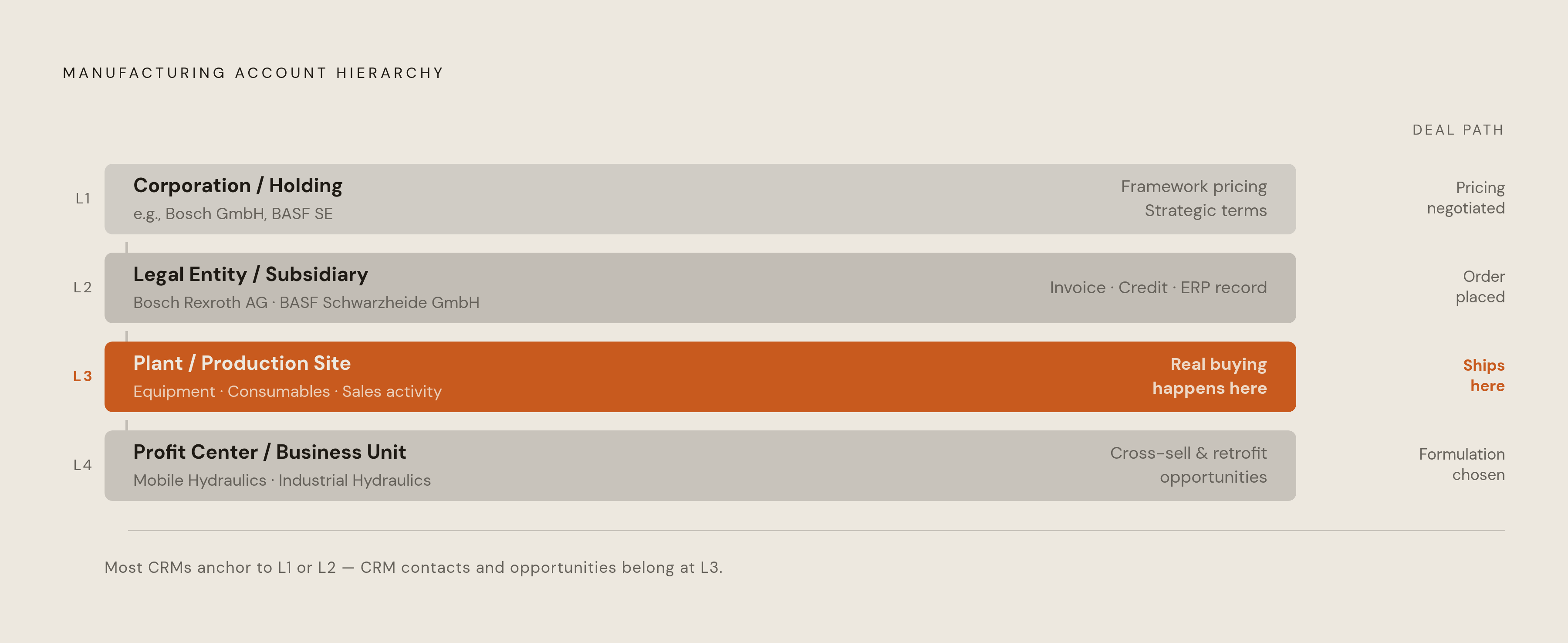
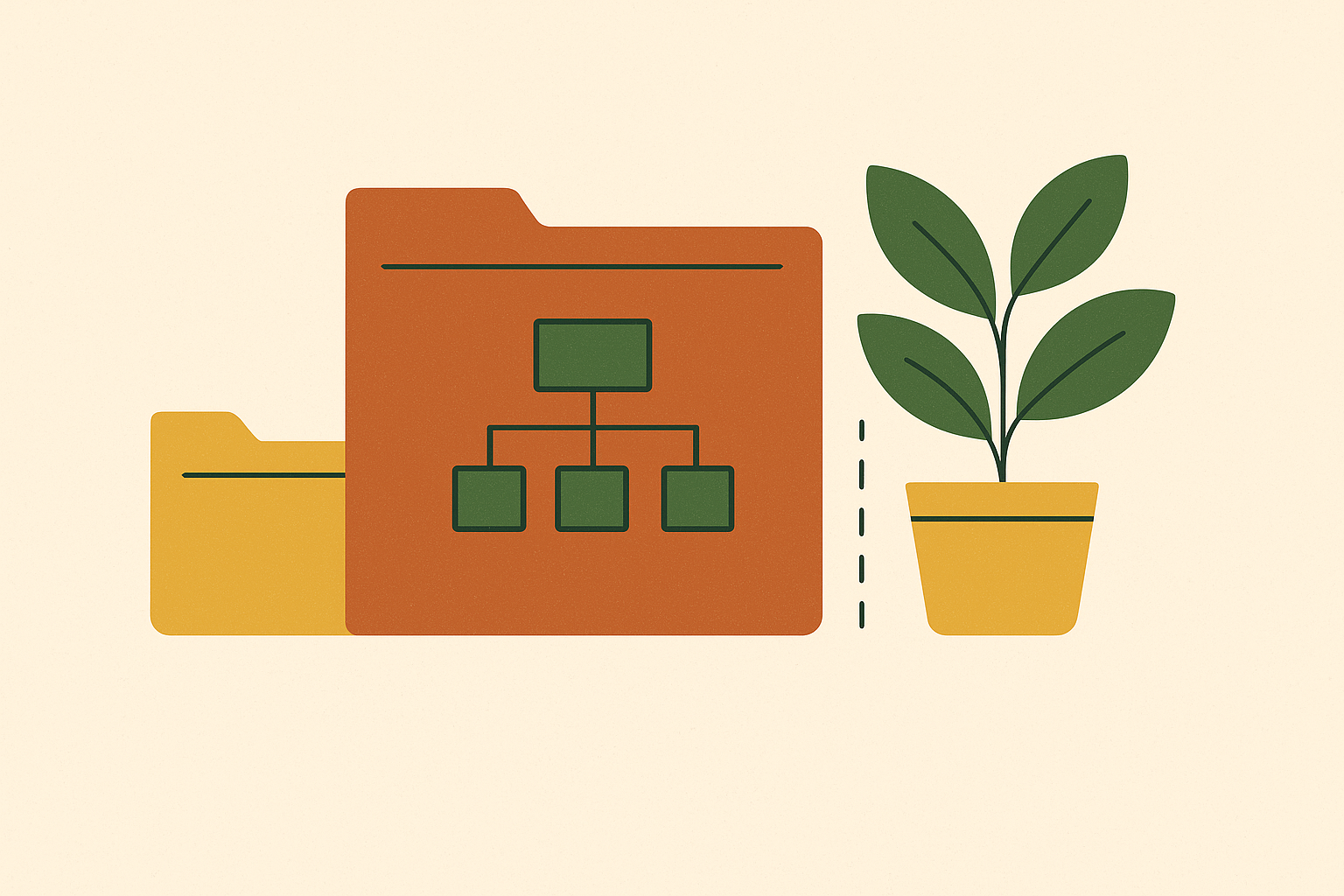
Manufacturing customers organize themselves across four levels, and each one runs on its own logic. A CRM that flattens them into one record type is modeling a business that doesn't exist.
Level 1 is the corporation or holding company: global framework agreements, corporate discount scales, strategic partnership terms. Nobody places an order here. It exists to set the contractual terms everything below inherits.
Level 2 is the legal entity or subsidiary, the company in the strict legal sense: "Bosch Rexroth AG," "BASF Schwarzheide GmbH." Invoices get issued here. A balance sheet exists here. Credit gets assessed here. In most ERP systems, this is the primary business partner record.
Level 3 is the plant, the production site. This is where the actual operating decisions get made: equipment gets specified, consumables get bought, and most of the sales activity that closes deals happens right here. Contacts, opportunities, and day-to-day CRM activity should be built around this level, not the ones above it.
Level 4 is the profit center or business unit, a division inside a single plant with its own budget: "Mobile Hydraulics" running alongside "Industrial Hydraulics" inside the same building. This is where cross-sell and retrofit opportunities hide, and they stay hidden if the plant gets treated as one undifferentiated account.
A single deal can touch all four levels at once. Pricing gets negotiated at Level 1, the order gets placed at Level 2, the product ships to Level 3, and the specific formulation gets chosen at Level 4. A CRM tracking only one of those levels is blind to the other three.
Take Apex Industries Holdings, corporate headquarters in New York, sitting above a chemicals subsidiary in Houston, which sits above a chemicals plant in one city and another in a different one. Each plant is its own account, with its own contacts, its own purchasing pattern, its own product needs. The parent records exist to provide rollup and contract context, nothing more. Treat the parent as the real account, and the whole picture gets read backwards.
What the CRM's native architecture can and cannot handle
Every major CRM platform supports some version of parent-child account linking. None of them handle manufacturing's four-level structure out of the box, and the gaps matter more than most teams assume going in.
Salesforce supports Account Hierarchies natively, but the system has no concept of hierarchy type. "Bosch Rexroth AG" and a single production plant both show up as the same account object, with nothing in the platform distinguishing a legal entity from a production site. HubSpot offers a Parent Company field and lets metrics roll up one level through calculated properties, but that rollup doesn't cascade automatically through three or four tiers to the ultimate parent. SAP Sales Cloud provides corporate account structures, but the sync logic back to ERP tends to break the moment a plant gets reorganized under a different subsidiary, which happens constantly in manufacturing M&A. Mid-market tools like Pipeline CRM cap out even harder: each company gets one parent, and the hierarchy runs at most three levels deep, parent, child, grandchild. For a company running the four-level structure described above, that's a real architectural ceiling, not something a workaround fixes.
There's also a matrix problem no platform solves natively. A seller might run a German branch that covers a customer's EMEA plants and a US branch that covers the same customer's AMER plants. That's the seller's own org chart crossed against the customer's plant structure, and none of the platforms named above have native logic for reconciling both hierarchies at once.
None of this makes the parent-child structure optional, though. It has to be built on purpose, through field customization and explicit governance decisions, because it will never just emerge from a default setup, no matter which platform gets picked.
How to build the parent-child structure: the decisions that determine whether it works
Start by identifying the ultimate parent, the corporate entity that holds the master agreement. That becomes the anchor record everything else links back to.
From there, create a discrete account record for every plant. Not a contact. Not a shipping address field buried on the parent record. A full account, with its own owner, its own pipeline, its own activity log, linked up to the correct subsidiary or directly to the parent depending on how the customer is actually organized.
Then decide, field by field, what inherits down from the parent and what gets set independently at the plant. Negotiated pricelists, payment terms, the master contract reference, and corporate discount scales should inherit from the top. Sales rep assignment, process type, equipment profile, production volume, current supplier, quality certifications, territory, and last-touch date belong at the plant level and nowhere else. Credit limits deserve their own rule too, assessed at the legal entity level, since that is where the balance sheet and invoicing actually live.
Roll-up reporting comes next. Build the fields or reports that aggregate plant-level pipeline, revenue, and engagement back up to the parent. Skip this step and the hierarchy gives structure with no consolidated view, which defeats half the point of building it in the first place.
Visibility and permissions follow the same logic as territory assignment: access should reflect how accounts are assigned within the hierarchy. That's a territory decision as much as an admin setting. Finally, validate the tree. Check for orphaned plant records with no parent link, duplicate parent accounts created by different reps who didn't know one already existed, and contacts entered at the wrong level entirely.
One billing decision needs to get made explicitly, up front, before anything else: how invoicing, ordering, and delivery map across the different hierarchy levels. Map that before the CRM and ERP go live together, not after the sync starts failing. And someone has to own the question of who creates a new plant record when a customer opens a new facility. Leave that ownership unassigned, and the structure starts decaying the moment the account base outgrows whoever built it originally.
What to capture on the plant-level account record to make it commercially useful
A correctly linked plant record that's empty solves the hierarchy problem and nothing else. The fields on that record are what turn it into something a rep can actually use.
Process type and the six-digit NAICS code matter most, because machining, stamping, grinding, and casting each call for entirely different chemistries. A company sitting under a broad industry classification could be running any number of distinct processes, and each signals a completely different product need. Equipment make and vintage matter too: the equipment profile itself often decides the product spec before a rep ever picks up the phone.
Materials processed belong on the record as well. Aluminum, steel, titanium, and cast iron each demand different fluid chemistry, and that one field can qualify or disqualify a whole product line before a sales call even happens. Production volume and shift structure indicate consumption rate and contract size: a three-shift operation running continuously is a different opportunity than a single-shift job shop, even if both plants belong to the same parent. For metalworking specifically, production scale indicators on the plant record can help estimate consumption and account revenue potential.
Certifications carry their own weight, since industry-specific quality standards narrow down which products even qualify for consideration. Current supplier and competitive install status set the sales motion, since a plant locked into a long-term agreement is not the same conversation as a plant actively shopping around. And buying signals, tracked as activity on the plant record itself, matter as much as any static field: facility expansions, new construction, automation investment, a leadership change at the plant or VP level. A cluster of those signals hitting at once is usually the clearest sign of which accounts deserve outreach first.
A rep walking into a plant already knowing its process type, equipment, materials, certifications, and current supplier has done the qualifying work before the first conversation even starts. That's the difference between a cold call and a call that isn't cold at all.
How the plant-level structure converts directly into territory design and coverage logic
Territory has to get assigned against the plant hierarchy, not the parent's headquarters address. That's the operational rule the whole structure exists to enforce, and skipping it undoes everything built above.
Manufacturing buying cycles typically run six to eighteen months and involve buying committees of five to eleven people spanning procurement, operations, engineering, finance, and safety. Territory design that ignores where the plants physically sit misaligns coverage against where those committees actually convene. The duplicate coverage problem described earlier is a direct, mechanical consequence of flat account structure: two reps can work the same facility from different contacts, and the system won't warn either of them.
Different territory models draw on the plant record differently. A geographic model, built around field reps who visit multiple accounts a week, needs plant addresses as its inputs, not headquarters addresses, since plant routing matters more than where the corporate office happens to sit. A vertical model, built around process expertise rather than geography, depends entirely on the NAICS and process-type field living on the plant record, since that's what makes segmenting by vertical possible at all. A hybrid model can run both at once: enterprise accounts owned at the parent level by a key account manager, mid-market facilities covered geographically by territory reps, both drawing from the same underlying hierarchy without either one losing sight of the other.
Making any of this work in the CRM requires a specific set of fields living at the plant level: territory name, territory owner, account tier, ICP score, industry or process segment, region, named-account status, active sequence status, opportunity stage, last-touch date. And the hierarchy is what lets different reps, potentially with very different skill sets, get assigned to different plants inside the same corporate family: a longer-cycle consultative seller on the complex enterprise plant, a faster-moving rep on the smaller facility, without anyone losing sight of how the two connect.
Using the parent-child structure to find expansion revenue inside existing accounts
White space in manufacturing is geographic before it's anything else. A won plant is a beachhead for every sister plant the same parent operates, but only if those sister plants exist as discrete, linked records in the CRM. If they don't exist as records, they don't exist as opportunities either, no matter how real the potential actually is.
The referral dynamic that makes this work is straightforward: a plant manager vouching for a supplier to a counterpart at a sister facility solves the credibility problem before the first call even happens. The hierarchy is what lets that referral path get tracked, instead of relying on someone remembering it happened.
Cross-sell inside a single plant runs on the same logic. Metalworking lubricants, cutting fluids, rust preventatives, cleaners, coolants, and drawing compounds sit next to each other naturally, and the process-type and equipment fields on the plant record are what surface which of those adjacent products actually apply at that specific facility.
Terex Corporation offers a concrete version of this pattern. The heavy equipment manufacturer's sales team lacked visibility into how customers were actually buying, until analysis of a year's worth of sales orders revealed the pattern behind replacement and add-on part purchases, surfacing upsell and cross-sell opportunities that had been sitting there unnoticed the entire time. The same logic applies to plant-level purchase history: attach it to the correct account record, and the pattern becomes visible instead of buried in a spreadsheet nobody opens.
Handled this way, white space analysis stops being an annual account-planning exercise that produces a slide deck once a quarter. It becomes a running, continuously updated view instead. Share of wallet, the question of what percentage of a customer's total spend actually flows to a given supplier, simply isn't calculable without the plant-level structure, since it requires knowing every plant a customer operates, what each one currently buys, and what each one could plausibly buy instead. The expansion motion follows directly: identify the parent, list out every plant as a child account, score each one for product fit and current supplier vulnerability, prioritize the plants showing displacement opportunity or new facility signals, then hand them to territory reps who can already see the relationship context from the plant that's already won.
Maintaining the hierarchy as accounts evolve through M&A, plant openings, and organizational changes
None of this holds still. Plants get sold, shut down, or folded into a different subsidiary after an acquisition. New facilities open under an existing parent with no CRM record until someone builds one. A subsidiary gets renamed after a corporate restructuring, and every child account linked beneath it needs to follow along.
The governance question raised earlier, who owns the creation of a new plant record, matters most exactly at these inflection points. M&A activity and new plant openings are precisely when hierarchies fall out of sync with reality, if nobody's job includes catching it. A plant reorganized under a new subsidiary after an acquisition needs its parent link updated on purpose. Left alone, it keeps rolling up to a legal entity that no longer owns it, and every revenue and territory report built on top of that record quietly goes wrong until the numbers stop reconciling and someone finally notices.
No platform setting maintains this automatically, on any of the systems described earlier. The hierarchy is only as accurate as the discipline behind updating it, and that means a named owner, a set review cadence, and a validation step every time a customer account changes shape. Skip that discipline, and the structure degrades right back into the same flat, undifferentiated list of parent companies it was built to replace, just with more fields sitting on it.