CRM Data Quality Problems Specific to Industrial Sales Teams
Manufacturing plants, not parent companies, are the real accounts—and most CRMs miss that entirely.
Bad data costs money and wastes rep time. That much is old news, mostly written with a SaaS pipeline in mind, where a contact record either matches a real person's job title or it doesn't. Industrial sales carries that same problem, but underneath it sits a second, more structural one: the account record that actually matters in manufacturing is the plant, not the parent company, and almost no CRM was built to model that distinction. Fixing contact hygiene doesn't touch it, because the data itself is often fine. It's the wrong unit of account, and no amount of deduplication changes that.
Validity's 2025 State of CRM Data Management, surveying 602 CRM users, found that 37% had lost revenue directly attributable to bad data. Read that number with a software company in mind and it describes wasted outreach: a rep emails a contact who left the company eighteen months ago. Read it with a multi-plant industrial manufacturer in mind, and it describes something closer to a rep calling the wrong building entirely, because the CRM never told her the building existed.
How manufacturing sales actually works, and why it demands a different account record
A single corporate entity in manufacturing might run a dozen or more facilities, and each one operates almost like its own business: its own production line, its own purchasing authority, its own equipment, its own buying committee. What a plant makes determines what it buys. A facility stamping automotive body panels needs different consumables, coatings, and chemical inputs than a sister facility under the same corporate parent making refrigerators. Same logo on the building, completely different requirements sheet.
The buying committee on the other end isn't small, either. Challenger research puts the average number of stakeholders in a typical industrial purchasing decision at 10.2: plant managers, procurement, operations, quality, finance, and sometimes a corporate engineering group sitting at an entirely different site. Traditional industrial sales leaned on repeat business and on inbound calls from buyers who needed help figuring out what they needed. That dynamic has shifted. Research into industrial buyer behavior found that 57% of industrial buyers have already narrowed their options before a seller ever makes first contact.
Meanwhile, lead conversion in manufacturing and industrial sectors sits in a low band, somewhere between 1.5% and 3.5%. At that rate, chasing the wrong facility, or the right facility but the wrong person inside it, is a serious inefficiency. It's most of the sales motion's margin for error, spent on nothing. A CRM record showing "company name, HQ address, NAICS code, headcount" tells a rep almost nothing about what to say when a plant manager actually picks up the phone.
The plant-vs.-company mismatch at the core of most CRM architectures
Most CRM platforms were built for a different kind of sale: direct, single-location, one or two decision-makers, the motion that defined inside sales for software. In that world, "account" and "company" are basically interchangeable, and the data model reflects it. A manufacturer running multiple plants shows up as one account: one address (usually the headquarters), one industry code, one revenue figure, one set of contacts. None of it says where the actual purchasing happens.
NAICS codes and headcount figures, the firmographic layer most CRMs and data vendors default to, describe how a company gets classified. They say nothing about what a specific facility produces, what machines run the floor, or what that implies about what the plant needs to buy next month. So a rep assigned to "cover" the account might spend a quarter working the corporate procurement office while three plants inside that same territory are actively buying from a competitor, because the CRM has no record that those three plants exist as distinct entities at all.
This is a structural problem no admin can solve with custom fields. It's an assumption baked into the platform: that a company and its locations are the same thing. In manufacturing, they never are. A CRM built for industrial selling needs multi-site account hierarchies so volume across plants is visible at a glance, role fields and influence maps on each opportunity (economic buyer, technical buyer, coach, blocker), and pipeline stages that mirror the actual manufacturing sales motion rather than a generic subscription funnel. None of that exists natively in a generic CRM built for a subscription funnel.
What stale and incomplete records actually mean when the account is a facility
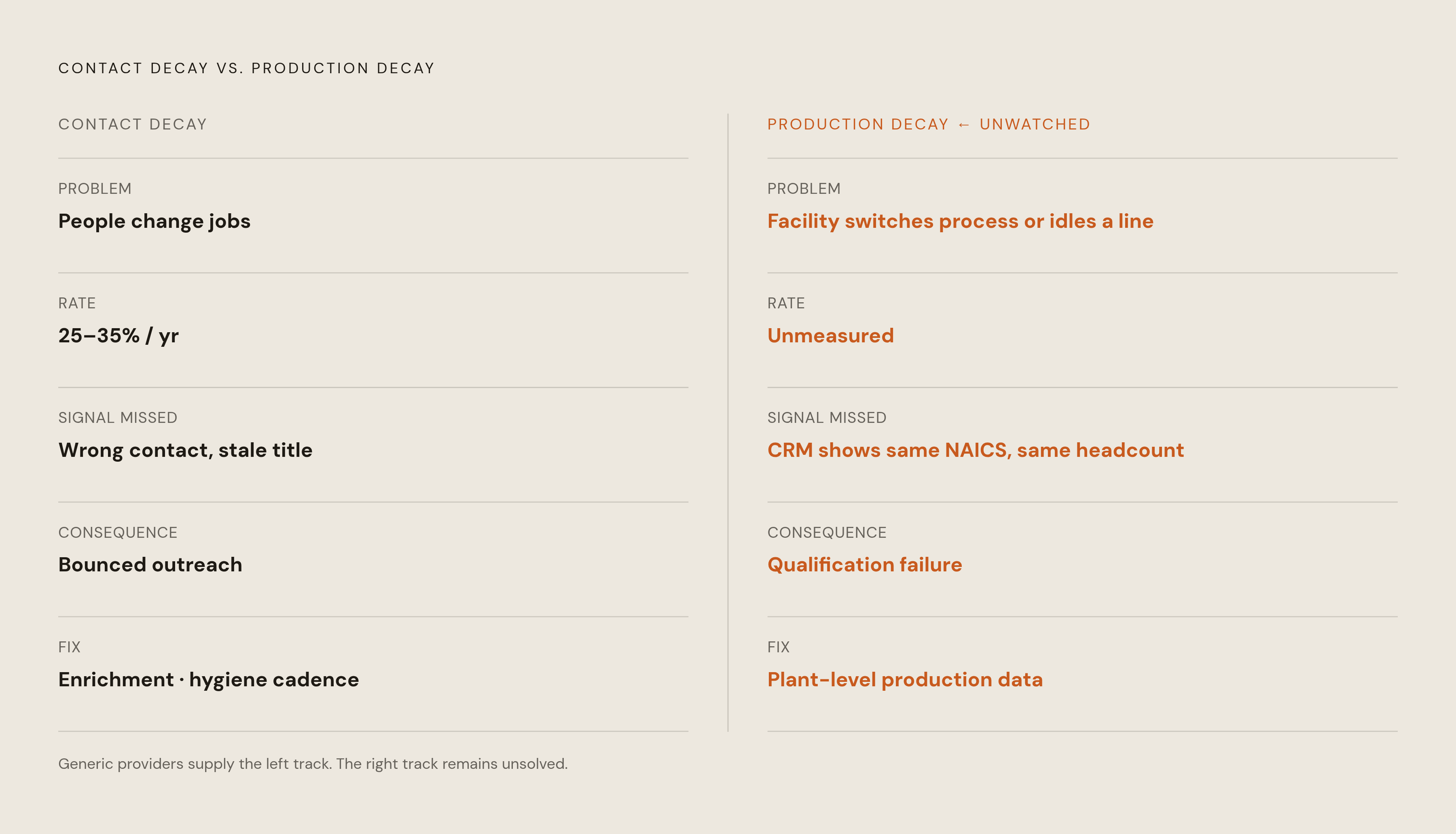
General data decay statistics are bad enough on their own. B2B contact data decays somewhere between 25% and 35% annually as people change jobs and companies restructure. For industrial sellers, though, decay runs on two tracks at once, and only one of them gets any attention.
Contact decay is the familiar one: the plant manager leaves, procurement gets a new lead, the ops VP retires. Standard problem, standard fix, mostly solved by enrichment tools and a decent data hygiene cadence.
Production decay is the one nobody's watching, and it's also the costlier problem. A facility switches from a solvent-based coating process to a water-based one. It brings in new equipment. It shifts a whole line to a different process, expands capacity, or idles a line entirely. That information almost never makes it into a generic CRM, and it's rarely available from a generic data provider either. The CRM record still shows the same NAICS code, the same headcount, the same industry tag it had two years ago, even though the plant now needs an entirely different chemistry to run its floor.
This is where "incomplete data" stops being a personalization problem and becomes a qualification problem. A rep can't know whether a facility is even a legitimate prospect without knowing what it actually produces, and no amount of email cleanup answers that question. What gets lost is the clean inbox itself. It's the fact of what a plant runs on its floor right now, which is the one fact a rep actually needs before making the call.
How the ERP-CRM disconnect compounds the problem for manufacturing teams
Operational truth in a manufacturing organization doesn't live in the CRM. It lives in the ERP: order history, production schedules, inventory position, service records, pricing agreements, the signals that tell a sales team whether an account is expanding, contracting, or quietly slipping to a competitor. Sales works out of the CRM. Operations and finance work out of the ERP. In most organizations, nothing connects the two automatically, and that gap is the more consequential one, not the plant-level data gap sitting on top of it.
The consequence lands directly on forecasting and account planning. Reps build territory plans and pipeline forecasts against CRM data that has no relationship to actual order patterns, while the ERP data that would reveal reorder timing, volume shifts, and account health sits locked in a system sales never opens. ERP integration is widely treated as the single biggest differentiator in manufacturing CRM selection, and for good reason: some platforms share a native database with the ERP, others depend on middleware or custom APIs, and the gap between those approaches shows up directly in the reliability of what sales teams can actually see and act on.
When ERP data doesn't flow into the CRM, sales leadership tends to ask why adoption is low. Rather, anyone expecting high adoption should ask why. Reps figured out a while ago that the system doesn't reflect reality, so they stopped trusting it and started keeping their own spreadsheets. For industrial teams, the real cost of that workaround stays invisible, because the cross-sell signals buried in order history and account activity patterns never surface in the tool where reps actually plan their day.
Territory planning built on company-level data systematically misses manufacturing density
Territory planning in industrial sales usually runs on geography, an existing account list, and gut feel, largely because that's what the CRM can export. Manufacturing density doesn't cooperate with that method. An industrial corridor can pack more addressable production capacity into 30 miles than a rep's entire multi-state territory holds everywhere else combined, and the CRM has no way of showing that concentration.
Research has found that optimized territory planning can lift revenue 2% to 7% without adding a single headcount. In manufacturing, that upside almost certainly runs larger, because the baseline territory was built on company counts instead of plant-level opportunity to begin with. A territory built on company-level CRM data undercounts plants, since multi-site manufacturers show up as a single account. It misses facilities left out of the CRM altogether, whether greenfield sites or plants held by a competitor. And it can't distinguish a large plant from a small one, because production volume was never a field anyone captured.
There's an equity problem hiding inside all this, too, and it rarely gets named. Two reps can carry the same number of CRM accounts while one territory holds dramatically more addressable manufacturing capacity than the other, and nobody notices, because the data never reflected actual production volume in the first place. That kind of imbalance only surfaces when territory analysis starts from real facility-level data, plant by plant, product line by product line. Company counts can't produce it. Good territory planning for manufacturing sales needs data on what each facility makes, its production scale, its equipment, and its physical location, not a pin dropped on a corporate headquarters somewhere on a map.
Inside existing accounts, the CRM's plant-blindness hides the largest cross-sell opportunities
Selling to an existing customer is widely understood to succeed at a substantially higher rate than converting a brand-new prospect. In industrial sales, "existing customer" almost always means one plant inside a multi-plant account, which raises the obvious question: what about the other plants?
They're invisible. Same corporate parent, different facilities, quite possibly the exact same product need, and none of it shows up in a CRM that models the account at the company level with no plant hierarchy underneath it. A specialty chemical rep who wins a water treatment application at Plant A gets no CRM signal that Plants B, C, and D, under that same parent company, run the identical process and could use the identical product. That intelligence has to get rebuilt by hand, plant by plant, every time, usually through a relationship or a lucky conversation on a plant tour rather than through the system that's supposed to hold the answer.
Reps' diligence alone can't fix this, because the problem sits below the rep, in the structure of the record itself. Cross-sell opportunity in a manufacturing account lives at the facility level: which process does this plant run, which of the seller's products does that process actually require, which plants in the family aren't customers yet. None of those questions get answered from a company-level record, no matter how well-maintained it is. The revenue lift from upselling and cross-selling within current accounts is substantial, and capturing it in an industrial context depends entirely on knowing what each facility does, not just knowing the name of the corporate contact. Account growth strategies that treat the CRM as the source of truth will systematically underexplore multi-plant accounts, because the CRM was built without any way of seeing the plants at all.
When AI is added to a CRM that doesn't model plants, the errors scale faster
CRM platforms are adding AI assistants, lead scoring, automated prospecting, next-best-action recommendations, and forecasting models at a fast clip right now. All of it depends on context. If the underlying account data is structured around companies instead of plants, the AI inherits the exact same blind spot the rep already had, just running faster and touching more accounts per hour.
A lead-scoring model trained on company-level firmographics will score a multi-plant manufacturer the same way regardless of which of those plants actually run the process relevant to what's being sold, because that distinction was absent from the training data to begin with. A next-best-account recommendation engine, built on a CRM that already undercounts plants, will recommend accounts the rep already knows, while the facilities left out of the system in the first place stay exactly as invisible as before, just with an automatically generated report attached saying there's nothing new to find.
AI doesn't fix duplicated, stale, inconsistent, or badly mastered data. It amplifies whatever is already there. In manufacturing, where the foundational account model was built around something other than facilities, amplification means scaling territory blind spots directly into automated outreach, into forecasts, into pipeline projections that look precise and are wrong in exactly the place the CRM was always wrong. Adding AI on top of a broken account model doesn't make the model less broken. It just makes the errors faster, more confident, and harder to trace back to the record that caused them.
What a CRM data foundation built for manufacturing sales actually requires
The fix isn't a cleanup project, and treating it like one is the mistake most organizations make first. Deduplicating contacts and refreshing job titles doesn't touch the underlying problem. The account model itself has to change: the plant becomes the primary record, and company or corporate hierarchy sits as a layer above it, not the other way around.
A plant-level record earns its keep only if it carries real substance. What the facility actually produces, in specific product terms rather than an industry code. What process it runs, since that determines which consumables, chemicals, coatings, fluids, or packaging materials it needs. What equipment sits on the floor, because machinery type signals purchasing need with far more precision than headcount ever could. Production scale and activity signals, since a plant running three shifts is a fundamentally different opportunity than one that's partially idled. Environmental and regulatory profile, which shapes which product formulations are even viable for that site. Verified contacts at the facility itself, direct lines to plant managers, procurement, and operations, not a corporate switchboard number or a role-based inbox nobody checks. And an org chart mapping the hierarchy across sites, so it's possible to see at a glance which plants are already customers and which ones aren't.
ERP integration belongs in this foundation too, not as an afterthought bolted on later. Order history, reorder cadence, and volume changes need to flow into the account record directly, so cross-sell timing and account health become visible to sales without someone running a manual data pull from a system they don't have access to. Pipeline stages need to mirror the actual manufacturing sales motion, RFQ, quote, engineering review, approval, order, instead of forcing an industrial deal through a generic funnel built for subscription software renewals.
Territory planning becomes meaningful only once it's built on plant counts and production density rather than account counts and geography, with the same underlying data foundation doing double duty: better account records and equitable, opportunity-weighted territory design come from the same source. Platforms that index manufacturing facilities at scale, capturing production profile, equipment, process type, and activity signals at the plant level, and integrating directly with the CRM systems sales teams already use daily, are what make this operational for a large, distributed industrial sales organization, rather than a research project every rep has to redo alone.
Whether any of this is actually working shows up in behavior, not in a dashboard. Reps spend less time reconstructing plant-level context before every call. Territory coverage starts to reflect actual manufacturing density instead of a map of corporate headquarters. And cross-sell opportunities inside multi-plant accounts start showing up because the data pointed to them, not because a rep happened to ask the right question on a tour of the floor.