New U.S. Factory Openings as a Sales Prospecting Signal
Factory openings trigger predictable purchasing cascades with hard deadlines.

For industrial sellers, this is not a policy story. It is a purchasing-opportunity story. The first force is geopolitical. Most OEMs surveyed by the Reshoring Initiative cite worry about risks such as a potential Taiwan crisis as a primary reshoring driver. That concern has real purchasing consequences: when a company decides that a supplier two thousand miles away is safer than one eight thousand miles away, it builds a plant, and a plant needs everything from capital equipment to consumables.
The second force is federal incentive money. The result shows up in the job mix: electrical equipment and computer/electronics together account for a majority of announced reshoring jobs in 2024. These are not low-margin assembly operations. They are capital-intensive facilities with exacting process requirements.
The third force is tariff-driven footprint change, and it is happening fast. In Q2 2025 alone, IoT Analytics tracked 227 public industrial firms announcing footprint changes, the majority expanding within the U.S.: 87 expanding existing U.S. operations, 33 moving production from China, and 13 relocating from Mexico or Canada. The Reshoring Initiative's 2024 Annual Report counted 244,000 announced manufacturing jobs returned to the U.S. in 2024, which pushed the running total since 2010 past 2 million.
The signal must be read carefully. IoT Analytics' Industrial Macro Pulse from May 2026 concludes it is too early to call a "reshoring boom." The data show a strong manufacturing sector, not a boom, and manufacturing construction spending is down from its mid-2024 peak. That nuance is precisely why timing matters for sellers. Corvus, a commercial intelligence platform, indexes more than 500,000 manufacturing facilities with more than 60 data points per facility, including production type and equipment, making it possible to distinguish a reshoring announcement that signals immediate chemical or fluid demand from one that does not.
What a factory opening actually signals: a predictable cascade of purchasing decisions with hard deadlines
A new factory does not create one sale. It triggers a structured sequence of purchasing decisions tied to construction and ramp-up timelines, each with its own lead time and decision window. The sequence runs from capital equipment qualification through MRO supply contracts, process chemicals, and fluid programs. All of these must be evaluated and contracted before production begins, not after. A plant cannot run its first production shift on a promise of cutting fluid.
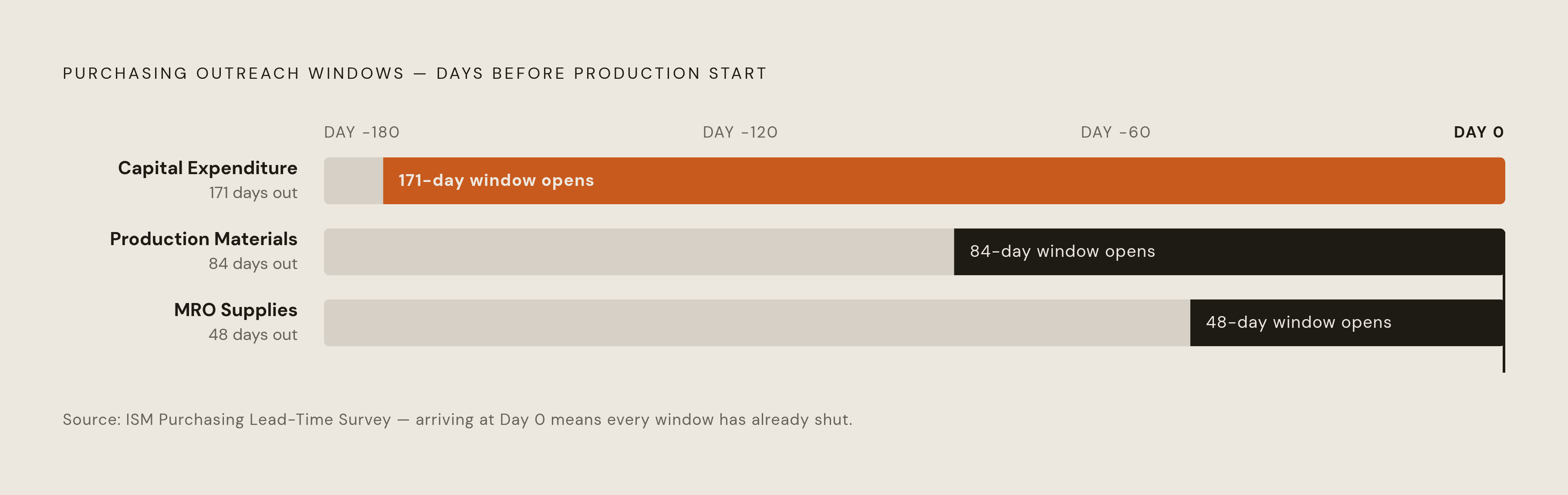
The hard numbers come from ISM lead time data. As of June 2026, capital expenditure commitments average 171 days, production materials 84 days, and MRO supplies 48 days. If you arrive on opening day for an MRO conversation, you are already three months late by ISM's own figures. The purchasing window is widest and least competitive well before the grand opening. By the time a plant is operational, the majority of supply contracts are already decided.
A common objection deserves a direct answer. Sellers who do not sell capital equipment sometimes assume they can wait. The lead time data says otherwise. Even sellers of consumables in fluids, chemicals, and coatings must be qualified through plant trials before a line runs. Once the list closes, the conversation changes from evaluation to displacement, which is a much harder sale.
There is a second-order effect that multiplies the opportunity. A new chip plant in New York, Texas, or Arizona causes an industrial ecosystem to spring up around it, multiplying the number of new accounts in a region. The anchor plant is one prospect. Its substrate suppliers, gas handlers, packaging vendors, and precision machining partners are dozens more, each with its own purchasing cascade and its own deadline clock.
Which verticals and plant types generate the most immediate purchasing need for industrial sellers
Process type, not broad industry sector, is the correct unit of analysis for predicting purchasing need at a new facility. A pharmaceutical API plant needs cleaning chemicals and HVAC-grade sanitizers. The six-digit NAICS code, not the two-digit sector, tells the seller which product family is relevant, and even that has limits when a plant runs multiple processes.
The named active projects show how specific this gets. Micron's $200 billion investment across Idaho, New York, and Virginia, with the New York fab breaking ground in early 2026, signals demand for ultra-pure chemicals, specialty gases, and precision equipment. Eli Lilly's $6 billion active pharmaceutical ingredient facility in Huntsville, Alabama, part of $27 billion in investment across four new U.S. pharmaceutical plants, signals demand for cleaning chemicals, sanitizers, and controlled-environment HVAC products. Eaton's $242 million, 1-million-square-foot facility in North Little Rock, Arkansas, for modular electrical enclosures signals metalworking fluids, coatings, and MRO. GE Appliances' $1 billion investment at Louisville's Appliance Park, including more than $400 million to move dryer production from Mexico, signals stamping lubricants, coatings, and assembly adhesives. Rivian's $5 billion, 9-million-square-foot site in Stanton Springs, Georgia, scheduled to produce 400,000 vehicles annually by 2028, signals forming lubricants, metalworking fluids, coolants, coatings, adhesives, and water treatment. Kikkoman's third U.S. production facility in Jefferson, Wisconsin, which opened September 18, 2026, a 240,000-square-foot plant representing approximately $560 million in investment over ten years, signals food-grade lubricants, cleaning chemicals, water treatment, and food safety coatings.
The verticals most structurally tied to new-plant activity are specialty chemicals, metalworking fluids, and industrial lubricants. New precision machining plants for aerospace, automotive, and semiconductors are primary demand drivers for metalworking fluids, and the U.S. market was valued at USD 2.6 billion in 2025. Deloitte's 2026 Chemical Industry Outlook adds context: persistent overcapacity in basic chemicals means specialty sellers cannot win on price alone. New-plant capture is the structural growth path, and differentiation comes from matching chemistry to specific manufacturing steps. That requires knowing what the plant will actually run before the conversation begins.
Why most industrial sales teams miss the window even when the signal is visible
The gap between a publicly announced factory opening and a sales team's first outreach is almost always caused by data and process failures, not lack of effort. One parent firm can run a dozen facilities, but each has its own manager, procurement budget, and production line. A CRM keyed to the corporate HQ address causes field reps to drive past nearby plants that are not in the system.
The data decay problem compounds the issue. CRM data decays at roughly 30% per year on average, per Gartner research. The research and prospecting burden then falls on the rep, who spends an outsized share of the week switching between systems and manually reconciling data, pulling time away from actual selling.
The intent signals exist in public data. Manufacturing America's 2026 state-of-play analysis adds a further dimension: technician readiness, not land cost or tax breaks alone, now determines which reshoring projects succeed or stall. If you arrive after the hiring wave, you compete against an incumbent relationship and lose on process before product is ever discussed.
How do I know when a manufacturing facility is actively evaluating new suppliers
You need plant-level data, not company-level data, to act on a new factory opening, and the fields that matter are operationally specific. Certifications such as ISO 9001, AS9100, IATF 16949, and FDA registration signal the quality and regulatory requirements the supplier must meet, and they often predict which product grades are required. Plant-level verified decision-maker contacts, the plant manager, VP of operations, procurement director, and maintenance lead, matter more than the corporate HQ contact.
NAICS codes and headcounts at the company level are not a substitute for this data. A company with 5,000 employees at HQ may run a 50-person specialty machining plant two counties away that is the actual buying unit. Integration with HubSpot, Salesforce, and Dynamics 365 means this plant-level data feeds directly into the CRM workflows where territory assignments, route plans, and outreach sequences are actually managed.
How to build a territory plan that treats factory openings as recurring events, not surprises
Territory plans built on real manufacturing density, including planned and under-construction facilities, systematically outperform plans built on geography or existing account lists alone. IndustrialSage tracker data shows investment concentrating heavily in Texas, Virginia, Arizona, New York, and Idaho. A territory plan built on historical plant density in the Midwest may structurally miss the next five years of new-account opportunity.
Because of the second-order supplier localization effect, map not just the anchor plant but the supplier ecosystem it will attract. A semiconductor fab triggers demand from chemicals, gases, substrates, precision equipment, and packaging suppliers, each of which becomes a new manufacturing account. IndustrialSage updates its tracker weekly as a model of the monitoring discipline required.
The most concrete illustration comes from a pump manufacturer case. The fix was not more effort. It was data that reflected the plant portfolio rather than the company name. Corvus captures real-time activity signals at the plant level, so you can filter new facility announcements by construction progress and estimated time-to-production, and prospecting effort lands inside the actual purchasing window rather than after critical vendor decisions have already been made.
Factory openings inside existing accounts as the most underused cross-sell trigger in industrial sales
A new plant at an existing customer is the clearest, lowest-risk cross-sell and expansion signal available to an industrial sales team. Most teams miss it because their CRM reflects the company, not the plant portfolio. An existing account may have one plant on contract and eleven others in the CRM as a single line item. The rep without it learns from a competitor's win notice.
The pump manufacturer case illustrates this directly. For specialty chemicals and fluid sellers, this gap is structural. This is a new commercial event that requires a new conversation, and the rep who initiates it early has an advantage no cold call can replicate.
The ERP is an underused signal source for sellers whose customers are already on contract. Plant-level visibility reveals the gap between what the account buys and what the account needs. That gap is revenue already within reach, requiring no new logo, no new relationship, and no new risk.
The prospecting sequence: what to do when a new factory announcement hits your territory
A factory opening announcement is a starting gun, not a news item. The sales team that has a defined response sequence will always reach the right contacts before the team that treats it as background reading. First, qualify the signal immediately. Confirm plant type at the process level, not just sector, along with the production start date or estimated timeline, facility size and planned capacity, and what equipment has been announced or permitted. This determines which product categories are relevant and sets the lead-time clock.
Second, map the buying organization at the plant level. Identify the plant manager, VP of operations, procurement director, and maintenance lead as distinct contacts, not the corporate procurement contact. At a new facility these roles are often being filled in real time, making early outreach directly to the plant-level hire the highest-value move.
Third, calibrate outreach timing against lead times. Use the ISM framework of 171 days for capex, 84 days for production materials, and 48 days for MRO, and count backward from the announced production start date to see when each product category conversation must begin. If you miss this window by even a quarter, the vendor list is often closed.
Fourth, engage before the RFP with value specific to the plant's process. Differentiation in metalworking fluids and specialty chemicals is driven by matching chemistry or fluid systems to specific manufacturing steps and by offering plant trial frameworks. This engagement only works if the rep knows what the plant will actually run, which requires plant-level data, not a company overview.
Fifth, flag the new plant in the CRM and link it to the parent account. This prevents the account from appearing as a single line item and ensures territory assignment, route planning, and quota credit reflect the actual plant-level opportunity. Corvus integrations with HubSpot, Salesforce, and Dynamics 365 make this a structural fix rather than a manual workaround.
The teams that win consistently are the ones for whom a new plant opening in their territory is never a surprise. The factory opening belongs, in the end, to the seller who saw it coming and engaged before the first hire posted a job listing.