Conversion Funnel Mapping for Specialty Chemical Distributors
Specialty chemical deals hinge on technical evaluation, not awareness.

Think of a conversion funnel built for software or consumer goods: it assumes a single buyer who moves through awareness, interest, and decision, pulled along by content and closed by a sales call. Specialty chemical distribution does not work this way, and treating it as though it does produces a pipeline that misrepresents the business it is meant to track. The actual buying process runs on technical evaluation, formulation compatibility, approval from several different people inside the customer's organization, and trust built over months or sometimes years of working together. A marketing qualified lead who downloaded a spec sheet is not meaningfully closer to a purchase order than one who never heard of the company. Manufacturers heading into 2026 want distributors who bring end-market-specific technical knowledge and formulation support, so you are already being evaluated on capability long before any formal request for quote gets issued. A funnel that measures only top-of-funnel awareness and bottom-of-funnel close will miss the entire phase where the deal is actually won or lost.
The buying committee and its approval logic at each stage
Before any funnel stage can be mapped correctly, the sales team needs to know who inside the customer's building actually holds the authority to say yes, and when that authority gets exercised. Technical contacts, the formulation chemists and QA managers, evaluate chemistry and process fit first. Commercial contacts in procurement and supply chain only enter the conversation once the technical case is settled, and then they negotiate terms and confirm logistics. Executive sign-off comes last, only after both of those layers are satisfied, so if you chase an executive relationship while skipping the technical gatekeepers, you are working the wrong end of the committee.
Regulatory complexity does not sit outside this process; it adds a structural layer to it. REACH puts a defined duty on distributors to pass safety information along the supply chain, and if you juggle dozens of raw materials across multiple jurisdictions, you weigh a distributor's regulatory expertise as part of the core evaluation. You assess compliance capability at the technical stage, alongside formulation fit, before the deal is basically done, not as paperwork bolted on after.
Reformulation cycles matter here because they can reopen a buying decision that might otherwise stay closed for years. Roughly half of specialty chemical companies report that they have reformulated or phased out products containing chemicals of concern over the past three years, and a similar share expect to continue that work over the next three. Each of those reformulation events reactivates the full committee: the chemist has to revalidate, QA has to resign off, procurement has to requalify terms. A distributor tracking only one contact per account has no way to see this cycle coming, and no way to know whether the account relationship is stable or about to be reopened from scratch.
Top of funnel: identifying plants at the moment a purchasing need is forming
The top of the specialty chemical funnel is a timing problem more than an awareness problem. Most industrial purchasing decisions take shape well before a sales rep ever gets a call, so if you wait for an inbound inquiry, you are often already behind whichever incumbent supplier is already in the building.
Plant-level production signals read these early moments far more reliably than firmographic filters like industry code or employee count ever could. A facility adding CNC capacity, shifting its materials mix, or posting openings for EHS roles is telegraphing a chemical purchasing decision well before any RFQ circulates. Three categories of triggers at the plant level matter most: supply chain disruptions that send a competitor's customers looking for an alternative source, leadership changes (new operations VPs tend to review vendor relationships in the months right after they take the role), and capex plans that get telegraphed publicly, including earnings call commentary announcing capacity expansion.
Tariff disruption has added a further layer of top-of-funnel opportunity as you head into 2026. Distributors report wider and more persistent tariff-related disruption than manufacturers do, and it touches sourcing, product availability, and delivery schedules. Plants caught in the middle of that disruption are actively reassessing their supply relationships right now, which makes them genuinely in-market. A plant sitting in the right NAICS code, running smoothly and satisfied with its current supplier, is not a prospect worth chasing. A plant in the middle of a process change or a supply disruption is, and the funnel has to be built to find that plant at that moment, not six months later once a competitor has already closed it.
Middle of funnel: navigating the technical evaluation phase
Once a distributor earns a conversation with the right plant at the right moment, the deal enters a phase that generic funnel models simply do not account for: technical evaluation. A prospect who has had a few commercial conversations but has not validated formulation fit has not progressed toward close. That prospect sits at a gate that only application expertise can open, and no amount of email nurture or follow-up cadence moves it forward.
Distributors working in personal care, coatings, food, or rubber segments often maintain laboratory infrastructure that lets customers test new ingredients, troubleshoot an existing formulation, or confirm performance claims before committing to full-scale production. That lab capability works as a mid-funnel conversion mechanism, not as a marketing asset sitting on a website. For smaller formulators without in-house R&D, the distributor's technical team effectively substitutes for the customer's own application engineering. The distributor who shows up with that support earliest builds an evaluation relationship that a later-arriving competitor finds very hard to displace, because switching at that point means redoing work the customer has already completed with someone else.
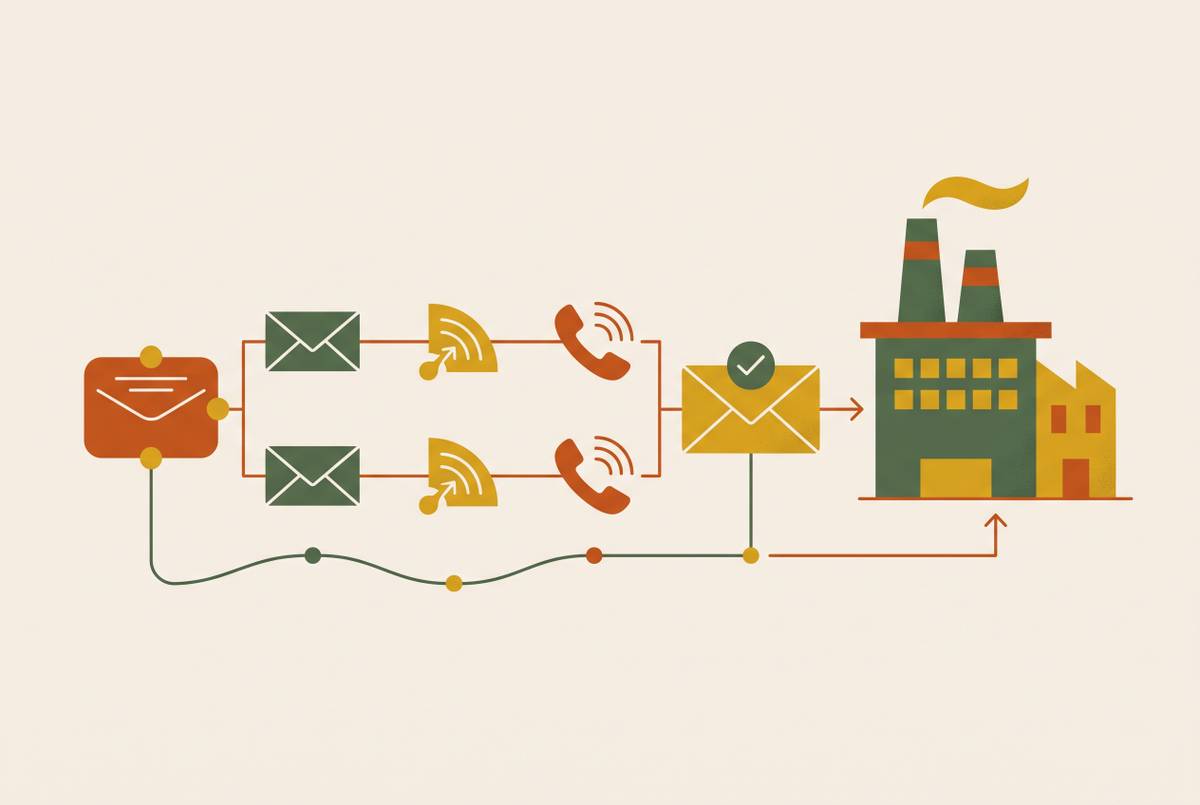
Regulatory navigation runs alongside the technical evaluation. Proficiency in REACH, CLP, TSCA, GMP, and labelling compliance has become a core differentiator for distributors serving pharmaceuticals, personal care, and food ingredients. A distributor who cannot demonstrate that capability during the technical evaluation loses the qualification outright, regardless of how competitive the price is. The practical design implication for a funnel is that the move from top-of-funnel to mid-funnel should be triggered by a real technical engagement: a sample request, an application lab visit, or a formulation consultation. So CRM stage definitions need to reflect that trigger directly, or the funnel will show movement that never actually happened on the ground.
Funnel conversion rates and the re-qualification barrier
The single most misunderstood friction point in this funnel is the cost and risk a customer takes on by re-qualifying a new supplier. For process chemicals like metalworking fluids, re-qualification can take many months and needs engineering sign-off, so it drags on conversion in a way no amount of commercial pressure or price discount can shortcut.
That barrier cuts two different ways depending on where a distributor sits. For the incumbent, it functions as a retention moat: customers rarely switch mid-production run, which gives the incumbent time to expand the relationship even while a competitor is actively pitching the account. For the challenger, it means a direct attack on the incumbent's core product, a full fluid conversion, carries the most re-qualification risk and the longest evaluation cycle of any move available. Attacking there head-on is usually the slowest path to a win.
The more productive strategy for a challenger is adjacent-category entry: targeting cleaners, rust preventives, or wastewater treatment chemicals, categories where re-qualification risk is lower and a technical relationship can be built without forcing a full fluids conversion. That foothold can expand over time, once trust is established through a lower-stakes product line. Reformulation activity has become a consistent part of product strategy rather than an isolated event, and that matters here because by the time reformulation hits, the customer has already accepted re-qualification risk on their own terms. Those moments are the highest-probability conversion windows a challenger distributor is going to get. A funnel that does not model this delay will underestimate time-to-close across the board and will misallocate follow-up effort: a deal that looks stalled may simply be sitting in a qualification hold that calls for technical patience.
Bottom of funnel: the decision criteria that close specialty chemical deals
The decision at the bottom of the specialty chemical funnel is rarely made on price alone. It gets made on demonstrated technical capability, supply reliability, and the customer's confidence that the distributor can function as a long-term formulation partner. Supply chain reliability in particular has become a top-tier decision criterion heading into 2026, and companies are prioritizing reliability and tariff risk management in their distribution relationships. A distributor who can show multi-sourcing capability and regional supply continuity is addressing a concern the customer is actively weighing at the exact moment of decision.
The consultative approach, solving a problem the customer has not yet fully defined, closes faster than a proposal-response approach because it reaches the decision committee already framed as a solution. A distributor who surfaced the need through an early plant signal and then co-developed the formulation answer is positioned as the author of that solution. A distributor who enters at the RFQ stage is competing on a specification they had no hand in writing, defending against an incumbent who wrote the rules of the comparison.
Bottom-of-funnel stage definitions should include explicit checkpoints rather than vague judgment calls: has the technical contact approved the formulation, has the QA manager signed off, has procurement received a compliant regulatory package. Close probability should be calculated against those gates, not against how much time has elapsed or a rep's gut feel. A bottom-of-funnel built this way gives a sales leader a pipeline number that can actually be trusted, rather than a stack of optimistic guesses dressed up as a forecast.
CRM design and account data in the funnel
If the CRM behind it cannot represent that stage logic, none of it means anything. A system tracking only company-level contacts and generic deal stages cannot capture a multi-stakeholder, multi-phase buying process, and the result is a pipeline that looks fuller than it actually is, paired with a sales team that cannot see where deals are genuinely stuck.
At minimum, the CRM needs to separate technical contacts from commercial contacts, track the current phase of technical evaluation for each account, log active formulation trials, and record regulatory documentation status. So without that structure, stage-progression reports are just noise dressed up as insight.
The ERP sitting next to the CRM is an underused source of exactly this kind of intelligence. Order volume changes, credit patterns, and service ticket frequency are already recorded inside it as early warning signals. If a key account orders noticeably less over several consecutive months, that signals churn risk the revenue team usually never sees, because nobody has connected the ERP data to the CRM data. Generic firmographic databases make the same gap worse: a CRM full of NAICS codes and headcounts cannot tell a rep what a facility actually produces, what process chemicals it runs, or whether a recent equipment change has created a new purchasing need. What drives every funnel stage described above is plant-level production data, not industry classification codes. Platforms that connect plant-level manufacturing data directly to CRM records tie what a facility makes and runs to the accounts and opportunities a rep is managing, giving the funnel the factual foundation it needs to work as a forecasting and prioritization tool.
Account growth as a second funnel running inside existing relationships
The highest-probability pipeline in specialty chemical distribution is usually the cross-sell and upsell opportunity that sits inside accounts where you already have a technical relationship. The same re-qualification barrier that slows down new account conversion works in the opposite direction here: once trust is established in one product category, expansion into an adjacent category inside that same account faces much less friction than winning a brand-new customer from scratch.
The embedded service model is the clearest documented path to this kind of expansion. A distributor with on-site presence generates real-time data on how a customer is actually using a product, and that data makes cross-sell and upsell targeting far more precise than a generic account review ever could. A distributor who knows what a plant is running and consuming can see an adjacent need before the customer has articulated it, and can bring the formulation answer to that need before a competitor knows the opportunity exists. That is the second funnel running quietly inside every account a distributor already holds, and it deserves the same stage discipline and CRM structure as the acquisition funnel built to win the account in the first place.