Outbound Prospecting Cadences for Industrial Sales Reps
Plant-floor events, not digital signals, reveal when manufacturers are ready to buy.
Outbound cadences built for manufacturing accounts fail for a structural reason, not a tactical one: they borrow their signal logic from software sales, and that logic does not describe how a plant buys. The fix is not a better script. The trigger is different entirely: it is built around plant-level events, not the digital intent data SaaS teams rely on.
Why generic cadence frameworks break down for industrial reps
Most cadence templates in circulation assume a buyer who lives in email, responds to LinkedIn messages, and can be nudged along by a drip of content. Process engineers, maintenance supervisors, and production managers do not operate this way. They answer phones. They are on the floor, not at a desk refreshing an inbox, and a cadence built around digital touches at SaaS frequency will miss them before it has a chance to work. That channel mismatch is a design flaw baked into the framework before a single call goes out.
The persistence gap makes the problem worse. Research from the Brevet Group, cited by Skipcall, found that most B2B sales need five or more touches to close, but most reps give up before the fourth attempt. In software sales, where digital channels offer more surface area for a prospect to respond on their own schedule, that early abandonment is costly but recoverable. Buying cycles stretch longer in industrial sales, and you can rarely reach a plant-floor buyer through anything but a phone, so if a rep quits at touch three, a deal closes that was never going to move faster anyway.
B2B sales broadly has already shifted from volume-based outbound to signal-based outbound. Autobound's 2026 outbound playbook documents how targeting fewer accounts with higher relevance produces response rates well above the cold outreach average. That shift is real for manufacturing too, but the signal has to change with it. You can see a software buyer's intent in page visits, content downloads, and job-change alerts. A plant's intent appears in steel on the ground: a new line, a new permit, a new press. A rep who imports a signal framework built for digital behavior and applies it to a facility that communicates through capital expenditure and environmental filings is reading the wrong data.
What plant-level events signal about a facility's purchasing timing
A facility tells a rep what it needs and roughly when it will need it through what it physically does, information no firmographic database captures. A plant does not announce purchasing intent the way a software buyer does by filling out a form. It announces readiness through construction, permitting, and hiring, and each of those events maps to a purchasing window that opens before the equipment ever runs.
Capital expansion is the clearest example. If a plant adds press capacity or brings on a new production line, it will need forming fluids, lubricants, or process chemistry matched to the new line before commissioning starts. The purchasing decision happens on the front end of that project, not after the line is already running, so a rep who waits for a public announcement of "we're buying metalworking fluids" has already missed the window.
Equipment composition tells an even more specific story. A plant running twelve progressive presses, four transfer presses, six weld cells, and two boilers, holding a Title V air permit and a VOC coating permit, is a plant with demand for cutting and forming fluids, weld consumables, rust preventives, and parts-washer chemistry. It is a parts list, and knowing it turns a cold call into a conversation about a process the buyer actually runs instead of a generic pitch about products the rep happens to sell.
New product lines carry the same weight. When a plant shifts to a new alloy, a new substrate, or a new packaging format, the chemistry and consumables it buys change, often permanently. Environmental permitting changes work as a leading indicator of the same underlying shift: a new air permit or a new wastewater discharge permit usually means a process change or a capacity addition is already underway, and the purchasing activity that follows is close behind.
Standard commercial databases make this information hard to find because they classify manufacturers by industry code and headcount. Those categories were built for other purposes and tell a specialty chemicals rep or a metalworking fluids rep nothing about what machinery a given plant runs or what it will therefore need to buy.
Tiering and prioritizing accounts before the cadence begins
Not every signal deserves the same cadence depth. The sharpness and immediacy of the trigger should set how fast a rep moves and how hard the cadence pushes, and sorting that out before the first call keeps effort aimed at the accounts where it has the shortest path to paying off.
Tier 1 accounts call for action within hours, not days. Capital expansion announcements, new environmental permits, and confirmed equipment installations at a named facility all belong here, because they carry the shortest purchasing window, and the risk that a competing rep reaches the buyer first is highest. These are the accounts where speed is the whole game.
Tier 2 accounts can wait a week without real cost. Hiring activity for process engineers or maintenance roles signals that a process change or a capacity build is already in motion, and the same goes for a new product-line announcement from a corporate parent that will touch specific plants. The trigger still points to a real purchasing decision, but the window is wider than it is for Tier 1.
Tier 3 covers gradual production volume changes, modest headcount growth, no confirmed trigger event, but a strong fit with the rep's ideal customer profile. These accounts go into a lower-intensity cadence that keeps them warm without consuming the time a Tier 1 account demands.
White space adds a further layer to this prioritization. Facilities outside a rep's current call rotation are a standing revenue risk, especially in regions dense with manufacturing activity, so any newly discovered plant should enter the tier system the way an existing account would, not sit in a separate, lower-priority bucket. The tier a plant lands in determines how the rest of the cadence gets built.
The cadence structure industrial reps should run
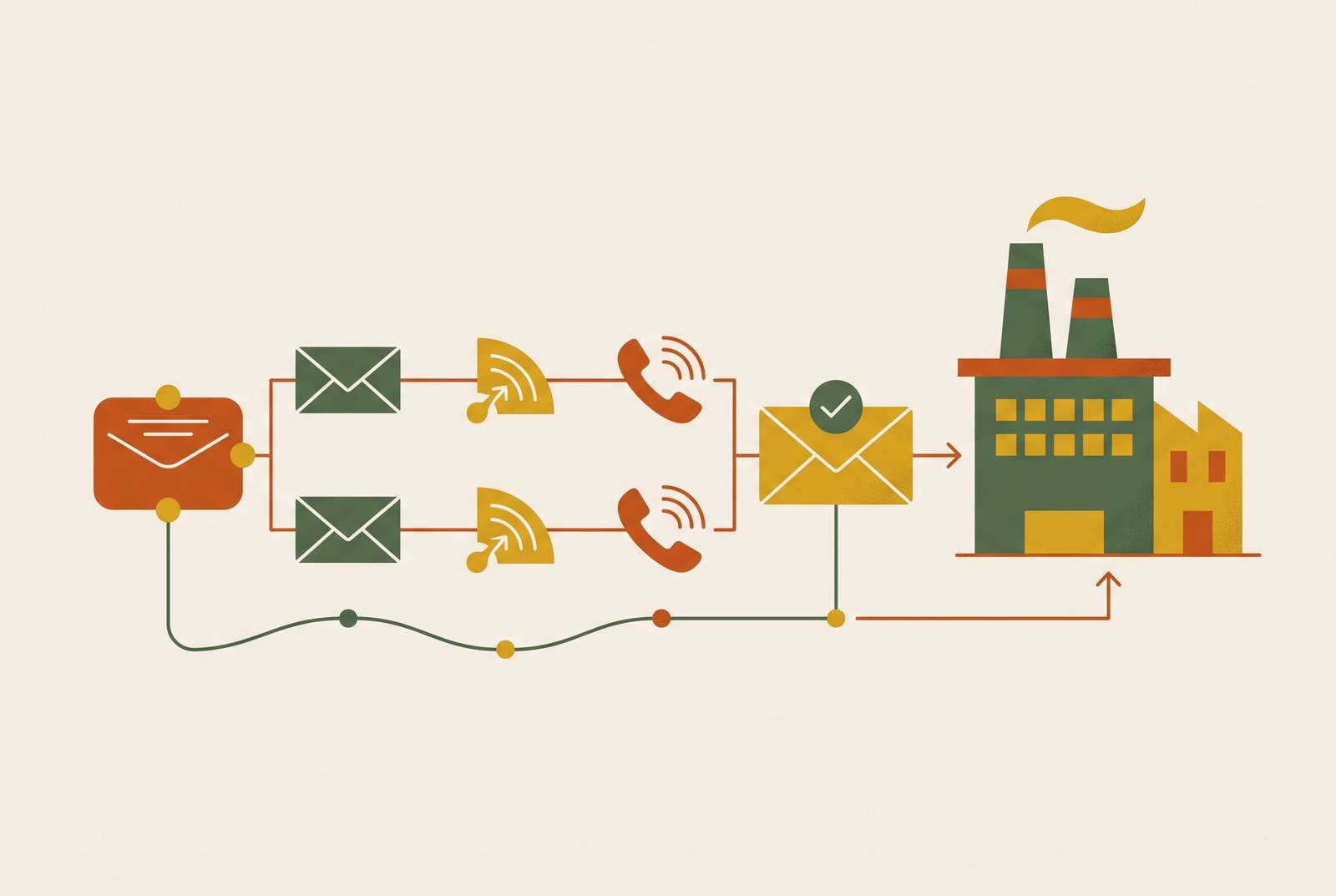
A cadence for industrial outbound should run across several weeks, with the heaviest activity packed into the first five days and each touch giving the buyer a new reason to respond instead of repeating the last message in a different format. The channel mix has to follow plant-floor behavior rather than SaaS convention: calls carry the weight of the sequence, email supports the call by delivering process-specific reference material (an application note or a case study from a similar operation) rather than serving as the primary channel, and LinkedIn plays a smaller, supporting role.
A working skeleton for a Tier 1 signal account looks like this. Day 1 opens with a call referencing the specific trigger (the expansion, the new line, the permit), a brief voicemail if there's no answer, and a short email the same day connecting that trigger to a process-specific point. Days 2 and 3 bring a LinkedIn connection request tied to the same trigger, with no pitch in the note itself. On day 5 a second call goes out, and a voicemail reaching the same unanswered line should reference the earlier email and offer a specific time to talk. Day 8 brings an email carrying a new piece of value, a relevant case study or a process comparison, instead of a check-in with nothing behind it. Day 10 is another call, and if a live connection still hasn't happened, the rep shifts to a peer of the original contact or a different person at the same plant. Days 14 through 17 continue alternating calls and emails, each one adding a new angle, and this is the point where multi-threading starts in earnest, reaching the plant manager and a direct report as separate contacts. Days 21 through 27 carry the breakup touch: closing the loop professionally, naming the trigger one more time, and stating when the next follow-up will happen.
Timing within that structure matters as much as the sequence itself. SalesHive's 2025 to 2026 outreach guide supports calling Tuesday through Thursday, specifically the 10 to 11 AM and 4 to 5 PM windows in the prospect's local time zone, as the highest-converting slots for booking appointments, with Mondays and Fridays marked as dead zones for prospecting calls. For a plant-floor contact whose day is structured around shift changes and production schedules, that mid-week window lines up with the moments they're most likely to be reachable at a desk rather than on the floor.
Multi-threading deserves particular attention in manufacturing accounts because the plant manager, the process engineer, and the maintenance supervisor carry different purchasing influence and respond to different kinds of outreach. Running parallel touches to more than one contact at the same facility raises the odds of a response without stretching the cadence out any longer than the 27-day skeleton already allows.
Messaging for a plant-level trigger event
The trigger is the argument for why the rep is calling at this specific moment. Manufacturing buyers notice immediately when that argument is vague, so if the message doesn't carry the plant-level signal through to the buyer, the cadence collapses fast.
The opening touch has one job: name the trigger explicitly. "I saw that your facility is adding a second stamping line" gives the buyer a reason to keep listening. "I work with manufacturers like yours" gives them a reason to hang up. The trigger needs to connect to a process need the buyer already recognizes, not to the rep's product line. A new progressive press line requires forming fluid qualification before it runs, and that qualification need is the reason for the call, with the product itself held back for later in the conversation. The ask on this first touch should stay narrow: a short call, a specific question about the process change.
Later touches need to build on the trigger rather than restate it. By the third or fourth touch, the message should shift from the trigger itself to a process-specific insight: what similar facilities typically run at this stage, what problems tend to occur during a capacity ramp like this one, and what has worked elsewhere. A case study from a facility running the same process carries more weight than a generic reference, and if you name the process, without necessarily naming the customer, the point stays concrete rather than abstract.
By the sixth or seventh touch, a peer reference or a specific application point can map the buyer's apparent situation onto a documented outcome somewhere else. MarketBetter.ai's 2026 cadence guide states the underlying principle for this kind of sequencing directly: each step should offer a new piece of value, positioning the rep as a helpful resource rather than just a seller. In industrial sales, that value is process knowledge rather than a content calendar of thought leadership pieces.
The breakup touch closes the sequence by restating the trigger and the offer briefly, then naming a specific date for the next check-in, tied to the plant's own timeline, a commissioning date or a fiscal quarter boundary, rather than a vague promise to reach back out at some unspecified point later.
How existing accounts fit into a signal-triggered cadence
The installed base is the most underworked asset most industrial sales teams have, and the same plant-level signals that drive new-account prospecting apply just as directly to growing the accounts a rep already owns. In specialty chemicals and metalworking fluids, the first drum sold into a facility is rarely the real prize. Converting an entire sump line, along with cleaners, rust preventives, and parts-washer chemistry, is where the account's value actually sits, and the trigger for that expansion is a signal a rep can watch for rather than a conversation that happens to come up.
Over a ten-to-fifteen-year equipment lifecycle, the original product sale often brings in only a fraction of the total revenue a facility will eventually generate. The rest comes from adjacent chemistry, maintenance products, and process upgrades, and capturing that revenue requires a proactive cadence rather than a wait for the buyer to call back. If a plant adds capacity or a new process line, that creates a cross-sell opportunity even when the existing line is already fully penetrated. Equipment maintenance intervals and warranty expirations signal that consumable or service purchasing is entering a review period. A facility that shifts the metals or substrates it processes changes what chemistry it needs, and a rep who knows about that shift before the plant's own purchasing team has fully acted on it holds a real advantage.
The barrier to acting on any of this is data opacity. Growth teams often miss cross-sell timing because the account record in the CRM reflects the plant's last purchase, not its current state. Static firmographic data doesn't just fail to help in this situation. It misleads, pointing a rep toward a version of the account that no longer exists.
Keeping cadence triggers current when plant conditions change
Plant conditions change faster than most CRM records get updated. Facilities change ownership, add production lines, shift the metals they process, close departments, or pick up new environmental permits on a timeline that outruns the typical annual data refresh most sales organizations run on. A cadence built on signal only works as long as the signal is current, and that currency is the part of the system most teams neglect.
A CRM carrying stale or generic firmographic data does more than cause a missed opportunity. It actively steers a rep toward outreach anchored to what a plant used to be rather than what it is now, and a buyer on the other end of that call can tell immediately that the rep hasn't done the work. A reference to a product line the plant stopped running two years ago, or an assumption about headcount that's since doubled, undoes the credibility that a well-timed, well-informed trigger is supposed to establish.
Sustaining a signal-triggered cadence over time requires continuous enrichment keyed to the same plant-level activity that makes the signals valuable in the first place: new permits, capital expenditure filings, process engineer hiring. Sustaining it is an ongoing operational requirement rather than a one-time data cleanup. The research burden that falls on a rep when this information isn't surfaced systematically is the largest time cost in industrial outbound today, and it's the reason most reps default to the accounts they already know well rather than pushing into white space where the signal, if anyone bothered to look, would justify the effort.
Measuring whether the cadence is working in an industrial context
The sources checked for this guide are listed below.