Identifying Emerging Industrial Clusters Before Competitors Do
Cluster formation shows up in commercial records months before government data confirms it.

Emerging industrial clusters form well before any government dataset or market report can name them. The commercial activity that signals a cluster, new facilities, equipment purchases, hiring surges, appears in commercial records months or years before the statistical agencies catch it, and the sales organizations that learn to read those signals directly are the ones that own the accounts by the time everyone else notices the cluster exists.
Why standard data tools miss emerging industrial clusters
A cluster only counts as "emerging" in the data once two conditions line up: a location quotient that's still low, paired with competitive activity that's clearly growing. That combination is a backward-looking confirmation, not a forecast. It tells you a cluster exists only after the underlying activity has already built up enough to move the numbers. The official signal always lags the real economic event.
A synthesis of interviews with 32 national cluster experts, conducted by Purdue University's Center for Regional Development, found that reshoring is reviving the agglomeration patterns that built the original industrial clusters of the 20th century, with new seeds of activity appearing in secondary markets. The experts interviewed for that project also pointed to a structural mismatch: the economic activity that defines a forming cluster happens before the systems meant to record it catch up.
That mismatch is built into the publishing schedule of the federal statistical agencies themselves. The Bureau of Labor Statistics, the Census Bureau, and the Bureau of Economic Analysis all run on fixed release cycles, monthly for a jobs report and a price-inflation series, monthly for income and spending data, quarterly for GDP. Each of those releases reflects economic activity that already happened weeks or months earlier. By the time a region's cluster profile appears in a commercial modeling tool like Lightcast or IMPLAN, drawing on that same government data, the window during which a supplier could have walked in as the first vendor on the ground has usually already closed.
Bend, Oregon's 2025 industry cluster analysis shows how this plays out. The city classified Creatives, Business Services, and Knowledge as "emerging" clusters, using Lightcast and Oregon Employment Department data layered with location quotient analysis and differential shift calculations. That data reflects employment and establishment counts the state agency had already collected and processed over prior quarters. The classification was accurate but described a cluster that had already been underway for some time before the analysis confirmed it.
For a sales organization, the practical cost of that lag is straightforward: a competitor who waits for a cluster to show up in a government dataset or a market report is bidding on accounts that an earlier mover has already closed.
The commercial signals that appear before any dataset catches up
If government data confirms a cluster after the fact, a different category of information reveals one while it's still forming. The most reliable early indicators of cluster formation are individual commercial events: a new plant opening or a facility permit being filed, a UCC filing for equipment financing, a CapEx commitment mentioned on an earnings call, a hiring push for automation or robotics roles, a request for proposal on a new production line.
These signals are useful because they're public record, and most of them can be read by machine. UCC filings go through state filing offices, usually the Secretary of State. Job postings sit on public job boards. CapEx plans and M&A activity show up in SEC filings and press releases. None of this is confidential, and none of it waits for a statistical agency's release calendar. Facility expansions, equipment-purchase UCC filings, and production ramp signals are regularly identified as the highest-value leading indicators for manufacturing prospecting, because each is a direct commercial action that predates any government employment count tied to the same facility.
Some of these signals carry more lead time than others. Earnings calls from publicly traded manufacturers can telegraph capital spending plans a full quarter or more before the spending happens. A vice president of operations who announces a new production line in a second-quarter earnings call is describing a timeline where facility prep and vendor selection happen in the third and fourth quarters, long before any analyst calculates the employment impact of the new line. Mergers and acquisitions operate as a macro-level version of the same signal. PwC's industrial manufacturing deals outlook found that deal values hit a record high over the past year, with activity concentrated around AI infrastructure, grid modernization, and defense and resilience capabilities. When acquisitions cluster around categories like power equipment and thermal management, you can see geographic concentration of capability before any map shows it.
None of these signals require privileged access. They're sitting in public filings and job postings right now. The competitive advantage doesn't come from finding a data source nobody else has. It comes from watching these sources constantly enough to catch the signal within days of it appearing, before competitors notice it weeks or months later.
Why manufacturing buyers are opaque to generic intent platforms
A reasonable objection at this point is that intent data platforms already exist to catch early buying signals, so why build a separate monitoring practice for manufacturing. Generic B2B intent data is built almost entirely from web behavior: page visits, content downloads, ad clicks. None of that reflects how a manufacturing buyer actually makes a purchasing decision.
A vice president of operations evaluating a new packaging line doesn't start by browsing a vendor's website. That person calls peers running similar lines at other plants, walks a trade show floor, requests spec sheets directly from equipment manufacturers, and reviews proposals from vendors who are already inside the building for other work. None of that activity leaves a digital trail that a generic intent platform can see. The problem compounds in a forming cluster specifically, because new facilities are staffed by people who haven't yet shown up in any contact database. A rep using a standard enrichment tool isn't just late to notice the cluster. That rep also has no way to find the plant manager or operations lead once they do notice, because that person doesn't exist in the system yet.
Reading manufacturing cluster formation accurately requires facility-level signals, permits, UCC filings, production line announcements, combined with contact resolution built at the plant level.
Stacking signals to locate a forming cluster before it has a name
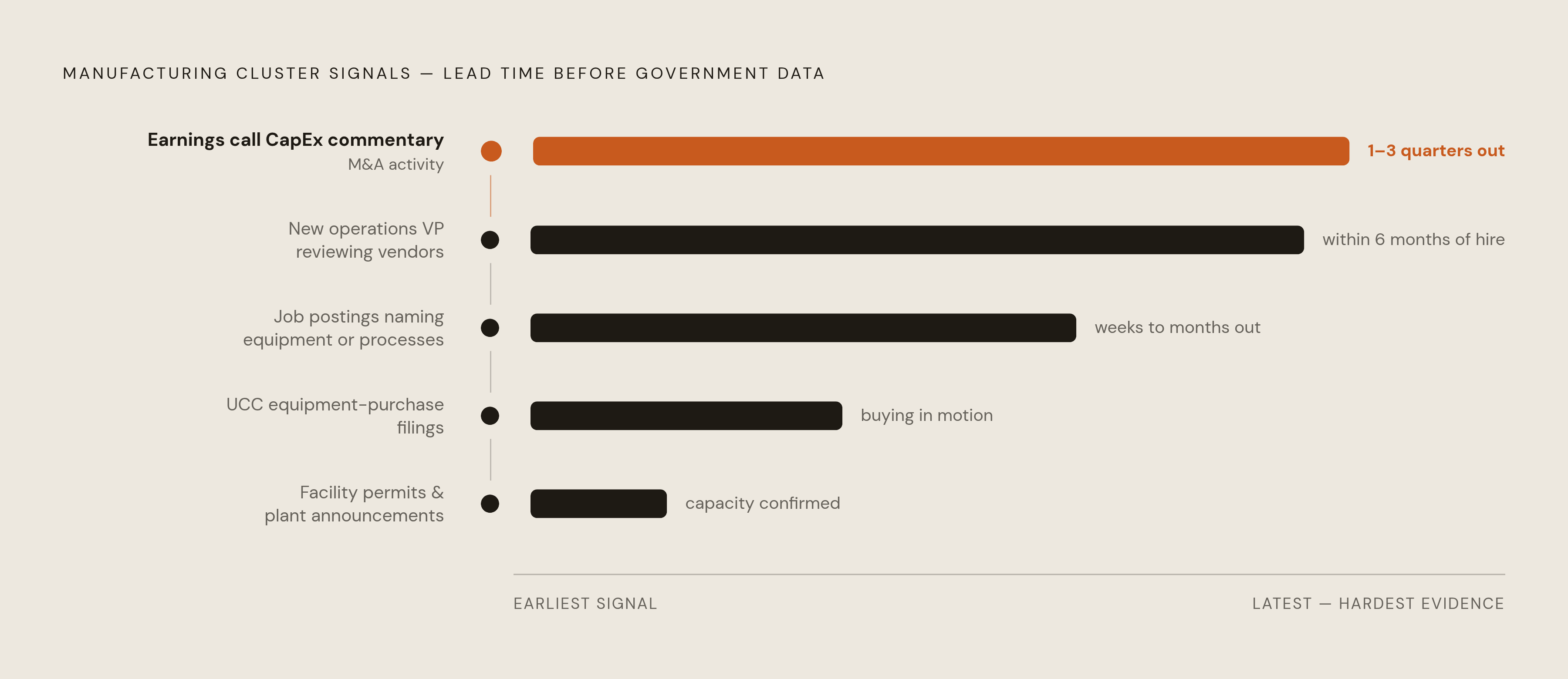
A single signal on its own is weak evidence. One new permit or one job posting could mean almost anything. The real evidence of a forming cluster is several of these signals appearing in the same geography around the same time: a new facility opening, paired with a CapEx increase, paired with a hiring push for automation engineers. Accounts carrying two or more stacked signals like that close at more than double the baseline win rate. CUT
Not every signal in the stack carries the same lead time, and ordering them helps a sales team decide where to look first. Facility permits and new plant announcements are the hardest evidence, proof that capacity is coming. UCC equipment-purchase filings show buying already in motion. Job postings that name specific equipment types or processes point to purchasing intent weeks to months out. Earnings call commentary on CapEx plans points one to three quarters further out than that. M&A activity and leadership changes matter too: a newly appointed operations VP typically reviews existing vendor relationships within six months of taking the role, and that review opens a window for a new vendor to get in front of that decision. Supply chain disruption, where a competitor's customers start actively looking for alternatives, rounds out the list.
This isn't theoretical. Kawasaki Robotics put this exact logic to work through Supplyco's Scout platform, which draws from more than 15 data sources to surface facility expansions, equipment filings, and hiring patterns. That approach identified six high-value customers that traditional prospecting methods had missed. Firmographic screening sorts companies by size and industry code, so it cannot produce that kind of result. Only a stack of commercial signals read together, in the same geography, can.
Two verticals where cluster timing is currently most consequential
Cluster formation isn't equally urgent across every corner of industrial manufacturing. Two verticals right now are moving fast enough, and concentrating geographically fast enough, that early entry carries an outsized reward.
Metalworking fluids is one. Aerospace has become the fastest-growing end-use segment for metalworking fluids, and growth is expected to continue at a meaningful pace through 2033. New aerospace machining clusters can be spotted through a specific combination of signals: job postings for CNC operators, permits for 5-axis machining centers, and facility announcements sited near existing aerospace primes or their tier-one suppliers. A fluid supplier that reaches one of these clusters at startup locks in formulation approvals and process qualifications that are expensive and disruptive for the plant to change later, which turns an early relationship into a long-term service contract almost automatically.
Specialty chemicals tied to electric vehicle and battery manufacturing is the second. Gigafactory announcements, relocations by battery component suppliers, and job postings for electrochemists or battery process engineers all mark the early stages of cluster formation in this vertical. Global EV sales passed 14 million units in 2023, and that volume has created sustained, years-long demand for advanced battery materials tied to each new gigafactory cluster. A specialty chemical seller who maps the full supplier ecosystem gathering around a single gigafactory announcement, cathode material producers, electrolyte formulators, thermal management component makers, is looking at a multi-account opportunity built from one public announcement.
The pattern repeats across both verticals. The anchor facility itself, the gigafactory, the aerospace prime, is not where the real opportunity lies; the real opportunity is the supplier ecosystem that forms around it, smaller facilities, often sited in secondary markets, that stay absent from any database until procurement officers start filing permits and job postings for the first production run.
Why geography-based territory design misses forming clusters
None of this signal-reading matters if a sales team's territories are still drawn the old way. A static, geography-based territory map will systematically under-cover the places where manufacturing density is building and over-cover the places where it has already declined, and that mismatch gets worse the longer the map stays fixed.
Static territories make sense for manufacturing's long sales cycles in one respect: they give reps time to build relationships without the ground shifting under them every quarter. But fixed boundaries turn into a liability fast once a market shifts or new facilities open, so some reps end up buried in opportunity while others sit in a territory that's gone quiet.
The most common input used to draw those territories is part of the problem. NAICS codes describe a company's industry category at the company level. A code can't tell you that a specific plant in a specific zip code added an aerospace line last quarter, bought a new 5-axis machining center last month, or is two months into a capital project that will double its output by next year.
Mapping economic clusters directly, rather than relying on NAICS categories alone, lets a sales organization align territory boundaries with where high-value prospects are actually concentrated, and pinpoint specific segments, industrial automation firms, renewable energy installers, within a broader region. Some teams now apply machine learning models trained on geospatial manufacturing data to find pockets of latent demand sitting inside existing territories that are being underserved, which then justifies splitting a territory or reassigning accounts to capture revenue the old map was leaving on the table.
There's a legitimate case against redesigning territories too often: in a business built on long sales cycles, ripping up the map disrupts relationship continuity. That argument holds against wholesale redesign done on a schedule. But you can still adjust coverage priority within an existing footprint in response to specific signals, a narrower and lower-disruption move than redrawing every boundary from scratch.
First-mover entry into a forming cluster
Acting early in a forming cluster means building a relationship with a plant during its setup phase, while vendor selection is still open and before any switching costs have been locked in by an existing contract.
The vendor who makes contact first wins eight out of ten deals. In a mature, established market that statistic describes a single account. In a forming cluster, where most of the plants are new and none of the vendor relationships are locked in yet, the same statistic compounds across an entire geography. The buying committee at a brand-new plant also looks different from the buying committee at a mature account. The plant manager typically holds more direct authority early on, because decisions under a given dollar threshold often don't need to clear a formal procurement process yet. Procurement infrastructure itself is thin at a new facility, so the operations team is usually looking for vendor guidance. That combination makes a forming cluster a structurally easier buying environment to enter than an established one, for the seller who shows up while it's still forming.