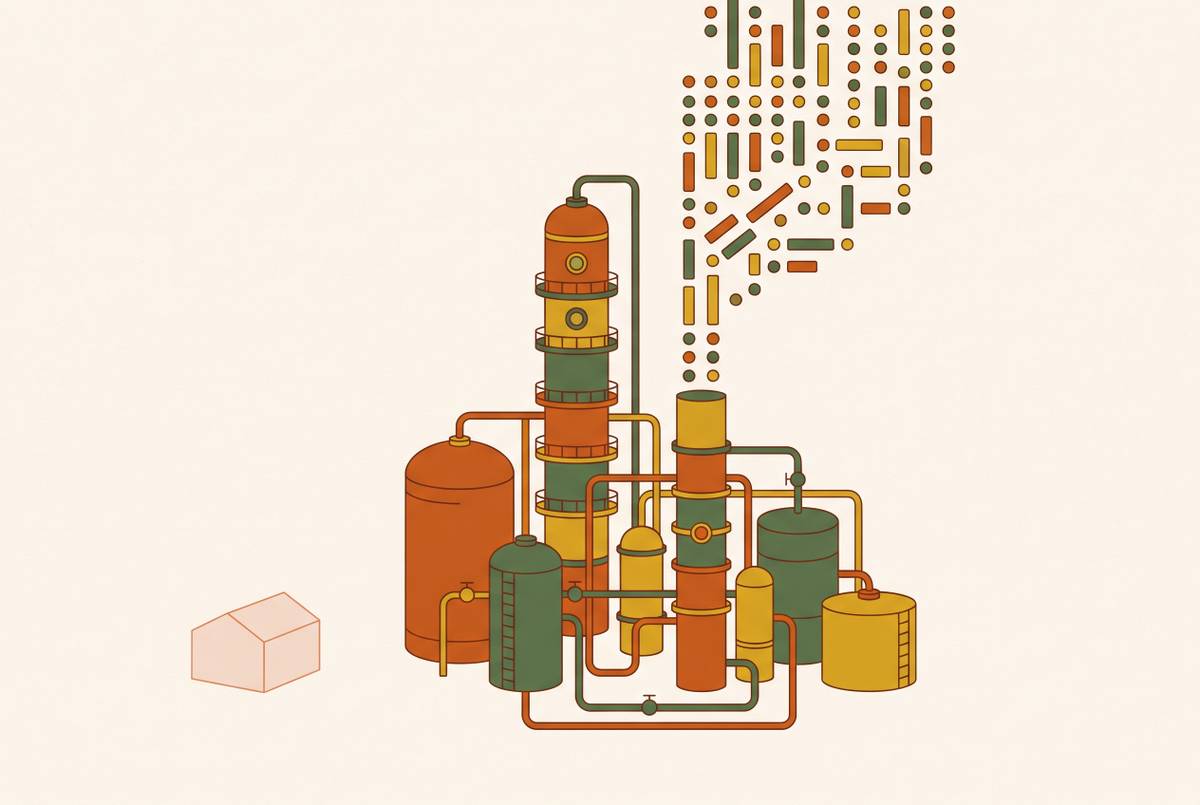
Facility-First Intelligence for Process-Chemical Sellers Who Need Plant Operating Data Not Headquarters Org Charts
How plant-level process data shows chemical sellers real demand.

Plant-level manufacturing intelligence for industrial sales teams connects each facility’s process units, utilities, permits, operating status and ownership to what it could buy and when. For process-chemical sellers, the plant profile must be the primary account-planning record because technical qualification happens at the site. Headquarters data establishes the corporate relationship, but operating data reveals the chemical opportunity.
Why process-chemical purchase decisions happen at the plant, not at headquarters
Plant engineers select catalysts, solvents, surfactants, water-treatment chemicals and lubricants against the requirements of the processes they run. A product must meet requirements for feedstock type, operating temperature and pressure, throughput targets and effluent limits to fit. Those requirements are specific to the site. A parent-company record can identify the enterprise, but it cannot answer the engineer’s specification question.
That distinction persists within a single corporate group because its facilities need not share process technology, maintenance management or regional procurement leadership. Each site also has its own approved-vendor list. A supplier’s acceptance at one plant therefore does not automatically qualify its chemistry for another.
Corporate procurement can negotiate category-level frame contracts and consolidate spending across approved vendors, giving headquarters a substantial role in the transaction. But the product still needs the plant engineer’s approval for the application before a corporate purchase order follows. Commercial databases built around legal entities, employee counts and parent-level revenue describe who negotiates the contract but leave out the process that makes the purchase possible.
What reps actually lose when the account record stops at the parent company
An account that appears fully covered can contain facilities the supplier has never assessed. The rep knows the enterprise, recognizes the procurement contacts and sees existing revenue, yet lacks a view of the other plants behind the same logo. Each may have its own process units, consumption profiles and buying committees. An invoiced account is not a covered enterprise. Without that distinction, account planning treats an existing relationship as evidence that the opportunity has already been worked.
The lost cross-sell is often tied to a specific installation. A cooling tower creates a treatment application that remains invisible if the account record contains only the plant’s main product. A permit for a solvent-recovery unit can signal changing chemistry needs, while an expansion can increase demand on a unit the supplier already serves. A coverage map that links facilities to applications makes them distinguishable from the business already won.
The same blind spot distorts territory design. Company counts can represent hundreds of small sites or a handful of large continuous-process plants, so apparently balanced territories can contain very different workloads and opportunities. Neither rep has a defensible view of market size without the operating context. Genpact’s enterprise debt research finds that disconnected production, quality and maintenance data, along with process debt, are major barriers to getting value from AI and sales in chemicals. The commercial consequence is practical rather than cosmetic because disconnected information prevents a team from connecting its product portfolio to the applications already inside its territory.
The six data points that describe a plant's chemical consumption profile
A plant’s chemical consumption profile rests on six categories of observable, public and reportable information. They describe the application, its scale and the conditions under which it buys. Process units establish what the plant makes and by what chemistry. A polymerization reactor, distillation column or cracker points to different chemical inputs, purity requirements and volumes. The utilities footprint shows another source of demand because cooling-water systems, boilers, wastewater treatment and compressed-air networks need treatment that a description of the plant’s main production leaves out.
Environmental permits show the limits on how those physical assets can run. Air permits describe capacity and controlled substances, water-discharge permits describe treatment processes and limits, and hazardous-waste manifests record outputs that can reveal upstream inputs. They provide a partial proxy for the specification. Operating status and run-rate then qualify the demand implied by that infrastructure. A plant at partial capacity or in a turnaround has a different purchasing schedule and volume requirement from the same installation running at full capacity.
Equipment and technology vintage show the process history needed to make sense of those signals. Older technology can require different chemistry from a redesigned unit, while a process-control upgrade can indicate that specifications may be under review. Ownership and operating company complete the profile by identifying who controls the site. An acquisition, divestiture or joint venture can change procurement contacts, approved-vendor arrangements and where the current supplier stands while the equipment stays the same. Together, these categories distinguish installed capacity from current consumption and technical fit from commercial access.
How plant trigger events create or destroy supply contracts in real time
A plant profile becomes actionable when a change alters the opportunity it describes. Shutdowns, expansions, ownership transfers and capital projects can remove demand, increase it or reopen a supply relationship. A process unit scheduled to close is not equivalent to an identical unit preparing to absorb additional production, even if both appear active in an account database.
Westlake’s December 2025 SEC 8-K describes a shutdown plan covering a PVC plant in Aberdeen, Mississippi, a VCM plant at Lake Charles North and one diaphragm chlor-alkali unit at Lake Charles South in Louisiana. The distinction between those units is commercially important because each represents a different process context. Stepan’s February 2026 8-K and its 10-Q filings describe approved plans to shut the Fieldsboro, New Jersey site and decommission select assets at Elwood, Illinois, also known as Millsdale, and Stalybridge, U.K. A full-site shutdown and selective asset decommissioning imply different changes to the remaining demand. Treating either announcement as a general piece of company news leaves out the detail needed to judge how much business is at risk.
Sites that stay open and take on more volume can need more chemistry, and new plants need suppliers for all their chemical inputs. Neither outcome should be assumed from a closure alone. Facility-level monitoring connects the displacement event to evidence of activity at the receiving or expanding plant.
Construction permits and facility registrations also expose demand before a new site has an established buying organization. In semiconductor manufacturing, new fabs create applications for ultra-pure gases, solvents and process chemicals. Ownership transfers open another door by changing who has procurement authority over existing assets. In each case, the useful signal is the event’s effect on a particular facility.
Why CRM records decay faster at plant-level than anywhere else in B2B
A new reactor train or upgraded wastewater system changes the site’s consumption profile without requiring a new engineer, address or company name. The record may still identify the right person while giving the rep an outdated picture of what that person needs to buy.
Ownership changes create the opposite problem. The plant can keep its equipment and location while procurement authority, contacts and approved-vendor arrangements change around it. PwC’s 2026 chemicals deals outlook describes a selective and defensive market, with capital concentrated in large deals and attention focused on separation readiness and integration planning. For account strategy, the relevant distinction is between the continuity of the physical facility and the possible discontinuity of its buying organization. A site record keyed only to an address cannot express both.
Updated emails, titles and firmographics help a rep reach the buying committee, but they do not supply current process technology, operating status, permit changes or consumption-profile updates. Those require a maintained operating-data layer. Because people, equipment and ownership change on overlapping cycles, plant intelligence cannot be treated as a one-time enrichment project completed when the account enters the CRM.
What tools help sales teams understand plant-level operations in practice?
A facility-first demand-intelligence platform makes the plant profile the primary object for account strategy while retaining its link to the parent company. Firmographics, including SIC/NAICS codes, corporate hierarchy and employee count, show where the facility sits in the market. Buying-committee contacts connect that facility to the people involved in qualification and purchasing. Operating data supplies the missing application context. These layers serve different purposes, so a richer contact record is not a substitute for a richer plant record.
A practical specification includes plant profiles with 60+ data points covering operating status, process units, utilities, permits, ownership and related facility characteristics. The count alone is not the test. The profile needs enough detail to distinguish a plausible application from a generic industry match and enough evidence to explain that distinction. A supplier selling into several process applications needs to see which products fit which sites, rather than receiving one undifferentiated score for the parent account.
Plant-level fit scoring makes that comparison systematic by matching product criteria against process conditions, chemistry class and application. The evidence must remain visible to the rep. When a score comes from a permit, process-unit record or utility installation, the sales team has something specific to discuss with an engineer. Without that basis, prioritization becomes difficult to defend and outreach remains generic despite the apparent precision of the score.
Trigger-event monitoring uses permit filings, construction notices, environmental reports and ownership-transfer records to keep the profile tied to when the plant may buy. That live layer belongs in routine call planning and account prioritization. Territory planning then uses the number of plants, how complex their processes are and how often reps need to visit them.
How the AI embedding in chemical plants changes what commercial teams can know about their accounts
More sophisticated process AI and sensor networks can make plant operations a richer source of intelligence about consumption, operating conditions and changing chemistry needs. That strengthens the value of a facility-level data model. Richer plant data gives an outside seller no automatic right to see information about how the plant runs. Commercial intelligence must still distinguish the public and reportable evidence it can use from the plant data that remains inside the enterprise.
Fact.MR’s Chemical Industry 4.0 analysis identifies plant-data access as a requirement for enterprise risk teams assessing financing and operating exposure. The analysis separately identifies secure API tools as a requirement for manufacturing technology teams linking plant historians and planning platforms. These are distinct uses of the same operating context. They show why the plant is becoming a more important unit of analysis inside chemical enterprises, rather than remaining merely a location beneath a corporate record.
For sellers, the implication is a growing need to interpret operating evidence. As facilities become more deeply instrumented, their process configurations and changes can support more detailed assessments where that information becomes available. A facility-first architecture provides a place to connect those signals to existing applications and buying relationships. A headquarters-centered record does not provide that context by itself.
Genpact’s September 2026 chemicals point of view argues that AI creates enterprise value when embedded in the processes that run the business. The commercial equivalent is intelligence embedded in the way teams select accounts, plan calls and assess product fit. Plant-aware teams can interpret a new signal against an existing operating profile, while plant-blind teams must first discover which facility the signal concerns and why it changes the opportunity.