How to Prioritize Manufacturing Verticals When Entering a New Market
Use facility-level data, not industry codes, to find manufacturing buyers.

Vertical prioritization in manufacturing sales is a scoring exercise. It runs on plant-level signals, production density, process fit, and purchasing triggers, not on a NAICS code pulled from a database and sorted by headcount. Get this wrong at market entry and reps spend a year working the wrong list while a competitor who did the homework closes the accounts that mattered.
Manufacturing buyers in 2026 make suppliers work for the meeting. They research deep before a call ever gets returned, and the buying committee on the other side typically spans multiple functions, often drawing in engineering, operations, finance, and executive stakeholders who want a reshoring or automation story to go with the purchase order. Incumbent suppliers are wired into these accounts, sometimes for decades. Against that backdrop, the standard approach, pull a NAICS list, rank by employee count, hand it to a rep, produces a territory that's too big to work and too flat to prioritize. Two manufacturers with the same headcount and the same four-digit code can be entirely different accounts once you know one runs a single plant and the other runs nine. A generic list can't see that. Weeks are burned by reps on low-fit accounts, real demand goes untouched somewhere else in the territory, and the competitor who mapped facility-level signals gets there first, all because of that cost.
Why NAICS codes cannot tell you which verticals to prioritize
NAICS was never built for sales targeting. It was built for federal economic reporting, a taxonomy for counting things, not for figuring out who's about to buy metalworking fluid or industrial coatings. GICS serves a different master entirely, built for the investment community to classify public companies by how they trade, not by what they need to run a production line. Neither tool was designed with a quota-carrying rep in mind.
The code depth matters more than most sales teams realize. Manufacturing sits inside NAICS as one giant sector, codes 31 through 33, and it can be sliced all the way to six digits. A two-digit cut lumps together buyers who have nothing in common, a pharmaceutical compounder and a furniture maker end up in the same broad bucket. Going to six digits makes the segmentation start to look like an actual ideal customer profile, tight enough to build a target list around. If a sales team is buying data cut at two or three digits and calling it a vertical strategy, it's not, it's a rough sort.
Then there's the taxonomy drift. The Federal Reserve's G.17 Industrial Production release folded in a shift to the 2022 NAICS structure as part of its annual revision on November 24, 2025, updating the industry-group indexes. Any sales org still pulling from a data provider that hasn't caught up to that revision is segmenting against a taxonomy the government itself has moved past. Layer onto that the fact that a lot of commercial databases and older CRM instances still carry SIC codes, a classification system officially retired for most federal statistical work but still stubbornly present in commercial data feeds, and a sales team can end up running two incompatible taxonomies at once without anyone noticing until the pipeline numbers stop making sense.
The four dimensions that rank your target verticals
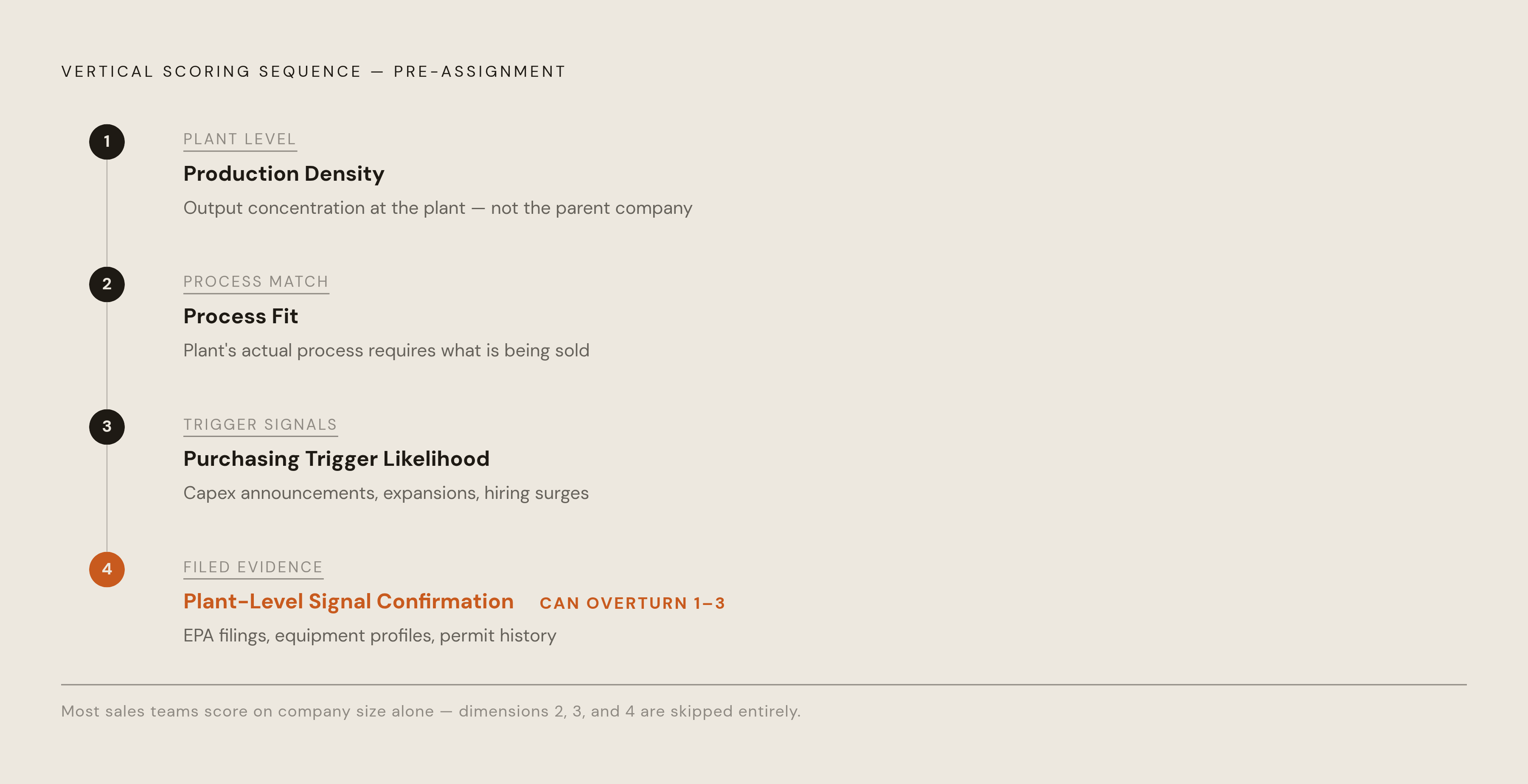
Score verticals before assigning a rep to one, and score them on four dimensions, not one company-size filter.
Production density comes first. A vertical can look enormous in a national report and still have almost no footprint in the actual territory a rep covers. Density has to be measured at the plant level, because a single manufacturer can run facilities across five different verticals under one parent company. Counting the parent makes the number meaningless. Counting the facility shows the rep a real pipeline to build, rather than a lot of windshield time between scattered accounts.
Process fit is the second filter, and it asks a plainer question: does what the plant actually makes require what's being sold. A facility running high-speed metal stamping has a different fluid and coating profile than one doing precision CNC work, and that difference predicts the purchase over the SIC code on file. Some verticals are near-universal fits, metalworking fluid in metal fabrication is close to a given. Others are conditional, the product only matters if a specific sub-process is present on the floor. Those two situations don't rank the same way, even if the vertical looks identical on paper.
Purchasing trigger likelihood is the third dimension, one most sales teams skip. Capital expenditure announcements, facility expansions, and hiring surges are among the loudest signals a manufacturing account is about to buy something. Verticals riding reshoring, EV supply chain buildout, data center infrastructure demand, or a defense spending uptick carry more of these signals than most, and they're structural, not a one-quarter blip. More than 47,000 megawatts of new data center capacity is under construction worldwide right now, and every megawatt of that needs thermal management, structural steel, and power infrastructure from somebody. That's a trigger-rich vertical sitting in plain sight for the right supplier category, not a soft trend.
The fourth dimension threads through the next section: how plant-level data confirms or overturns what the first three dimensions suggest.
Plant-level signals that sharpen the vertical ranking before rep assignment
The facility is the unit of analysis, full stop. A conglomerate running plants across five verticals isn't one account, it's five, each with its own equipment, its own buying triggers, and its own stakeholder map. Treating it as a single company record erases exactly the distinctions the ranking depends on.
A handful of plant-level signals either confirm a vertical's rank or blow a hole in it. What the facility actually produces predicts equipment needs more directly than what the parent company is classified as on a data feed. What equipment runs the floor matters too, machine data is one of the more commonly captured categories in plant operations, and it predicts consumable and service needs about as directly as any signal available. Environmental and permit history rounds it out: EPA filings and local construction permits are public record, and they reveal expansion, new construction, and compliance activity at the individual facility, long before a press release ever goes out. Hiring patterns close the loop, since workforce growth at a specific plant tends to run alongside capital investment and new production lines going in.
Most generic B2B intelligence tools are built for SaaS and tech buying motions, tracking funding rounds and headcount changes, not facility expansions, automation capex, reshoring announcements, or supply chain partnership shifts. They're built for SaaS and tech buying motions, tracking funding rounds and headcount changes, not facility expansions, automation capex, reshoring announcements, or supply chain partnership shifts, which are the actual signals of manufacturing buying intent. And contact data in this sector doesn't age gracefully. Facility closures, workforce restructuring, and M&A activity can invalidate a meaningful chunk of a contact list within months during any period of economic disruption. A static list from an annual data pull is already stale by the time a rep starts dialing a fast-moving vertical.
Which manufacturing verticals carry the strongest structural tailwinds in 2026
Tailwinds are an input to the ranking. A vertical riding a strong macro trend but showing thin local density or poor process fit still loses to a vertical with modest tailwinds and a tight fit. Keep that ordering straight, because tailwinds are the part of this analysis easiest to overweight.
That said, a handful of verticals show real signal strength heading into 2026. Defense and security components stand out: BDO's 2026 manufacturing outlook names defense as a mission-critical reshoring category, with previously imported components moving back to domestic production at an accelerating pace. Electrical transmission and broader energy infrastructure appear in that same BDO analysis, with domestic production of transmission equipment and solar panels flagged specifically as reshoring priorities. Data center support manufacturing is riding the capacity buildout mentioned earlier, more than 47,000 megawatts under construction globally, with water and energy constraints adding urgency to anything touching thermal management or efficiency. The EV and battery supply chain, battery pack enclosures, critical mineral processing for nickel, lithium, and cobalt, keeps surfacing across multiple market-entry forecasts as a 2026 focus area. And biomanufacturing and life sciences show up in Shoplogix's 2026 innovation investment analysis, tied to facility expansion and cluster-style partnerships between government, academia, and private industry.
A capital expenditure signal drives all of these too: 80% of manufacturers surveyed plan to put at least a fifth of their improvement budgets toward smart manufacturing initiatives. A vertical actively deploying automation and sensors is a vertical with an open purchasing window, which is exactly the kind of trigger the third ranking dimension is built to catch.
Grant Marketing's 2026 market entry guide makes the point that the winning move isn't "the EV market," it's a specific niche inside it, metal fabricators producing battery enclosures for Tier 1 EV suppliers, say. That same logic governs vertical prioritization generally. "Metal fabrication" is a starting category. A defined buyer with a concrete trigger is a target.
Translating vertical rankings into territory design and rep assignments
Territory design built around verticals beats territory design built around geography alone, and the reason is straightforward: reps who work the same vertical repeatedly build technical fluency and pattern-recognition on objections that a geography-only rep never develops. Manufacturing buyers expect a rep to already understand their compliance requirements and their production language before the first call ends, and vertical specialization is what makes that possible.
The revenue case isn't speculative either. Harvard Business Review research puts the lift from optimized territory design at 2 to 7% in revenue, with no added headcount. That's a lever pulling directly on the number a VP of Sales gets measured against, not a soft operational nice-to-have.
Once the vertical ranking exists, it maps onto territory structure fairly cleanly. Verticals scoring high across density, fit, and active triggers, with a track record of wins, become primary assignments for fully ramped account executives. Verticals with strong tailwinds but thinner density or unproven fit become development bets, smaller pods, often SDR-led, with a defined window to prove out before a full AE gets committed to them. Everything below that gets deferred, not written off, and gets revisited once trigger signals strengthen or density improves in that particular territory.
None of this works if capacity planning stays theoretical. Territory maps have to be built against fully ramped selling capacity, not the headcount on an org chart, because ramp times for enterprise manufacturing AEs run long, and mapping a territory against capacity that doesn't exist yet just creates whitespace a competitor will fill first.
Enriching your CRM with plant-level data for vertical prioritization
A CRM record with a NAICS code, a headcount, and a headquarters address doesn't tell a rep what a specific facility makes, what's running on the floor, or what's active at that location right now. The ranking framework above is only as good as the data in the system reps actually use every day.
The account and facility record needs a handful of fields most CRMs don't carry by default: production type and process classification, an equipment profile showing what machinery and process lines are running, active trigger signals like expansion permits or hiring surges or capex announcements, and a vertical tag applied at the facility level rather than stamped once on the parent company. Alongside that, the stakeholder map needs to separate corporate contacts, a VP of Operations or VP of Engineering thinking about budget and strategy, from facility contacts, a plant manager or operations director thinking about evaluation and day-to-day adoption. Collapsing those two roles into one contact record strips the deal team of the ability to navigate the committee.
The stakes for getting this right are higher than they used to be. In 2025, a large share of marketers report running active account-based marketing programs, and ABM built on precise segmentation is tied to a substantial increase in average revenue per account. But that precision only holds if the account data underneath it is accurate at the facility level. A company-level record with the wrong plant tagged to the wrong vertical undoes the entire program before a single campaign goes out.
Applying the framework: what vertical prioritization looks like in practice for a new market entry
Running the framework in order builds the shortlist automatically. Start with density: pull every facility in the target geography, not every company, and count plants, not headquarters. Layer in process fit next, filtering out verticals where the product is a conditional add-on rather than a near-universal input. Then check trigger signals, capex announcements, permits, hiring surges, against the verticals that survived the first two filters. What's left is a short list of verticals with real local density, a legitimate product fit, and active buying signals, which is a fundamentally different list than a NAICS export sorted by employee count.
From there, territory design follows the tiers laid out above: top verticals to ramped AEs, promising-but-thinner verticals to development pods, everything else deferred until the numbers change. And every account entering the CRM needs the facility-level fields, production type, equipment profile, active triggers, vertical tag, stakeholder map, or the ranking work done up front decays the moment a rep opens the account record. A sales org that builds this into market entry from day one shows up to a new territory with a qualified shortlist. One that skips it shows up with a spreadsheet and a lot of hope.