S&OP Process and What It Means for Suppliers Selling to Manufacturers
Timing your pitch to the S&OP cycle phases gives you real leverage with manufacturers.
Suppliers who understand how the S&OP cycle works can time their outreach, prioritize their accounts, and frame their pitch around the planning decisions that actually drive purchasing. What follows breaks the cycle into its component stages and translates each one into a concrete action for a supplier selling into manufacturing accounts.
Why S&OP runs on a fixed monthly clock
S&OP is a cross-functional, structured planning process that brings sales, operations, finance, and product leadership together around one agreed plan for the business. It is a cross-functional, structured planning process that brings sales, operations, finance, and product leadership together around one agreed plan for the business. It sets medium- to long-term direction, typically 3 to 18 (sometimes 24) months ahead, rather than managing daily execution.
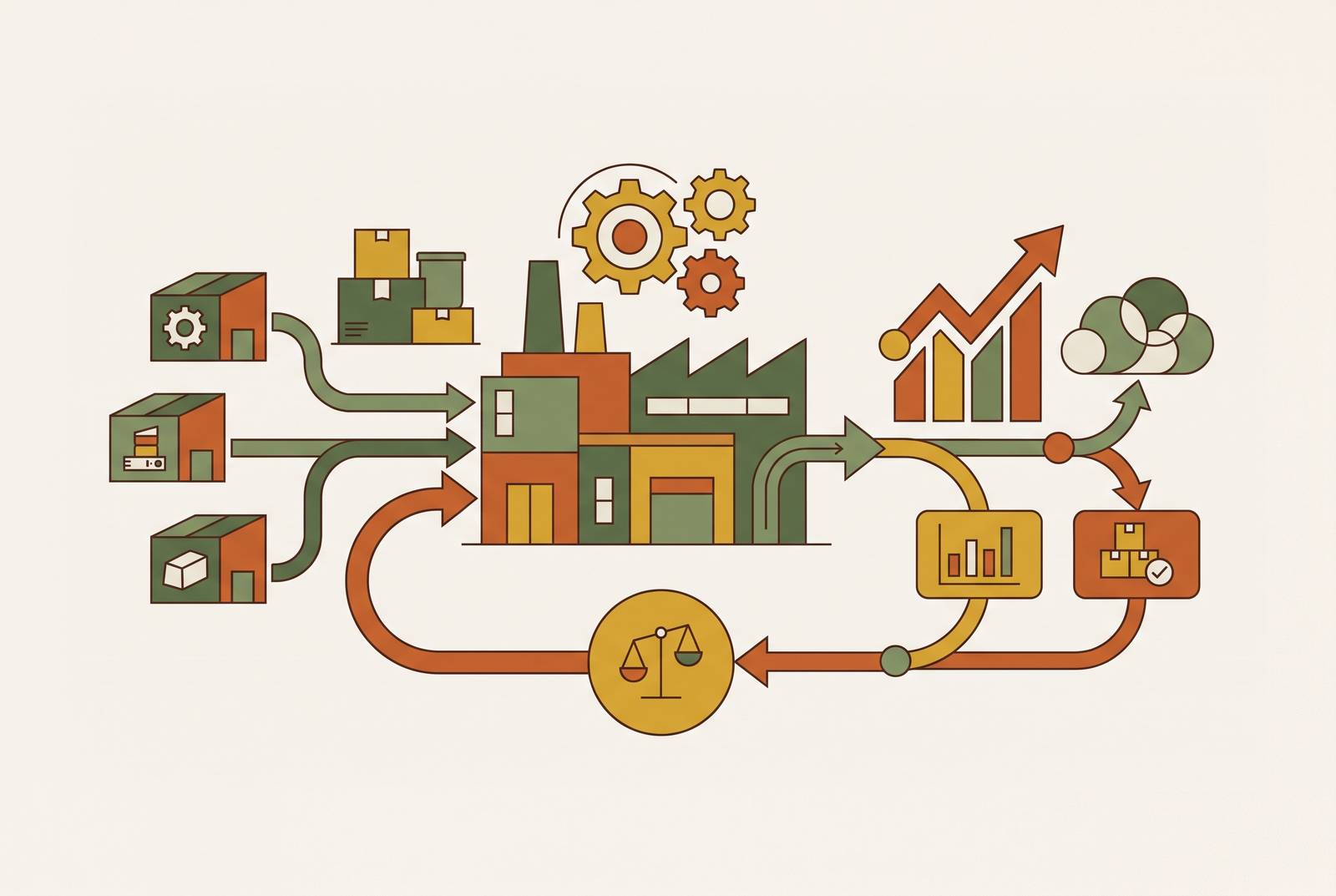
The monthly cadence is structural, built as a sequence of reviews that build on each other and end in an executive sign-off meeting where trade-offs get decided and a single plan gets committed to across the business⟦c…⟧. It is structural, built as a sequence of reviews that build on each other and end in an executive sign-off meeting where trade-offs get decided and a single plan gets committed to across the business techneeds.com. Five phases run in that sequence, each one feeding the next. Product Review brings in product management, marketing, R&D, operations, and finance to decide new introductions, end-of-life products, and promotions. Demand Review builds an unconstrained consensus forecast from historical data, market trends, customer input, and sales input. Supply and Resource Review checks that forecast against capacity, inventory, procurement capabilities, logistics, and supplier performance. Pre-S&OP surfaces the gaps between what's demanded and what can be supplied, proposes scenarios, and prices out the financial impact of each one ahead of the executive meeting. Executive S&OP is where the final call gets made, with executive leadership, heads of major functions, and finance in the room.
S&OP is distinct from Sales and Operations Execution, or S&OE, which governs the 0 to 12 week window and translates the approved S&OP strategy into daily and weekly operational decisions techneeds.com. S&OP sets direction; S&OE steers around whatever disruption occurs in the meantime techneeds.com. The S&OP software market was valued at 5.45 billion dollars in 2023 and is projected to reach 10.52 billion dollars by 2031, growing at a 10.4% compound annual rate, a scale of investment manufacturers are putting into this process that is not trivial pigment.com techneeds.com lighthouseconsultings.de. That is how large manufacturers are choosing to run their businesses, and because the process is structured, time-bound, and cross-functional, it is readable from the outside, provided a supplier knows what to look for. It is how large manufacturers are choosing to run their businesses, and because the process is structured, time-bound, and cross-functional, it is readable from the outside, provided a supplier knows what to look for.
Decisions purchasing gets from each phase of the S&OP cycle
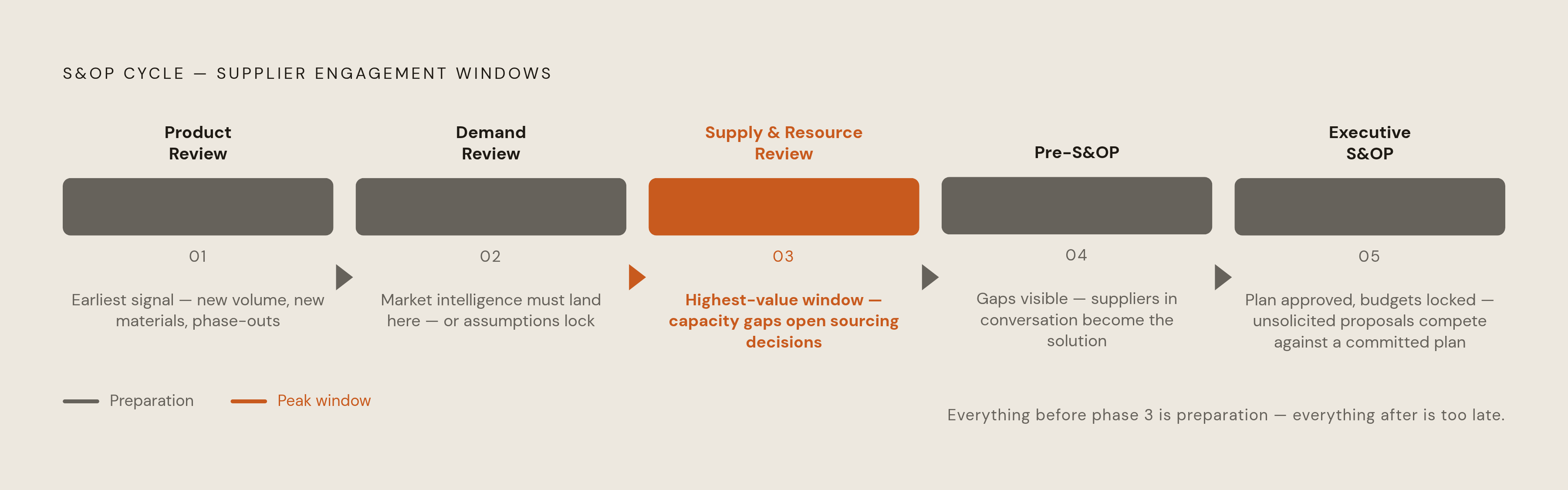
Each phase of the cycle answers a different question, and each answer has a different implication for a supplier watching from outside the building. Product Review decides what will actually get made, including new product introductions, line extensions, and phase-outs, and for a supplier this is the earliest possible signal of a coming volume shift, a new material requirement, or a category quietly going dormant. Demand Review is where the consensus forecast gets built, and whatever supplier input exists (market intelligence, lead time data, pricing trends) needs to land upstream of that consensus, because once the Demand Review signs off, its assumptions are locked.
Supply and Resource Review is where procurement windows open and close. Capacity gaps trigger sourcing decisions, inventory targets translate directly into purchase volume projections, and supplier capabilities get weighed against what the plan actually requires. Pre-S&OP is the moment those gaps become visible to the people responsible for closing them, and a supplier who has already put the right numbers, capacity figures, and lead times in front of the procurement or supply planning team is positioned as part of the resolution rather than a stranger showing up mid-crisis.
Executive S&OP decisions are authoritative and budgeted. Once that plan is approved, discretionary purchasing outside of it becomes hard to justify, which makes the executive meeting the worst possible moment for a supplier to be introducing themselves for the first time. Because the cycle runs roughly monthly, a supplier who shows up with a fresh proposal the week after sign-off is a full cycle behind, and outreach timed before the Supply and Resource Review has a materially better shot at actually shaping the plan. This logic sharpens further under stress: when a supplier is flagged as unstable, whether from shortages, geopolitical risk, or logistics delays, S&OP becomes the structured mechanism for responding to it, with leadership working from quantified scenarios instead of firefighting on the fly. In that moment, a trusted incumbent supplier with good data on hand is considerably harder to displace than a new name walking in cold.
Disconnected systems among 80% of manufacturers, and the gap they create from a supplier's seat
Roughly 70% of global manufacturers have implemented some version of S&OP, yet many of them still struggle to turn the process into decisions that actually cross departmental lines pigment.com. The gap between S&OP as a procedure and S&OP as something that changes outcomes comes down to governance, not effort pigment.com. A more specific figure sharpens the picture: 80% of manufacturing companies plan sales and capacity in entirely separate systems, sales plans sitting in spreadsheets, production numbers locked in the ERP, purchasing handled by email, with nobody holding a unified view techneeds.com lighthouseconsultings.de. Sales plans sit in spreadsheets, production numbers are locked in the ERP, and purchasing is handled by email, with nobody holding a unified view, so excess inventory piles up in one part of the plant while another part runs short, and decisions in the room go to whoever argues loudest rather than whoever has the better forecast techneeds.com lighthouseconsultings.de.
A supplier paying attention can spot the symptoms of a weak S&OP process without ever sitting in on the meeting. Separate planning worlds, where procurement and operations work from different numbers entirely, is one. Excess inventory sitting alongside simultaneous shortages is another, a telltale sign that demand and supply planning have stopped talking to each other. Gut-feel decisions with no structured basis, a monthly fire-drill pattern where the same surprises recur cycle after cycle, and missed delivery promises where sales commits volume operations can't actually produce round out the list.
None of this makes a weak-S&OP manufacturer a bad account. It does mean the buying signal is harder to read, the timing less predictable, and the pitch needs to be framed around closing the coordination gap rather than assuming a clean plan is sitting there waiting to be matched. A manufacturer running mature S&OP, by contrast, offers legible purchase windows, structured points where suppliers get reviewed, and cleaner data all around, which makes for a much higher-quality signal on timing and positioning. The S&OP process at a large CPG manufacturer like Nestlé, cited as a collaborative S&OP success story, is structurally nothing like the process running at a mid-size fabricator still working out of spreadsheets techneeds.com. Reading which kind of account is sitting across the table is part of the job.
The S&OP cycle sets the purchasing calendar that most suppliers never see
For any manufacturer running at scale, S&OP is the mechanism that turns strategy into procurement reality, and the cycle itself sets exactly when purchasing windows open and close. That monthly rhythm creates a handful of predictable moments worth tracking. Before Demand Review, sales and marketing are still finalizing volume assumptions, and market intelligence from a trusted supplier can still shape the forecast at this stage. Between Demand Review and Supply Review, the plan already exists but the supply gaps haven't been resolved yet, which is the single highest-value moment for a supplier who can fill that gap with the right lead time and the right capacity. After Executive S&OP sign-off, budgets are locked and plans are committed, so an unsolicited proposal now has to compete against an approved plan instead of shaping one.
Even inside an approved plan, the S&OE layer creates its own secondary purchasing moments techneeds.com. A missed delivery or a sudden demand spike triggers reactive sourcing inside that 0 to 12 week window, and suppliers with fast lead times and reliable capacity become the obvious call when that happens techneeds.com. Timing matters at the level of whole sales cycles too: the average manufacturing sales cycle runs 130 days, so a supplier who enters after the plan is approved has already lost at least one full cycle before they can influence anything SalesRoads techneeds.com. Entering before the supply review shortens that considerably SalesRoads techneeds.com. Product launches and phase-outs surface in the Product Review stage months ahead of any formal RFQ, so a supplier tracking the product roadmap conversation can anticipate a new material requirement well before procurement ever puts it out to bid. Does anyone actually know where each key account currently sits in its own S&OP cycle? If the answer is no, that's a gap in intelligence.
Plant-level production data as an indicator of a manufacturer's position in its planning cycle
The obvious problem here is that S&OP is an internal process. Suppliers are not invited into the review meetings and almost never see the outputs directly, which leaves the real question as what observable, outside-the-building signals actually proxy for S&OP stage and buying intent. A handful of plant-level signals correlate closely. Equipment additions or capacity expansions mark a plant in growth mode, with the demand plan behind it expanding and procurement for consumables, materials, and services following close behind. New product introductions or line changes indicate a Product Review decision has already been made, with new material requirements already entering the procurement pipeline. Environmental permits and regulatory filings often precede capacity changes, and they signal an investment decision that was made at the executive S&OP level, not a whim.
Generic business data, the kind built on NAICS codes and headcount counts, tells you an account exists and roughly how big it is. It says nothing about what a plant is currently making, what capacity it's running, or what its planning cycle is signaling right now, and those specifics only come from facility-level profiling. S&OP itself runs on the principle that you cannot plan what you cannot see, and the same failure applies to a supplier working off stale or generic account data: it's the identical error a manufacturer makes when it runs its own S&OP process on bad inputs. Knowing that a facility just added a production line for a new product category lets a supplier time outreach to land inside the Supply Review window, before an incumbent quietly fills the gap, instead of arriving after the plan is already locked. Organizations that run S&OP well hit forecast accuracy rates above 85%. The supplier-side equivalent of that number is a fair question to sit with: how accurately can a sales team forecast which of its accounts is about to open a buying window? Plant-level data is what makes that forecast possible Techneeds.
Framing supplier value inside a manufacturer's S&OP logic
At its core, S&OP exists to close the gap between what demand requires and what supply can actually deliver, and a supplier who speaks in those terms is more useful in the room than one who opens with product features. The Supply and Resource Review is really asking one question of every supplier under consideration: can this supplier reliably deliver the volume, on the lead times, at the quality and cost the demand plan requires? A pitch built around those four dimensions, volume reliability, lead time, quality consistency, and total cost, speaks directly to what the reviewer needs to answer.
Transparency about a supplier's own capacity and lead times functions as a competitive edge in itself. It hands a supply planner information they need to run their own scenarios, and that is worth more than any glossy overview document. Risk framing matters too: mature S&OP processes build in scenario planning around supply disruption, so a supplier who can say what happens if a delivery slips, and what the contingency is, is answering a question the reviewer is already sitting with. At the executive level, the language shifts again, because decisions there get validated financially. A proposal that can be expressed in terms of inventory reduction (benchmarks in the 20 to 30% range are achievable with solid S&OP implementation) or operating cost impact (5 to 10% reductions cited against the same benchmarks) is speaking the language the final decision-maker is actually using pigment.com demandfarm.com techneeds.com lighthouseconsultings.de.
Turning up to a procurement meeting with a generic product pitch, timed to no particular planning moment and with no read on where the account sits in its cycle, just shifts work back onto the buyer. They end up translating features into planning terms and estimating volumes against a plan they've never shown the supplier in the first place. And the room is rarely just one buyer. Industrial buying committees run large, with only 7% of industrial manufacturing sales happening through digital channels alone and significant purchases typically involving five to eleven stakeholders salesmotion.io. That means a supplier needs a pitch that speaks to supply planners, procurement, operations, and finance all at once salesmotion.io.
Using S&OP cycle awareness to prioritize accounts and sequence territory coverage
Territory planning in industrial sales has a well-documented weak spot. 58% of B2B sales organizations consider their own rep territory plans ineffective, and a major driver of that, in manufacturing specifically, is that territories tend to get carved up by geography or company size rather than by whether an account is actually ready to buy Sales Management Association. S&OP cycle awareness gives sales leadership a better axis to sort by. Accounts sitting in or approaching their Supply and Resource Review window should rank above accounts that just came out of executive sign-off, and that's a distinction based on timing, not size.
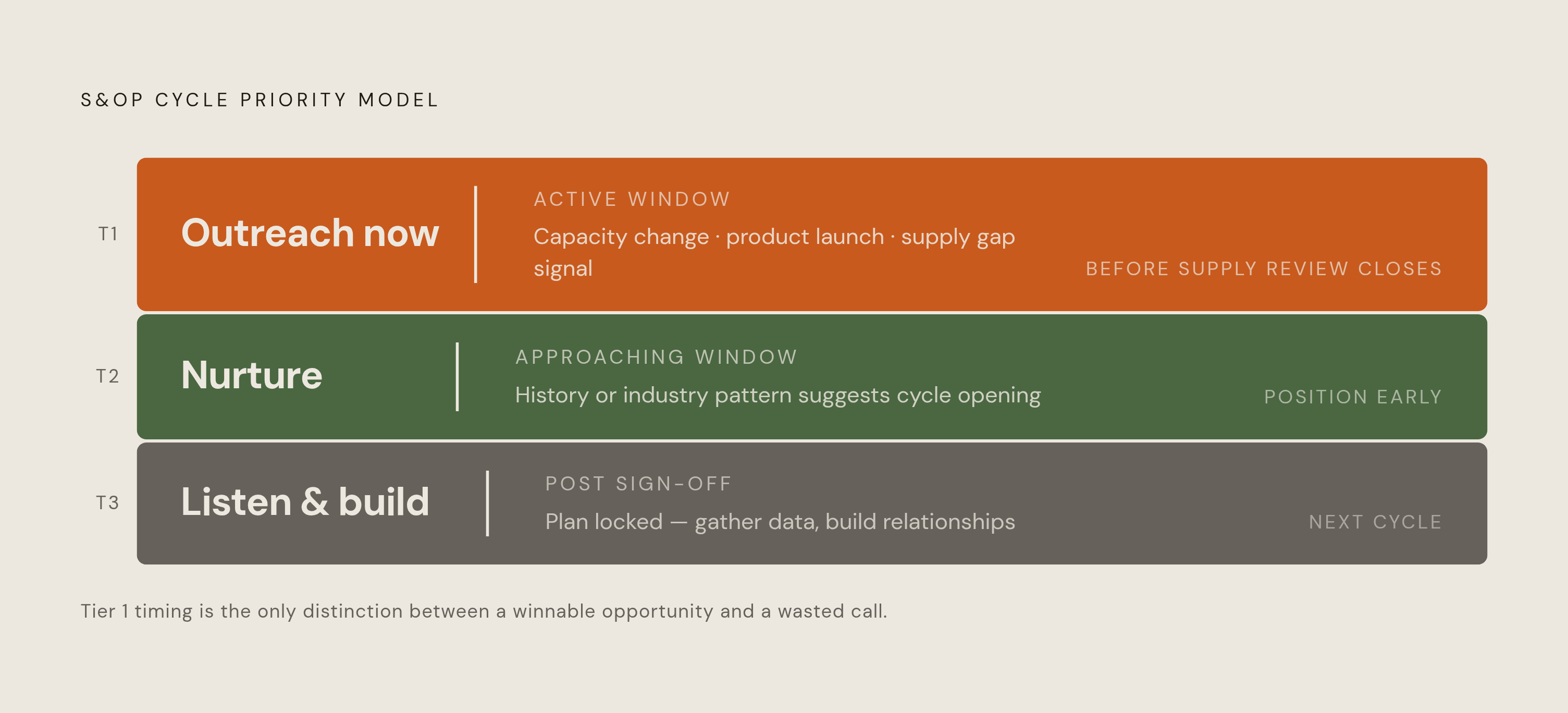
Accounts with an active window make up tier one, where plant signals suggest an upcoming capacity change, product launch, or supply gap, and the right move is outreach now, before the supply review closes. Tier two covers accounts approaching a window, where there's no immediate signal but account history or a broader industry pattern suggests a planning cycle is about to open, which calls for nurturing the relationship and getting positioned before the window actually opens. Tier three covers accounts that just went through sign-off, where the plan for this cycle is locked, and the better use of time is gathering data and building the relationship for the next cycle rather than pushing a proposal that has no planning home to land in.
Sorted this way, a sales team stops treating every account as though it were on the same clock, which it never was to begin with. The manufacturer's own planning calendar becomes the sales team's calendar too, and the accounts worth calling this week look different from the ones worth calling next quarter because of where each one actually sits inside a process running on its own fixed, monthly rhythm. Account tiering by S&OP signal.