Inside Sales Versus Outside Sales in Industrial Markets
Field sales costs more but wins complex deals where buyers need in-person trust.
Inside sales runs about $50 per interaction. Outside sales runs about $308 per visit. That gap looks like the whole story, and for a lot of sales leaders staring at a budget spreadsheet, it becomes the whole story: pick the cheaper motion, protect margin, move on. But the cost figures describe an outcome, not a decision rule. They tell you what a company already spent after it decided what kind of sale it was running. How big the deal is, how long it takes to close, how many people have to sign off, and how much trust the buyer needs before money changes hands drive the cost line.
How inside and outside sales operate
That volume is the point. Without travel time eating the calendar, a rep can cover more ground, more people, more territory, all without ever leaving a desk. Outside sales flips that math around. Field reps get in front of a handful of people a day, in person, and the whole model is built around depth rather than reach, working relationships and navigating stakeholder politics that don't resolve over a screen share.
The ramp times tell you something important too. Inside reps get productive fast and cost less in year one. That's not a knock on field sales; it's the price of a motion built for complexity rather than speed.
Inside sales is not a rebrand of telemarketing. It involves multi-touch engagement over weeks or months, real product expertise, and relationship-building that plays out over a long horizon, not a script read off a screen. And the macro trend backs the model's relevance in ways that go beyond cost. Gartner projected that 80% of B2B sales interactions would happen through digital channels by 2025, which extends the inside model's reach advantage considerably, though it does nothing to close the gap where deals are genuinely complex and the buyer needs more than a channel, they need a person standing in the plant. Inside sales operates as remote selling via phone, email, video, and digital channels, with reps engaging 40–60 prospects per day, built for speed, volume, and geographic reach without travel costs. Outside sales ramp takes 6–9 months, with higher total first-year cost including travel, vehicle, and extended ramp period, according to SPOTIO.
Why manufacturing buyers set a higher bar for supplier trust than most industries
Manufacturing buyers are vetting operational dependencies, not shopping for vendors. They're vetting operational dependencies. Get the wrong chemistry, the wrong fluid, the wrong coating, or the wrong piece of equipment into a production line and the line stops, and stopped lines cost real money by the hour. That single fact reshapes how plant managers and operations directors treat a sales conversation. They expect a rep who understands their specific production environment, not one reciting a category pitch that could apply to any facility in the sector.
In-person visits carry meaning here that they don't carry in lighter-weight sales. A rep who shows up on-site is signaling, whether deliberately or not, that the relationship is worth the travel. Buyers in manufacturing, construction, and healthcare routinely read remote-only engagement as insufficient for anything that counts as a major purchase. That's not a preference quirk; it's a filter buyers apply before they'll extend trust at all.
Then there's the committee. Purchases now typically involve more than four stakeholders, and that number has climbed steadily over the past decade. On enterprise deals with five or more people in the room, outside sales holds a real, decisive edge, because mapping a committee, figuring out who actually holds authority versus who just holds a title, and building enough credibility across all of them to move a purchase order forward is hard to do without walking the floor. A rep who has only ever engaged that account through a screen is working from a worse map.
None of this is well served by a generic ideal customer profile built on industry code, headcount, and zip code. Plant size, ownership structure, the geography a facility distributes into, even import behavior, all shift who actually holds the purchasing authority at a given site. Trust, in this context, isn't a soft nicety, it's the literal precondition for getting past the front gate, into the buying committee, and eventually onto the purchase order.
Where deal size and cycle length draw the line between models
The rule of thumb from the research is straightforward. Under a moderate deal threshold, with a standardized product and a sales cycle under 60 days, inside sales tends to scale better.
A manufacturing equipment rep calling on plant managers to demonstrate machinery, walk through integration requirements, and work the deal through procurement makes the divide concrete. That's field sales, full stop, and it's the default motion across industrial B2B for a reason. But not every industrial sale looks like that. Inbound inquiries, spare parts orders, smaller accounts, reorders on an established relationship, all of that is volume work that doesn't justify the cost of a plane ticket and a hotel night. Inside teams handle it well, and handle it cheaply.
The dollar amount alone doesn't explain why a specialty chemical supply agreement behaves differently from an equivalently priced software contract. What's riding on it is a production dependency, a facility that can't tolerate a supply disruption, a trust relationship that has to hold up over years, not just through a single renewal cycle. The average deal's cycle length is the real constraint on the model, not just a scheduling detail. When the average deal is above a higher threshold, involves multiple stakeholders, and the cycle is 90 days or longer, outside sales or hybrid delivers higher win rates. Where cycle length becomes the real constraint, outside sales reps earn their cost when they are working deals that compound in value over 90–180+ days, as the relationship investment pays off in deal size and retention, not just the first close.
How industrial digital adoption is reshaping where inside sales fits in the buyer journey
Industrial buyers have changed how they want to shop, and the shift has been fast by industry standards. In 2017, only about 20% of industrial companies said they preferred digital interactions and purchases. By 2024, that number had climbed to 67%. That's not a marginal drift; it's a near-total reversal of buyer preference inside less than a decade.
A complex, multi-stakeholder, high-trust sale still needs the things a field rep provides. What changes is when the field rep gets involved. Buyers now do a lot of their own homework, comparing options and narrowing a shortlist, before they ever pick up the phone or agree to a plant visit. By the time an outside rep walks in the door, the buyer has often already formed opinions, and that rep needs to bring something sharper than what a website or spec sheet already delivered.
Inside teams sit right at that entry point now. A rep who can catch a buyer early, in the self-directed research phase, qualify the interest, and hand off a well-scoped opportunity, isn't lowering the quality of what reaches the field rep, they're raising it. The field rep walks into a better-prepared conversation instead of starting from zero. The trust-building work outside sales does hasn't gone away; it's just been compressed into a shorter window and now has to deliver more value per visit than it used to.
The hybrid model that most industrial sales organizations are converging on
Research on high-growth B2B teams shows inside sales' share of new-logo acquisition rising substantially between 2017 and 2025, with that growth landing in a hybrid model rather than a wholesale replacement of field sales. The hybrid model is where that shift has landed, not a replacement for outside sales but a division of labor built around it.
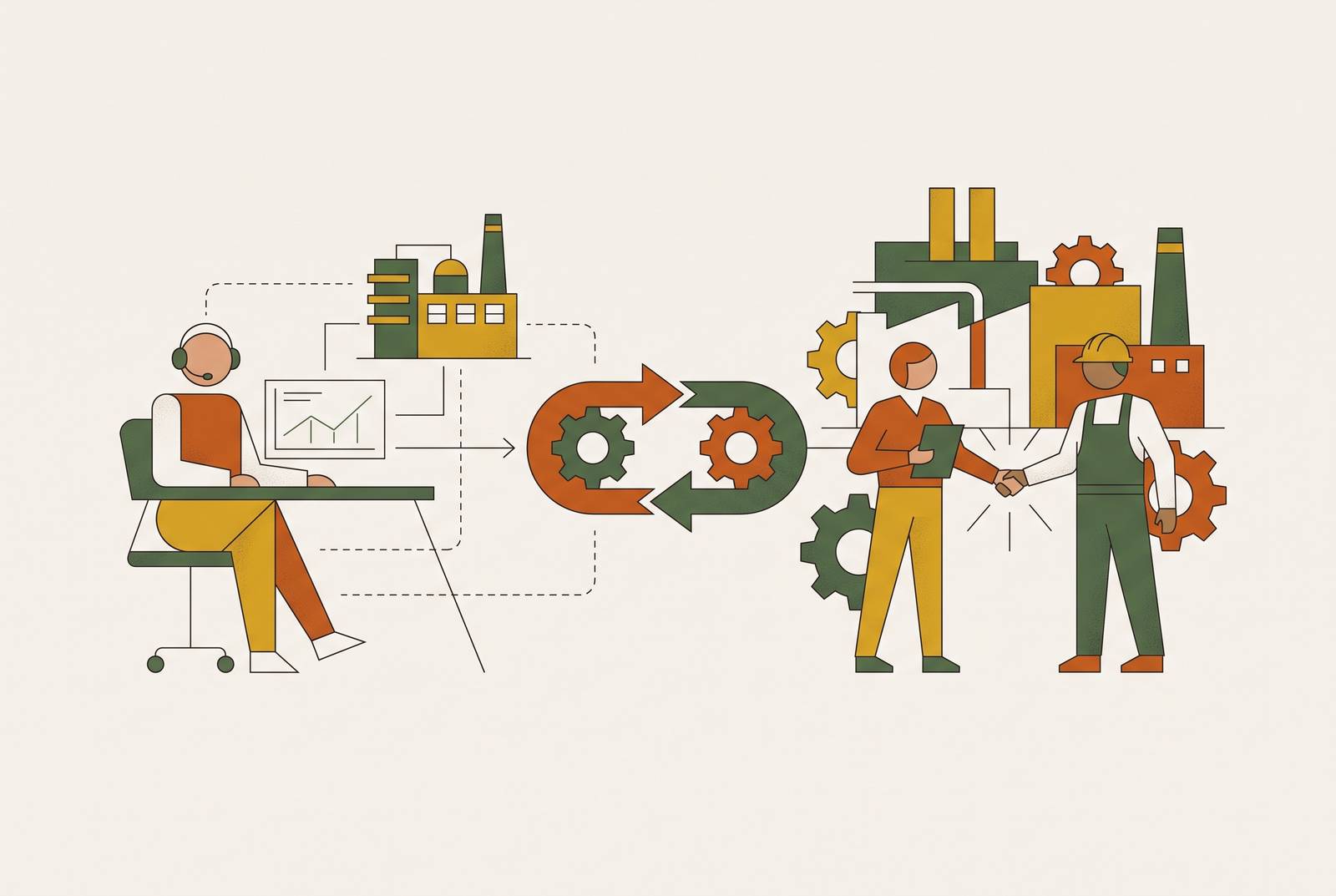
In practice, industrial distributors have already worked out roughly what this looks like. Inside reps take the smaller transactional orders, the reorders, the volume accounts. Field reps and technical sales engineers take the large projects, the custom configurations, the strategic accounts where a relationship has to be built from scratch. The line between them comes from account scoring, engagement signals, and strategic fit, the same variables that show whether a deal actually needs a plant visit to close, not an arbitrary revenue cutoff.
Comp plans that punish an inside rep for handing off a deal they've nurtured for months, and handoffs that lose all the context the inside rep built up, mean the field rep walks into the first in-person meeting knowing less than the buyer does. Aligned compensation and clear, numeric handoff criteria, deal size, stakeholder count, product complexity, fix the first problem. A CRM workflow that actually carries the history forward fixes the second. Neither fix is glamorous, but both are what separate a hybrid model that works from one that just looks good in an org chart.
What territory planning looks like when it accounts for both motions
Manufacturing activity doesn't distribute evenly across a map, and that unevenness is the whole territory planning problem in a sentence. Some regions have dense clusters of large plants sitting close enough together that a field rep can run an efficient route between them. Other regions have the same total manufacturing footprint spread thin across small, dispersed facilities that no amount of clever routing makes cost-effective to visit in person.
That density gap is exactly where the hybrid model and territory design have to talk to each other. Dense clusters of high-value plants justify putting a field rep on the ground, because the routing works and the repeated face time actually builds the trust the buyer needs. Dispersed or smaller facilities are better served by inside reps, who can cover the same ground without the travel economics quietly eating the ROI. Segmenting territory by vertical, metals, food and beverage, plastics, rather than by pure geography, also lets reps build the kind of production-environment fluency that manufacturing buyers use to judge supplier credibility.
The payoff for getting this right isn't hypothetical. Harvard Business Review found that optimized territory planning lifts revenue by 2 to 7% without adding a single new headcount. That's not the return on hiring more reps; it's the return on deploying the reps already on staff correctly.
None of it works, though, if the underlying data is wrong. A territory built purely on NAICS codes and headcount counts misses the plant-level reality that actually determines which facilities are worth chasing for a given product, the gap between how a company is classified and what a specific plant actually produces, runs, and buys.
How plant-level production data changes what each sales motion can accomplish
SIC and NAICS codes describe what a company makes at the sector level. They say nothing about what a specific plant produces, what equipment sits on that plant's floor, what chemistries or raw materials it consumes day to day, or what volume it's running. That's a wide gap, and it's the gap both inside and outside teams fall into when they plan without better information.
An inside rep working inbound leads or building a prospecting cadence off classification codes alone is guessing at fit. High call volume doesn't fix that, it just means the rep is misrouting effort faster and at greater scale. A field rep has the opposite problem: walking into a plant without knowing its production environment strips away the exact expertise that manufacturing buyers use to decide whether a supplier deserves their trust.
Sharper account profiling for manufacturing needs more than industry and size. It needs plant count and size, since single-plant operations behave differently from multi-plant networks, and sub-100-employee shops differ from 500+ employee facilities. It needs to account for production model, make-to-stock against make-to-order against engineer-to-order, since each carries its own pain points. Get that resolution right, and the inside/outside decision turns from a guess about cost into a read on what a specific sale, at a specific plant, actually requires to close. Sharper ICP profiling for manufacturing accounts requires the elements identified in research brief S1, LeadHaste.