Evaluating Account Allocation Software for Chemical and Industrial Field Sales
Plant-level production data, not geography alone, determines which accounts deserve rep time.
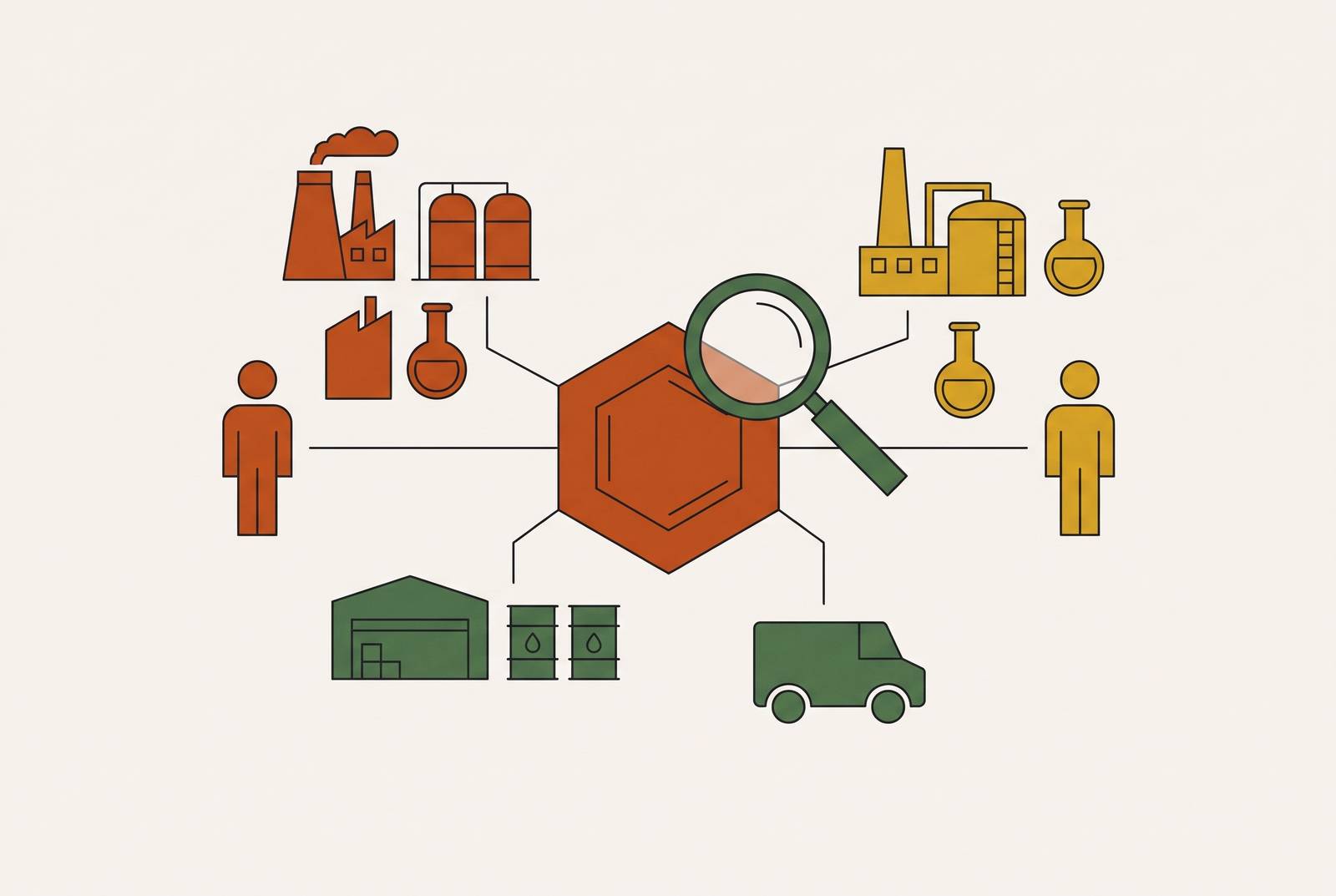
Territory planning tools for manufacturing sales teams should be judged on the plant-level production intelligence they have, how they use manufacturing density in territory design, and how they connect to the CRM field reps already use. For chemical and industrial field sales, account allocation software must help teams cover their territories and grow their accounts. Geographic balance alone cannot show whether a facility runs the processes a seller’s products serve.
Why account allocation for chemical and industrial field sales is a different problem than general B2B territory planning
In manufacturing, the buying decision happens at the plant level. A single legal entity may run facilities that differ in their equipment, production processes, shift structures, and who has the authority to buy. Each facility is effectively a separate account. Assigning the parent company to a rep therefore does not resolve which sites represent opportunity or which operational stakeholders influence a purchase.
Generic account allocation tools commonly assign accounts by geography, firmographic tier, or revenue history. Those attributes describe location, company scale, and past business, but they do not establish process fit. A specialty chemicals or metalworking fluids rep needs to know which facilities actively run the processes the product serves. A nearby plant is not necessarily a prospect. A large corporate account can also have locations that differ in how much they might buy.
The technical sales motion makes that distinction consequential. Performance degradation at a plant can trigger downtime, budget uncertainty, and extended fluid lifecycles, so productive conversations depend on pre-call knowledge of plant operations. Commercial pressure compounds the problem. Deloitte’s 2026 Chemical Industry Outlook describes overcapacity, soft demand, and global uncertainty, as companies shift their portfolios toward specialty chemicals to earn higher margins. As growth depends more heavily on execution within existing books, the wrong allocation tool wastes more than software budget. It consumes rep time on accounts that will never convert.
What “account allocation” actually means in an industrial sales context, and the two jobs the software must do
Account allocation has two distinct jobs in industrial field sales. Territory coverage determines which rep owns which facilities and balances workload against opportunity across a geographic or segment footprint. Account-level prioritization determines which facilities deserve time, in what order, and why. The distinction is fundamental to the purchase decision. Most tools address only one job, while buyers can mistake strength in that job for a complete allocation capability.
Mapping-first platforms solve a real coverage problem by reassigning ZIP codes or counties and showing the effect on workload metrics. They establish ownership and make structural imbalances visible. But ownership is not a measure of opportunity. A county may contain many plants with radically different production profiles and purchasing needs, so an evenly distributed account count can conceal an uneven distribution of viable business.
Prioritization requires knowledge of what each facility makes, what equipment it runs, and what production volume suggests about purchasing need. Company names, headcount bands, and industry codes cannot tell reps that much about a plant. The procurement objection is often that filtering by four- or five-digit NAICS or SIC codes provides sufficient manufacturing coverage. Classification is useful, but coverage is not completeness. Operational contacts at the plant level are underrepresented in any single general database, and no single enrichment source provides the full facility depth a specialty chemicals or metalworking fluids rep needs.
The data foundation and why industry codes alone do not supply plant-level production intelligence
The depth and accuracy of facility data are the most important variables in evaluating industrial account allocation software. Precise four- and five-digit SIC or NAICS classification belongs at the facility level, with location data tied to the actual plant. The record must describe the site being allocated. Applying the parent company’s attributes uniformly to every location obscures differences that determine product fit.
Production capacity indicators and output signals add purchasing context that headcount cannot provide. Equipment installed-base information supplies the process connection required for metalworking fluids, coatings, and specialty chemical sales. Product suitability depends on what the plant runs. A company classified under a broad chemical manufacturing code may operate several process types, only some relevant to a particular seller. Without those distinctions, even an industry filter that looks precise leaves reps with accounts that have not been checked well enough for fit.
Environmental and regulatory footprint data also show how the conditions that shape purchasing are changing. PFAS restrictions, for example, are prompting upstream chemical manufacturers to exit certain markets in anticipation of regulatory limits, creating supply shortages that formulators must navigate. Facility expansions, production line additions, capacity investments, and supplier switches describe changes in manufacturing operations rather than generic interest associated with software buying. Together, these inputs establish what a facility needs and when that need may change, providing a foundation for both territory design and account development.
How to plan sales territories around manufacturing density, not geography
Manufacturing concentrates in production clusters. Territory plans based on area or rep headcount therefore produce uneven workloads and missed coverage. An industrial territory must balance addressable opportunity within reachable facilities, workload equity across reps, and routing that reflects how field teams move between plants. Manufacturing density is useful only when it describes relevant facilities.
Enterprise territory tools have a legitimate role in that structural design work. SAP Territory and Quota has tools for AI-based territory optimization and balancing, for geospatial insight and visualization, and for predictive quota planning and analysis. These capabilities support territory alignment and planning. They do not remove the need for production-level inputs, because an optimization engine can only balance the account attributes supplied to it. The distinction is between the territory design function and the intelligence required to apply it to industrial selling.
For example, a stamping plant and a plastics compounder within the same ZIP code can represent very different opportunities for the same seller. If the input data does not distinguish their production profiles, geographic optimization cannot recover that missing information. Better allocation redirects existing rep time toward higher-potential facilities. That is how territory realignment can produce revenue uplift without additional headcount, rather than treating recruitment as the only route to greater coverage. Evaluation depends decisively on what the platform knows about each facility before its territory algorithm runs.
CRM integration and how field-accessible intelligence determines whether the platform gets used
Reps are unlikely to use account intelligence every day if it sits outside their daily workflow. Industrial sales cycles often last many months and involve people in engineering, procurement, finance, and supply chain roles. The CRM tracks the resulting touchpoints, deal stages, and technical requirements. Allocation intelligence should be part of that working account record. A separate research environment leaves the rep to bridge the gap between understanding a facility and managing the opportunity.
ERP and CRM integration also connects allocation to account health. Ordering patterns, service tickets, credit holds, and reorder frequency offer more reliable early indications of churn or expansion than third-party signals alone. Their usefulness depends on clean plant-level records. Three spellings of the same plant location, or facilities assigned to the wrong rep through ZIP-code-based ownership, undermine the connection between operational events and account responsibility. Additional intelligence does not repair an unresolved facility identity.
Adoption is therefore an evaluation requirement. Industrial teams already face skill gaps, different adoption rates across departments, and the inertia of established ERP and MES workflows. Another login adds a genuine burden. Buyers should test whether the platform reduces pre-call research within the tools reps already use.
Account growth signals and how software supports cross-sell and upsell inside manufacturing accounts
Existing accounts offer the most cost-efficient revenue opportunity when specialty chemical producers face overcapacity and soft demand. Yet servicing current demand is different from identifying a larger need before a specification is written. Industrial reps are often trained and rewarded for the former. Account allocation software must therefore surface expansion readiness rather than depend on memory or unsystematic research. Its account-level job continues after the initial sale.
Reorder patterns approaching the next pricing tier can indicate that a facility is operating at greater production intensity than when the account was first sized. That is a reason to revisit total addressable spend. Construction, production line additions, and capacity investments indicate a plant scaling operations and create a natural window for a larger or higher-spec product conversation. The useful signal connects the operational change to the facility where the sales conversation belongs.
Changes in regulations can open a cross-sell window even when a plant is not expanding. PFAS restrictions are forcing lubricant manufacturers to scrutinize their raw material streams and demand PFAS-free certifications from suppliers, creating a purchasing trigger. Sellers able to understand a facility’s chemical exposure and offer compliant alternatives have a basis for engaging during that review. Plant-level production data also reveals where an existing product relationship may extend to adjacent products the facility does not yet order.
Multi-plant customers make this visibility especially important. One site may be fully penetrated while another remains untouched, even though both sit under the same corporate account. Company-level revenue obscures that asymmetry. Facility-level intelligence separates an established relationship from an unserved production need and gives the rep a specific reason to investigate.
The evaluation criteria that actually separate useful platforms from expensive shelfware in this category
The first criterion is facility-level data granularity. Before looking at the platform’s other features, buyers should check whether it profiles each plant or copies company-level attributes across locations. A familiar facility provides the practical test. Ask for a live demonstration using a named plant the sales team already knows, then compare the production record with the rep’s knowledge. A parent-company industry code alone cannot show what happens at each facility, even when the rest of the company profile looks complete.
The second criterion is manufacturing-native signal logic. Facility expansions, equipment changes, production line additions, and regulatory compliance triggers show what shapes industrial buying in ways that generic web-behavior intent data cannot. Signal labels are not enough to establish relevance. A demonstration should show whether the platform surfaces an actual manufacturing event tied to a facility. This criterion establishes whether the intelligence reflects the customer’s operations before it informs allocation.
The third criterion is territory logic that reflects manufacturing density. A design layer must be able to weight accounts by production profile and purchase potential alongside geography or revenue history. Geographic balance remains useful but is insufficient. The practical test is whether those production attributes inform territory design while the platform balances workload and reachable opportunity. A sophisticated optimizer applied to undifferentiated plant records still allocates rep capacity against the wrong inputs.
The fourth criterion is CRM integration depth and field usability. Buyers should check whether plant-level intelligence flows into the records reps already use in Salesforce, HubSpot, or Dynamics 365, or leaves reps to do research in a separate tool. Adoption depends on the resulting workflow. The practical test is whether using the platform reduces pre-call research time or adds another step. Clean facility records and usable integration must work together, because delivering intelligence to the wrong plant record does not help the rep act on it.
The fifth criterion is proactive account growth signal surfacing. A platform should use production changes, expansion activity, or regulatory triggers to show when existing accounts are ready for cross-sell and upsell, as well as help with initial prospecting. Existing customers belong in the demonstration too. The practical test is whether the platform flags a facility-specific reason to expand a relationship without leaving discovery entirely to the rep. For teams already using ERP, CRM, and legacy reporting systems, this gives them a clear result to require before they buy another tool for research.