Selecting CRM Enrichment Layers That Capture Specialty Chemical and Process Production Capabilities
How to pick CRM enrichment that shows what each plant runs.

CRM enrichment with real manufacturing facility data needs plant-level production records, context on process chemistry, and operational signals as well as company attributes or industry codes. For specialty chemical sellers, the right enrichment layer links what each plant runs to products that fit, the people who handle technical evaluations, and purchase decisions that are coming up.
Why generic CRM enrichment fails specialty chemical and process production sellers
A rep can enter a customer meeting with a complete company record and still not know what the plant currently runs. Revenue, sector, and headquarters contacts do not reveal the chemistry consumed at the site or the formulation work under way. Without operational context, a rep cannot connect the supplier’s portfolio to the customer’s current production needs, even when the CRM contains an extensive conversation history.
That frustration reflects a data architecture mismatch. Chemical manufacturing teams handle leads, pricing requests, and opportunities across CRMs, data warehouses, ERP systems, and external platforms. The warehouse holds statistical patterns but has no context on the relationship, while the CRM records conversations but may not predict patterns. External intelligence adds information about competitors and changes in the market, but it is not linked to the customer’s history.
McKinsey’s chemicals research identifies high sales team turnover and disjointed customer data as factors that compound these institutional knowledge gaps. Supply chain disruptions also pushed many chemical companies toward order taking, weakening the prospecting skills needed to pursue unfamiliar applications. The gap reaches beyond individual account preparation. Growth strategies may identify promising market segments without translating them into specific prospects for frontline sales, because company-level enrichment does not capture the process context needed to make that translation.
What industry codes actually classify — and what they leave out
Industry codes classify a facility’s dominant production activity. The official 2022 NAICS Manual bases a facility’s classification on its primary physical production activity, determined by the largest share of production value or revenue. Two plants under the same six-digit code can need different products, technical conversations, and ways of selling.
A coatings supplier targeting formulators by NAICS code alone can include facilities with no relevant chemistry and exclude plants running the right process under a neighboring code. Related application categories are not interchangeable. Coatings and adhesives may sit close together in a seller’s market taxonomy, but their proximity does not establish a plant’s formulation needs or compatibility with a particular product line.
Code assignment can introduce a second distortion. Auto-assignment from keywords in marketing copy reflects how a business presents itself rather than necessarily what an individual facility produces. Purpose-built industrial sourcing instead draws on primary classification sources, including official registries, customs databases, and trade association memberships. That gives classification a stronger basis, but even a code assigned correctly is only a starting point. It cannot substitute for production detail showing which specialty chemicals fit the plant’s needs.
How to enrich Salesforce and HubSpot accounts with actual plant production data
Corial’s specialty chemicals use case describes the gap between generic CRM records and formulation testing, stability data, and reformulation iterations. Those activities govern when a customer is in the market. A plant may be relevant to a supplier’s portfolio yet remain at a stage where technical evaluation, rather than a purchasing discussion, is the immediate concern.
Useful production data therefore begins with what the plant manufactures at the product and application level. It also captures the chemical inputs involved, whether production is batch, continuous, or semi-continuous, and the end-use applications served. These details change the commercial proposition. The same chemical can serve different purposes in cosmetics, food, and pharma, just as its value can differ across coatings, adhesives, and metalworking fluids.
The CRM data model must preserve those distinctions at the site. Relationship context belongs at that level too. Formulation chemists, QA managers, procurement, and supply chain require different information, and headquarters contacts do not replace the technical evaluators who qualify a product. Because evaluation cycles can run months, useful enrichment also identifies where the plant stands in testing or reformulation. Together, these records determine which product a rep raises, which contact receives the first call, and whether the timing fits the customer’s work.
How process chemistry context changes which enrichment fields matter
A waterborne coatings plant requires different rheology modifiers, surfactants, and biocides than a plant running solvent-borne systems. Both can appear in a CRM as coatings manufacturers. Reaction chemistry, solvent systems, cure mechanisms, and formulation constraints determine which products from a supplier’s portfolio are chemically compatible with the plant’s process.
This is where production data becomes portfolio intelligence. Knowing what a facility makes establishes an application, while knowing how it makes it narrows the product lines worth discussing. A rep who leads with an incompatible product risks losing credibility before the technical conversation develops. Selling specialty chemicals involves both technical consulting and commercial negotiation, so knowing the process gives a rep a specific customer problem to tackle with formulation expertise.
Regulatory profile further narrows the available choices. A product qualified for EU markets may require separate documentation for the US, Japan, or China, making regulatory status part of product qualification. For distributors, the range of possible applications makes this matching task especially demanding. Bloomr’s specialty chemicals framing spans sub-sectors including adhesives and sealants, construction chemicals, lubricants, food and cosmetic additives, and pigments, paints and coatings. Process chemistry helps a seller pick the product lines in a broad portfolio that fit the application, rather than present a catalog with no context on how the products would be used.
Equipment and permit signals as the operational enrichment layer that precedes intent
For chemical sellers, buying starts with a capital project or an announcement of an expansion, moves through a defined process change, and leads to requirements for the chemical inputs to buy. Timing changes the value of the intelligence. A permit can expose the project before a conventional contact database gives a rep a reason to approach the account.
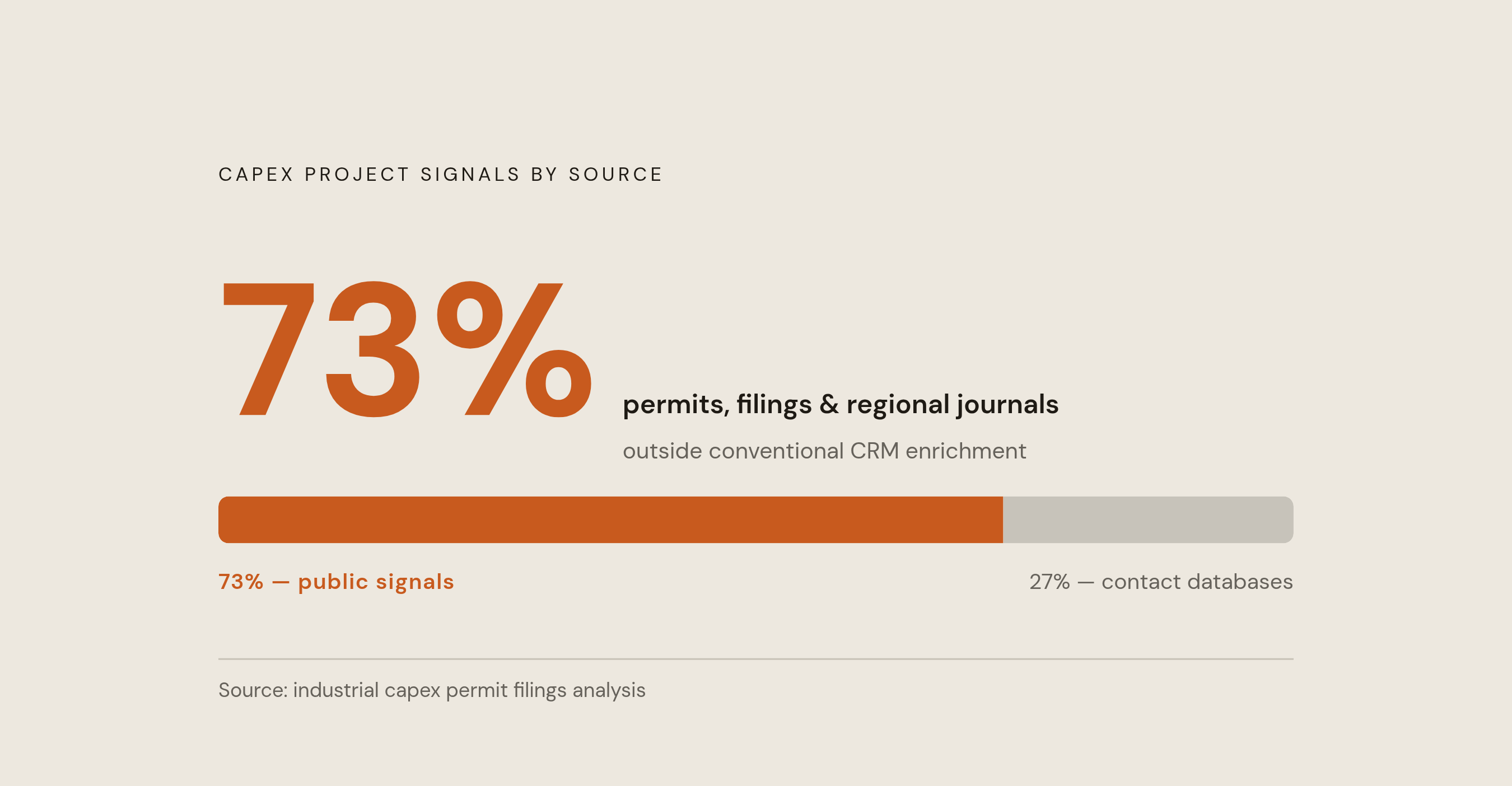
Construction permits are public records that are time-stamped and indexed through local government portals. Of all industrial capital expenditure projects, 73% are announced through local construction permits, facility expansion filings, or regional business journals. These sources sit outside generic enrichment layers. Their value to a chemical seller comes from connecting the announced work to the production process affected, rather than treating every expansion as an equally relevant lead.
As the process change becomes clearer, equipment and chemistry context make the opportunity more concrete. A plant expansion permit can indicate which inputs will be needed, at what volume, and on what timeline. Other operational changes can open different purchasing discussions. Plant manager and VP Operations transitions, reshoring and nearshoring announcements, ESG and decarbonization projects, and supply chain disruptions that prompt second-source qualification all add context to the account. At the purchasing stage, permit-triggered intelligence can expose floor coatings, adhesives, and metalworking fluids as line-item requirements, connecting the signal directly to products a chemical seller supplies.
Why cross-sell is the largest hidden opportunity inside existing accounts — and what enrichment must capture to surface it
Existing accounts typically buy far more from competitors than from the supplier serving them, but transaction history reveals only the supplier’s own share. That creates a structural blind spot. A rep needs to see the full range of chemistry a plant runs to find compatible adjacencies.
McKinsey’s research documents the commercial value of integrating account intelligence through a chemical company transformation that identified nearly a half-billion dollars in new customer opportunities. The transformation also produced a large year-over-year increase in pipeline opportunities and deals closed. Pricing trends across similar customers, changes in order velocity, and patterns in product mix become useful for taking action when linked to the current state of the relationship in the CRM.
Identity resolution makes that connection possible across systems. A warehouse account identifier, an external company record, and a CRM contact must resolve to the same entity before a revenue decline can be related to a leadership change. Site distinctions must survive that linkage. A global account represented only at headquarters obscures local interactions and buying decisions, while plant-level mapping reveals where compatible chemistry remains outside the supplier’s purchase history. For distributors serving smaller customers through principals’ channels, that visibility can improve share of wallet without proportional headcount growth.
How to evaluate an enrichment layer against the requirements of process production selling
A commercial leader should start a conversation with a vendor by asking how good its classification is. Ask whether codes come from primary sources reflecting facility activity or from keyword analysis of marketing copy. Having more contacts cannot make up for a biased view of the market. The next test is granularity, specifically whether distinct plants retain their own production processes, equipment profiles, and buying contacts.
Once the facility picture can be trusted, the next step is to check how the layer spots changes. A layer that supplies static firmographics answers a different question from one that surfaces permits, CapEx announcements, equipment changes, and leadership transitions. Update speed belongs in this discussion. Permit filings and capital announcements have a shelf life measured in weeks, so monthly refreshes can arrive after a competitor using real-time signals has already made contact.
Portfolio matching is the next, more demanding test. The layer should connect process chemistry and equipment to specific SKUs or product lines, with opportunity size expressed in gallons, pounds, or units where appropriate. Cross-sell visibility goes further still. It should expose the plant’s full chemistry needs, including inputs supplied by competitors. Plant-level specialists, general enrichment tools, and CRM or ERP foundations should therefore be compared by the role each can support.
What a well-enriched CRM looks like in practice for a specialty chemical sales team
Before a site visit, a rep should be able to see the plant’s active process chemistries, equipment profile, and matching product lines from the supplier’s portfolio. The record should distinguish existing purchases from products the plant is likely sourcing elsewhere, based on its full chemistry profile. A permit filing, leadership transition, or announcement of a new production line gives a rep a reason to discuss a specific application.
Stratos’s Commercial Digital Twin framing describes the strategic destination as scoring every account and product line by attractiveness and ability to win, then proposing an optimized CRM pipeline for each rep. That approach needs plant and process intelligence with enough detail to support the scoring. McKinsey’s research reports that the commercial transformation shortened accelerated resourcing and strategic decision timelines from more than two months to days. The operational benefit comes from having the intelligence assembled when a decision is needed.
For distributors with broad technical portfolios, the daily payoff is sharper prioritization. Reps can focus on accounts where an operational signal, a chemistry match, and an open cross-sell opportunity converge. Technical judgment still belongs to the rep. Enrichment supplies the context for using it well, so the next site visit begins with a relevant product and an informed application discussion.