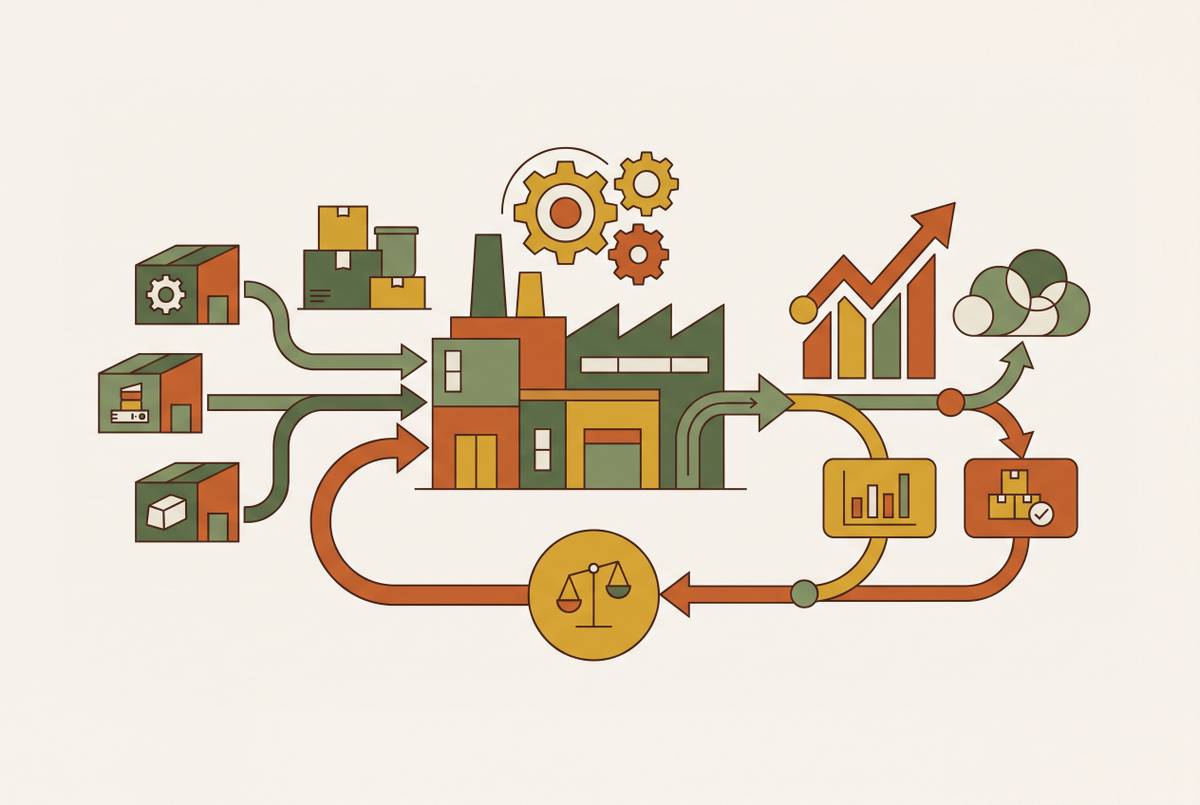
Account Team Structure for Industrial Manufacturing Sales Coverage
Plants, not parent companies, are the true accounts in industrial sales.
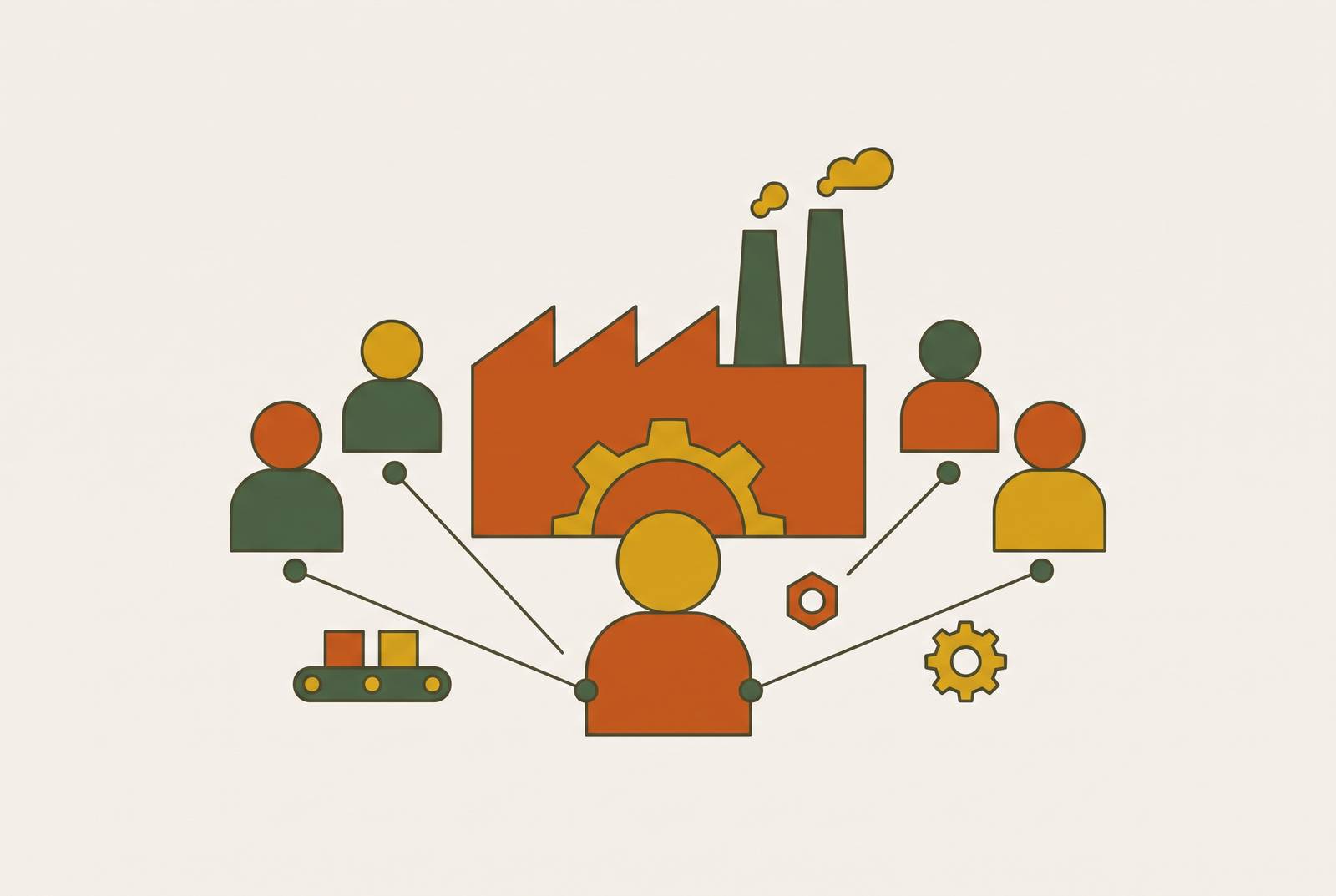
Territory planning tools for manufacturing sales teams should organize coverage around individual plants, combining production fit, facility density, route planning, and named-account ownership. Effective account team structure follows the same principle because the plant is the true account. Company-level records and geographic boundaries alone cannot give industrial sales teams the technical access and buying relationships they need or the basis for expansion planning.
Why the plant — not the parent company — is the account in industrial manufacturing sales
A global OEM may appear as one record at a corporate address while operating a dozen facilities across multiple states. Each plant has its own manager, budget, production line, and purchasing authority. Treating the enterprise as one account therefore hides the decisions that determine what gets bought and from whom.
One facility may operate make-to-stock production, while another works make-to-order or engineer-to-order, creating different pain points and purchasing triggers. Equipment varies just as sharply within the same parent company. A modern automated line and a legacy mixed environment need different products, technical conversations, and stakeholders, even when the same company owns both plants.
That variation breaks the assumptions behind standard B2B coverage design. Territory carving, quota assignment, and cross-sell strategy cannot use headquarters as a substitute for the facilities where purchasing decisions occur. A team organized around the parent may hold a relationship with the enterprise yet systematically miss its buying locations. The account structure must reflect those locations before the sales organization can divide responsibility meaningfully.
The buying committee inside a plant and what it demands of a sales team
A purchase of meaningful size brings purchasing, engineering, operations, maintenance, and finance into the decision. Purchasing evaluates price and contract terms, while engineering evaluates specification and reliability. Operations focuses on uptime and delivery, maintenance on serviceability, and finance on total cost of ownership. The evaluation has several distinct tests to pass. A commercially attractive offer still needs to satisfy the people responsible for running and maintaining the process.
Plant managers usually approve smaller purchases, operations directors or VPs decide on mid-range purchases, and the largest deals go through corporate procurement and formal RFP processes. Access alone is not enough to advance a sale. A plant manager cannot approve a purchase above her threshold, while corporate procurement will not engage on one below theirs. Reaching the wrong level can consume the cycle without creating a path to approval.
Industrial buyers also limit the time available for engagement. They are often on the plant floor rather than at a desk, protective of their time, and skeptical of digital outreach. Their availability is narrow and irregular. Because sales cycles commonly last many months, the seller must sustain several relationships through those uneven windows. One field rep cannot show technical credibility, build trust with operations, and negotiate commercial terms with the whole buying group at the same time.
How role specialization maps onto the plant-level buying reality
Field sales engineers and account managers are in charge of the main relationship and keep complex deals moving. They retain the account’s history and coordinate its commercial progress, but technical evaluation requires more than relationship continuity. Application or sales engineers supply the expertise needed in specification discussions with plant engineers and process chemists. Where product or process complexity persists after the sale, the specialist remains involved through implementation, qualification, and expansion.
Inside sales takes on reorders, quoting, and smaller accounts that do not justify field time. This division preserves field capacity for complex, relationship-intensive work. Distribution or channel managers serve a different coverage model. They manage distributor and manufacturer’s rep networks, whose incentives and reach require separate oversight from direct selling.
The most consequential separation is between new business development and established-account growth. New business managers run cold outreach, while key account managers build on and grow the largest relationships the company already has. The two jobs demand different skills and rhythms. Industrial retention depends on patience, technical depth, and a sustained relationship cadence that does not transfer automatically to prospecting. Conversely, assigning a hunter to service existing clients can erode the focus and edge needed to build new business.
Moving a rep mid-flight can damage a pipeline developed over months or a relationship built over years. A team that collapses hunting and farming asks one person to sustain incompatible working patterns, weakening both acquisition and retention. Those responsibilities should be separated when volume justifies dedicated ownership.
How to plan sales territories around plant density and production fit
Industrial territory planning should begin with where facilities are, what they make, and how closely their production needs match the supplier’s portfolio. Mapping plants and shops by production type distinguishes relevant opportunity from a simple count of corporate logos. Geography remains a constraint. ZIP codes and state lines can bound travel, but they do not reveal which operations depend on what the team sells.
Territory planning software can be compared by whether it just divides a map or helps teams plan facility-level coverage. Corvus, a manufacturing intelligence platform that indexes over 500,000 plants with production-level detail and turns that data into territory plans and pipeline for industrial sales teams, is one platform built around that distinction. The software should offer facility density mapping, production-fit prioritization, route planning, and support for both geographic and named-account ownership. Windshield time consumes scarce field selling capacity. A territory with concentrated, well-matched plants has a different coverage logic from one containing the same number of companies scattered across a region. The tool must make that distinction visible.
Smaller and mid-tier facilities fit geographic patches where field reps can plan efficient routes, while strategic facilities and large multi-plant accounts need named ownership wherever they are. Those models must coexist under explicit ownership rules. Otherwise, named-account reps can take easy wins from geographic patches while geographic reps neglect large accounts technically inside their boundaries. Neither outcome reflects deliberate coverage.
Territories also need a formal rebalancing cadence as portfolios, demand, and headcount change. New products, shifts in manufacturing activity, and competitive entries alter where the opportunity sits. A static map will miss those shifts. To rebalance territories well, teams need to know what each facility makes and needs as they move company records between reps.
What plant-level production data makes possible that company-level data cannot
A corporate address tells a rep nothing about what a facility three states away makes, which equipment it runs, or how much it produces. Company-level NAICS codes and employee headcounts describe an industry category. Two plants in the same category can have different process chemistries, equipment generations, and sourcing needs. The category is only a proxy. It cannot supply the detail needed to assign technical coverage or prepare a relevant first conversation.
The information also changes after the account enters the CRM. Contacts move, facility statuses change, and production configurations evolve, so stale records can actively mislead territory and account planning. A correct hierarchy is not sufficient by itself. The facility record also needs current production information, including what the plant makes, its equipment, production volume, environmental footprint, and activity signals. Without that foundation, additional role specialization gives more people an incomplete view of the account.
Knowing whether a facility operates make-to-stock, make-to-order, or engineer-to-order production helps determine the opening pain points and the stakeholders to approach first. Equipment generation further sharpens product fit. A modern automated line has different fluid, coating, and chemical needs from a legacy mixed environment, so this knowledge strengthens the technical conversation before the first call.
Plant expansions, new production lines, changes in operations leadership, and regulatory events can show when a plant is ready to buy. Purchasing patterns add another kind of signal. When orders for a product category keep falling, retention may be at risk, while no purchases in a category that similar plants buy consistently may point to a chance to cross-sell. Facility-level records let prioritization, preparation, and expansion planning begin from the same production reality.
Account growth and white-space identification within the plant-level account structure
Company-level white-space maps conceal variation in what individual plants have purchased. A product family may appear established across an enterprise even though a comparable facility in that network buys none of it. That gap is a quantifiable cross-sell opportunity. It becomes visible only when purchase history and production fit meet at the facility level. An account map showing decision-makers, a white-space map showing unsold categories, and a mutual action plan with dates all need that scope.
In metalworking fluids, priorities such as component longevity and multi-metal machining compatibility connect treating fluids to broader quality control frameworks. Those connections create opportunities for portfolio bundling. They cannot be inferred reliably from the corporate relationship alone because the relevant requirements belong to the plant’s production model. Expansion planning therefore needs both technical understanding and a record of products sold.
On-site technical presence deepens that understanding over time. Chemical management service relationships embed supplier staff at the facility, allowing them to identify production needs that an outside caller would not see. Quaker Houghton illustrates this relationship-based model at scale. Its deep technical service relationships, global footprint, and switching costs embedded in customer manufacturing processes show why on-site support can be difficult to displace. Equipment compatibility, process revalidation, and operator training create friction that protects an embedded supplier and makes entry harder for a challenger.
Application engineers find process problems, inside sales points out drops in usage, and key account managers map white-space. Crediting only the closing rep undermines that collaboration. The incentive structure should recognize the full team’s contribution and account for deals that often close well over a year after the first conversation. Standard monthly commission structures otherwise misalign credit with the time required to develop expansion.
How to sequence the build: which roles and capabilities to add at each stage of growth
The full account team is a destination to build toward. At an early stage, a generalist field rep may handle both new business and retention because volume does not yet justify separating them. The priority is to build the plant-level account map and CRM structure on which later specialization will depend. Even a small team needs to know which facility owns each relationship and opportunity.
At the growth stage, the first structural separation is hunting from farming. Dedicated new business development and account retention allow each motion to develop without repeatedly displacing the other. Scale then creates demand for further specialization. Key account managers take responsibility for the largest facilities, application engineers become dedicated overlays rather than work borrowed from field reps, and inside sales absorbs reorder and quoting volume. Field reps can then concentrate on complex, high-value conversations.
Tender specialists and project sales managers have a role when large contracted deals bring in a sizable share of revenue. Channel managers formalize distributor oversight once that volume justifies dedicated management. The trigger is the shape of demand. Adding every role in advance would mistake the eventual structure for the sequence needed to reach it.
Sales operations and manufacturing intelligence must develop with the commercial team. The plant-level CRM structure belongs before specialization, because changing the hierarchy becomes organizationally expensive once territories and quotas are assigned. More reps multiply a faulty account hierarchy’s coverage gaps unless the underlying facility relationships are corrected. Since territory reviews, white-space mapping, and expansion planning depend on the same facility data, building that foundation is a commercial strategy decision.