Reducing Manual Research Time for Industrial Sales Reps
Manufacturing reps waste hours on manual research that automation can eliminate.

Why pre-call research is so much heavier in industrial sales than in other B2B contexts
Manufacturing sales carries a structural weight most B2B categories don't. Deals involve complex product configurations, sales cycles that run long, and buying committees that have ballooned to six to ten decision-makers, each with a different stake in the purchase. By the time a rep gets a prospect on the phone, that buyer has typically worked through a substantial portion of their decision-making process already, estimates range from well past half to nearly the full journey, on their own, without a salesperson in the room. Average manufacturing sales cycles run around 130 days, and for larger enterprise accounts with tens of thousands of employees, that can stretch to 185 days or more. So research isn't a task a rep knocks out once before a single call. It accumulates, quietly, over the entire life of the deal.
Getting the contact right matters as much as getting the timing right, and most reps get this backwards. Pitch a plant manager on a deal she has no authority to approve, or pitch procurement on a purchase that falls below their threshold, and the prep work behind that call was wasted before it started. A rep has to work out, ahead of time, whether the deal calls for a technical evaluator or an economic buyer. That distinction depends almost entirely on deal size and structure, on the specifics of who happens to pick up the phone playing only a minor role.
None of the facts a rep actually needs live in a standard contact database. What the facility makes is what matters, along with what equipment it runs and what that implies about the consumables, fluids, coatings, or services it has to keep buying. Whether it operates make-to-stock, make-to-order, or engineer-to-order signals a different pain point and a different buying rhythm. And whether anything recent has shifted the picture, new leadership, a capacity expansion, an acquisition, a capex announcement, changes what the call should even be about.
Generic B2B databases surface company names and employee counts, full stop. So reps piece the rest together by hand: permit filings, LinkedIn, trade press, EPA records, one plant at a time. Then the ground shifts under them, because manufacturing contact data decays at a significant rate each year even in stable periods. Stack a 130-day cycle on top of a deep pre-call information requirement and data that's rotting in real time, and research doesn't just take long. It has to get redone, more than once, before the deal ever closes.
Where the research hours go inside a rep's week
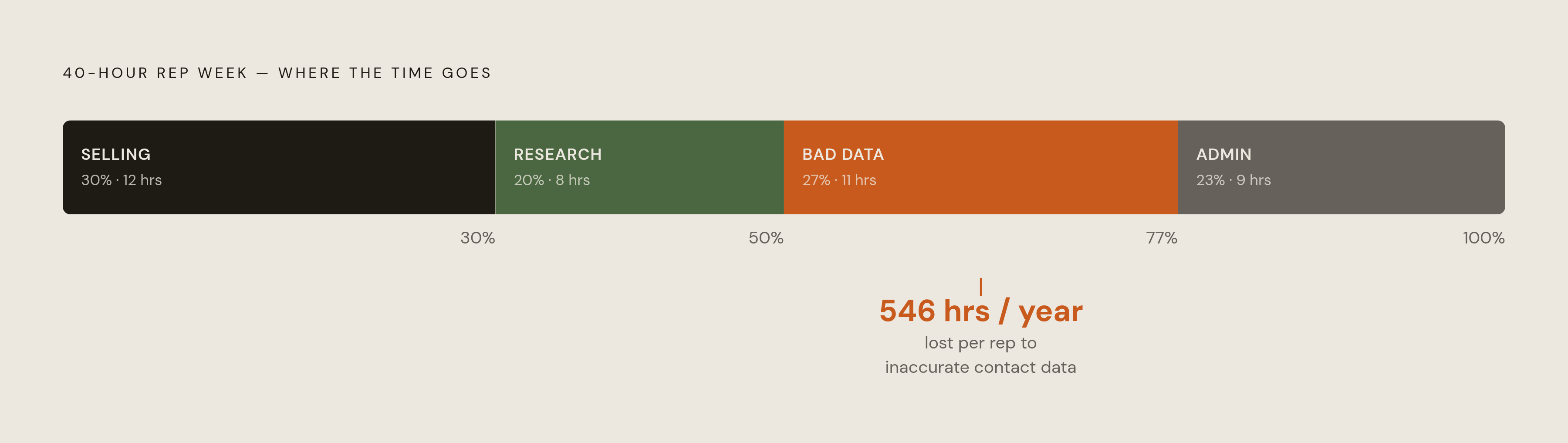
Break down a 40-hour week for a mid-market B2B rep and the picture turns uncomfortable fast. Industry research puts active selling at roughly 30% of the week, call it 11 to 12 hours. Account research and call prep eat another meaningful chunk on top of that, and unlike selling time, it comes with no direct payoff attached, only the promise of a better call later.
For reps selling into manufacturing accounts, that research bucket runs structurally larger than the B2B average, because facility-level reconnaissance has no equivalent in SaaS or financial services selling. Nobody pitching cloud software needs to know what chemicals a prospect's production line consumes, or how many gallons of coolant its machining centers go through in a year. Manufacturing reps do, and nobody hands it to them assembled.
Bad data doesn't sit there quietly either. It compounds. A rep chases a contact who left the company eighteen months ago, or preps for a plant that swapped its production line last quarter and no longer fits the target profile, and that's a full research cycle spent on nothing. Research cited via salesmotion.io puts the time reps spend working with inaccurate contact data at 27.3%, or roughly 546 hours a year per rep. That figure almost certainly understates how badly manufacturing data decays, since operational context (what a plant makes, what it runs) rots right alongside the contact data sitting next to it.
Tool sprawl doesn't fix this. It makes it worse, and that's the part sales leaders keep getting wrong when they respond to a data gap by buying another subscription. Gartner research found 72% of sellers feel overwhelmed by the number of tools in their stack, and sellers who report that overwhelm are 45% less likely to hit quota. Each tool got bought to save time, including a Sales Navigator seat here, an EPA permit tracker there, a trade database, and an ERP lookup. Stacked together, they don't save the hours they promised. They just relocate the work, and the rep still ends up doing the assembly by hand.
Why the research problem is also a quota problem
Only about a quarter to just over 40% of B2B reps hit quota in 2024, depending on whose count you trust (Salesforce and the RepVue Cloud Sales Index are in different places), but they agree on the shape of the problem even where they disagree on its size. Most of the sales force falls short, and it isn't falling short because reps aren't trying.
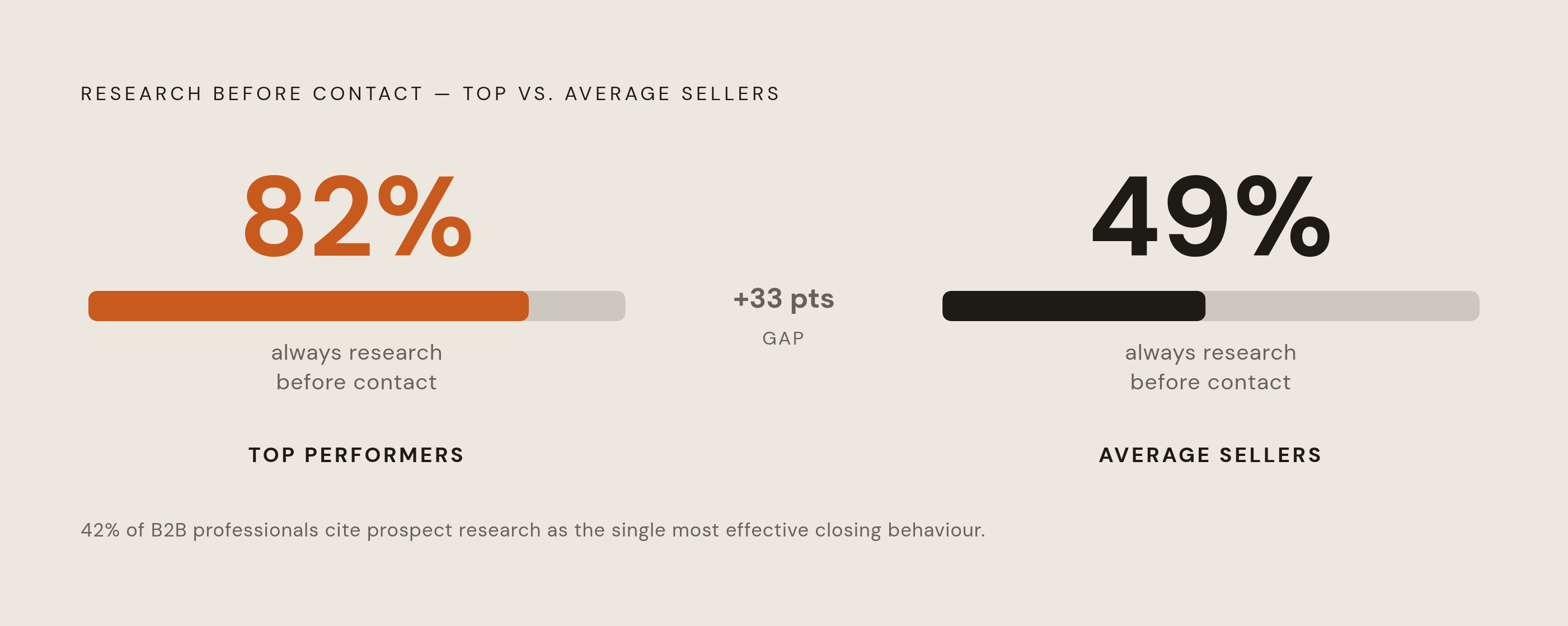
The split between top performers and everyone else runs straight through research habits. 82% of top-performing salespeople say they always research a prospect before making contact, against 49% of average sellers, a gap that runs straight through their results. That gap is the story itself. Separately, 42% of B2B sales professionals say the single most effective thing they do to close a deal is research the company and understand its actual challenges before the call starts. The activity that closes deals is exactly the activity the current workweek refuses to protect time for.
None of this argues for cutting research out of the process, which is the tempting but wrong response to a rep who's drowning in admin. The fix is making good research the default condition of every call, built into the workflow itself rather than reserved for when a rep carves three extra hours out of a Saturday. Timing sharpens the stakes further: a plant that just promoted a new VP of Operations or announced a capex investment is five to ten times more likely to engage than a randomly selected plant of similar size and industry, according to leadhaste.com. That kind of precision only works if the underlying research is already current, because by the time a rep manually reconstructs it, the window's usually closed. Every hour spent figuring out what a facility makes is an hour not spent calling the plant that's already in a buying mode right now.
What pre-built, plant-level intelligence actually contains
A contact database answers one question: who works there, and how does a rep reach them. Plant-level manufacturing intelligence has to answer a much narrower, much harder set of questions, and most tools on the market still don't attempt it.
What does the facility actually produce, down to specific product lines rather than a SIC or NAICS bucket that lumps a stamping plant in with a foundry? What production equipment does it run, and what does that imply about the consumables, fluids, coatings, chemicals, or services it needs to keep buying? What's its production volume and capacity utilization, and is it scaling up or winding down? What's its environmental footprint, which matters directly for water treatment, specialty chemical, and compliance-driven sales? And what activity signals have fired recently: permit filings, UCC lien filings tied to equipment purchases, job postings for process engineers, M&A announcements, leadership turnover?
The raw material for all of this already exists in public records: EPA environmental permits, local building permits, OSHA inspection records, UCC lien filings. It's public, and it's scattered across multiple systems that don't talk to each other. Reps burn hours pulling it together by hand instead of a platform doing it once. A manufacturing-focused data provider also has to include the roles a standard directory never lists: plant managers, procurement directors, VP Engineering, not just the C-suite names every generic database already has memorized.
Industry 4.0 activity adds a second layer of signal on top of the static profile. A facility expansion, a supply chain overhaul, an automotive plant retooling its assembly lines for EV production: each of these opens a concentrated window where automation software, industrial fluids, predictive maintenance tools, and logistics services all become relevant purchases at once. A platform built for manufacturing connects that announcement to the specific product need it implies, rather than leaving the rep to make the leap alone. That's the real dividing line for how a rep's day runs: intelligence delivered the moment a rep sits down to prep, versus intelligence a rep has to go hunt down. The first is a productivity tool. The second is one more tab open in the browser, quietly losing the battle for attention against everything else due today.
The impact on the numbers of shifting from rep-driven to system-delivered research
Bain's 2025 analysis, cited via salesmotion.io, found AI-assisted sales teams see 30% productivity gains and cut deal cycles by 68%. Bain's broader estimate suggests AI can roughly double the share of a seller's time spent actually selling, moving it from around 25% toward 50%. That's a fundamental shift to a workflow, not a marginal tweak. Using the same number of working hours, a rep who closes one deal a quarter can instead close two.
Teams running sales automation save meaningful hours per rep per week, adding up to significant reclaimed selling time over a year. Those teams make substantially more calls per day and run measurably more productive overall. None of these tools invent new hours in the day. They take hours currently lost to reconstruction and hand them back as selling time, which is a different thing entirely from just working faster.
The gap between top and average reps lines up with this almost too neatly to ignore. Research on rep performance distribution suggests the top 14% of reps drive 80% of revenue. Separately, Research on rep time allocation suggests top performers spend a meaningfully larger share of their time on active selling than the roughly 30% average across the broader rep population. Preparation, sustained over every call, makes the difference. Top performers spend their hours selling; average reps lose theirs to research and admin they never get back. Recover even a slice of that lost research time and hand it back as pre-built facility context, and more reps start looking like the top 14%, not because they got better at selling, but because they finally got the chance to do it.
Territory and account planning built on facility density rather than geography
Most sales territories still get carved up by geography first, and for industrial selling, that's the wrong starting point. Manufacturing markets reward a different logic: plant density, sub-vertical concentration, production model. A rep covering a 500-mile radius of mixed accounts is doing a fundamentally different job than one covering a tighter radius dense with plants that share a production model and a purchasing pattern, and the second rep outperforms the first, all else being equal.
Sub-vertical focus matters first. Automotive, aerospace, food and beverage, metals, plastics, contract manufacturing, electronics assembly: the strongest territories concentrate on two or three of these where the selling team already carries real process knowledge, built around shared operational depth rather than stitched together by zip code. Plant count and scale matter next. A single-plant operation with under 100 employees is a structurally different buyer, with a different approval threshold, than a 500-employee facility inside a six-plant network, and treating them the same is how territory plans go stale. Production model draws its own line too, since make-to-stock plants run on a different consumable purchasing cycle than engineer-to-order shops.
OpenText, per reporting from HubSpot, uses geography-first territories for general accounts alongside industry-defined territories, staffed by reps with real vertical experience, for legal, engineering, public sector, and energy segments. HubSpot's account doesn't claim the industry model beat the geographic one outright, but the logic transfers cleanly to manufacturing: a specialty chemical rep who understands automotive stamping plants runs circles around one working an undifferentiated territory, on judgment alone, before either of them makes a single call.
Dynamic territory management approaches call for tracking market conditions, intent signals, and rep performance in real time and reassigning territory as conditions shift. That only works if the facility data underneath is current enough to show which plants are expanding and which are contracting. A territory model running on stale plant data just automates yesterday's wrong assumptions faster and with more confidence. It just automates yesterday's wrong assumptions faster and with more confidence, which is worse than not automating anything.
Cross-sell and upsell opportunities practically announce themselves once real facility profiles exist. A plant already buying metalworking fluid that just added a new machining line is an upsell sitting in plain sight, waiting for someone to notice. A six-plant account where only two facilities ever show up in the CRM is a cross-sell map nobody's opened yet. Neither is visible from CRM data alone, because the facility profiles that would reveal them were never built in the first place. Territory plans grounded in real facility density take away the need for a rep to prospect cold in unfamiliar ground, since the accounts worth calling are already identified, profiled, and ranked by signal strength before the rep opens a new tab.
What to look for in a manufacturing intelligence platform
Gartner's tool-overload numbers point to one conclusion, and it's not the one most sales leaders reach for: the fix isn't another specialized tool bolted onto an already crowded stack. An extra tab a rep has to remember to check is a tax on their attention, one more place research goes to die.
A handful of questions separate a platform actually built for manufacturing from one retrofitted to look like it. Does it profile individual facilities, distinguishing Plant A from Plant B inside the same corporate family, rather than treating the parent company as the unit of record? Does it capture what a facility makes and runs, and connect that to purchasing implications, or does it stop at headcount and revenue band? How fresh are the signals, given that permit filings, lien filings, leadership changes, and capex announcements move fast, and contact data decaying 15% to 20% a year makes a quarterly refresh already a quarter behind reality? Does it cover operational roles, plant managers, procurement directors, VP Engineering, not just the C-suite names everyone already has? Does it push data into Salesforce, HubSpot, or Dynamics 365 where reps already work, instead of demanding a separate login?
General-purpose sales intelligence platforms handle contact data and firmographics fine. Where they fall apart is production-level facility context: equipment profiles, plant-specific purchasing signals, the operational detail industrial selling actually runs on. Most of these tools got built for SaaS and financial services first, then stretched to cover manufacturing as an afterthought, a gap that becomes visible the moment a rep asks a question more specific than "how many employees."
A newer category of manufacturing-specific platforms starts from the opposite direction, indexing plants by what they actually make and run instead of by NAICS code or headcount band. Some track 60 or more data points per facility, moving beyond knowing a company sits somewhere in "fabricated metals" to knowing a specific plant runs CNC machining centers that consume 40,000 gallons of metalworking fluid a year, a distinction that shows whether a call is worth making at all. Delivery through CRM enrichment is what makes that usable day to day: intelligence lands inside Salesforce, HubSpot, or Dynamics 365 at the account and contact level, so a rep gets facility context without leaving the screen already open in front of them.
There's a fast way to test any vendor that claims manufacturing focus. Ask how the platform profiles one specific facility: what it makes, what it runs, and what that implies about what it needs to buy next. If the answer starts with a NAICS code or an employee count, the platform wasn't built for this job, no matter what the sales deck says.
Sources
- How to Measure and Improve Sales Productivity in 2026
- Why Reps Spend 72% of Their Time NOT Selling (And How to Fix It)
- 18 Essential Sales Productivity Statistics for 2025
- Sales Productivity Statistics 2026: Rep Performance
- How Sales Reps Waste Time on Research: How Sales Reps Waste
- This Page Does Not Exist